![history.of.western.philosophy_thumb[5] (1)](https://tomreading.com/wp-content/uploads/2012/04/history-of-western-philosophy_thumb5-1.jpg?w=200&h=300)
History of Western Philosophy by Bertrand Russell
Book One
Ancient Philosophy
Chapter 1
The Rise of Greek Civilization
In all history, nothing is so surprising or so difficult to account for as the sudden rise of civilization in Greece
– earlier civilizations in both Egypt and Mesopotamia
– as everyone knows – the Greeks were unsurpassed in their achievements in art and literature
– they also invented mathematics and science and philosophy
– they wrote history as opposed to mere annals
– speculated on the nature of the world
– some still talk mystically about the Greek genius
– worthwhile to understand the development of Greece in scientific terms
– Philosophy begins with Thales
– Eclipse
– Philosophy and science
– beginning of the sixth century
– before this time?
– in part conjectural, but archeology during the present century, has given us much more knowledge than was possessed by our grandfathers.
– The art of writing was invented in Egypt about the year 4000 B.C. and in Babylonia not much later
– Ideograms
– Egypt and the Nile
– Mesopotamia
– the Tigris and the Euphrates
– Agriculture
– similar to that which the Spaniards found in Mexico and Peru
– divine king, with despotic powers
– a polytheistic religion with a supreme god with whom the king had an especially intimate relation
– military aristocracy, and also a priestly aristocracy
– serfs
– The Egyptians were preoccupied with death
– mummification and to the construction of splendid tombs
– Babylon had a more warlike history
– Sumerians, whose origin is unknown
– Marduk
– bull-gods were common
– Ishtar
– Great Mother
– ritual and the theology
– Lawgivers received their codes from a god
– Hammurabi
– Babylonian religion
– Magic, divination
– Astrology
– From Babylon come some things that belong to science: the division of the day into twenty-four hours, and the circle into 360 degrees; also the discovery of a cycle in eclipses
– development of commerce
– maritime
– Weapons
– necessary metals for weapons acquired by trade or
– Piracy
– the Minoans
– Minoans: an ‘impression of cheerfulness’ -BR
– Sir Athur Evans
– palaces of Crete were very magnificent
– our knowledge is dependent on archeological evidence
– Mistress of Animals
– fond of the bull-fight
– a linear script
– Mycenaean
– Fortresses
– a ‘haze of legend’
– Homer
– There is much uncertainty concerning the Myceneaen
– Greeks
– Ionians, then the Acheans, and last the Dorians
– have adopted the Cretan civilization pretty completely
– Achaeans are known from the Hittite tablets found at Boghaz-Keui
– Dorians retained the original Indo-European religion of their ancestors
– religion of Mycenaean times, however, lingered on,
– religion of classical Greece was a blend of the two
– not known if the Mycenaean were Greek or not
– later part of the Mycenaean age
– some pushed on, first into the islands and Asia Minor, then into Sicily and southern Italy
– supremacy of Athens came later
– aristocracy subsisted on the labour of oppressed serfs
– commerce and industry
– The mainland of Greece is mountainous and largely infertile.
– Slaves – male in the mines, female in the textile industry
– The kings were not absolute, like those of Egypt and Babylon, they were advised by a council of Elders
– tyranny and democracy
– their wealth was the ownership of gold and silver mines
– institution of coinage
– the acquisition of the art of writing
– They learnt the art from the Phoenicians
– Hiram of Tyre (969 -936) used the Phoenician alphabet
– The first notable product of Hellenism was Homer
– Iliad and the Odyssey took between them two hundred years to complete, some say from 750 B.C. to 550 B.C
– Athenian youth learned Homer by heart
– rationalizer of ancient myths
– Olympian gods
– There were other darker and more savage elements in popular religion, which were kept at bay by the Greek intellect at its best, but lay in wait to pounce in moments of weakness or terror
– Primitive religion, everywhere, was tribal rather than personal.
– sympathetic magic, to further the interests of the tribe, especially in respect of fertility, vegetable, animal and human
– Human sacrifice
– sacred animals and human beings were ceremoniously killed and eaten
– ‘religion, in Homer, is not very religious’ – BR
– more shadowy figures lie ‘Fate’ or ‘Destiny’
– the Homeric gods were gods of a conquering aristocracy
– Why should they do any honest work? They find it easier to live on the revenues and blast with thunderbolts the people who do not pay.
– They fight, and feast, and play
– They never tell lies, except in love and war.
– the humans: the House of Pelops
– Tantalos, The Asiatic founder of the dynasty
– Agamemnon
– in other parts of the world: Confucius, Buddha and Zoroaster
– Xenophanes
– the battles of Salamis and Plataea
– small city-states
– Sparta
– Corinth
– Pan
– Dionysus
– Bacchus: the disreputable god of wine and drunkenness
– greatly influenced many of the philosophers
– originally a Thracian god
– The Thracians
– beer
– wine
– dances
– civilized man is distinguished from the savage mainly by prudence, or to use a slightly wider term; forethought, i.e. plant now, harvest later
– The worshippers of Bacchus react against prudence
– “enthusiasm’
– sweeping away of prudence by passion
– Prudence vs. Passion
– Orpheus – ‘a dim but interesting figure’; – a priest and philosopher
– his ‘addiction’ to music came later, says Russell
– greatly influenced Plato (and thus) Christian theology
– he had scores of followers – cane to be regarded to as the ‘Orphics’
– the Bacchic myth
– Bacchus: the son of Zeus and Persephone
– the second birth of Bacchus
– Orphic tablets
– “Hail thou who has suffered the suffering… thou art become God from Man.”
– Mnesonyme
– The Orphics were an ascetic sect; wine, to them, was only a symbol, as later, in the Christian sacrament
– mystic knowledge
– Pythagoras
– Eros
– Eleusian mysteries
– The dance of the Maneads
– Euripedes, ‘The Bacchae‘
– an escape from the burdens and cares of civilization
– Only by purification and renunciation and an ascetic life can we escape from the wheel and attain at last to the ecstacy of union with God
– Greeks excessive in everything – in pure thought , in poetry, in religion, and in sin
– Prometheus, who brought fire from heaven and was rewarded with eternal torment
– Two tendencies in Greece:
1) passionate, religious and mystical, other-worldly
2) cheerful, empirical, rationalistic and interested in acquiring knowledge of a diversity of facts.
– full of youthful vigour
– Jane Harrison’s a “Prolegenoma to the Study of Greek Religion”
– Cornford’s “From Religion to Philosophy
– John Burnet’s ‘Early Greek Philosophy’
– the phenomena of ‘ecstasy’
– the rise of science
– the existence of the scientific schools that saved Greece
– the Orphic communities
– original home of these was Attica
– they spread with extraordinary rapidity, especially in Southern Italy and Sicily
– the worship of Dionysus
– They looked to a revelation as the source of religious authority, and they were organized into artificial communities
– The poems which contained their theology were ascribed to (the Thracian) Orpheus, who had himself descended into Hades, and was therefore a safe guide through the perils which beset the disembodied soul in the next world.
– a striking similarity between Orphic beliefs and those prevalent in India about the same time, though (Burnet holds), there could not have been any contact
– “orgy” originally meant “sacrament”
– intended to purify the believers soul and enable it to escape from the wheel of birth
– religious communities (i.e.’churches’)
– admitted by initiation
– from their influence arose the conception of philosophy as a way of life
The Milesian School
In every history of philosophy for students, the first thing mentioned is that philosophy began with Thales, who said that everything is made of water. This is discouraging to the beginner, who, is struggling –perhaps not very hard- to feel that respect for philosophy that the curriculum seems to expect. There is, however, ample reason to feel respect for Thales, though perhaps rather as a man of science than as a philosopher in the modern sense of the word.
Thales of Miletus
– Thales was a native of Miletus, in Asia Minor, a flourishing commercial city
– ‘Everything is water’
– Slaves
– Class warfare
– Plutocracy – Democracy – Tyranny
– Kingdom of Lydia lay to the East
– Fall of Ninevah (612 B.C.)
– Croesus last Lydian King (546 BC)
– Daphnae, Egypt: first Greek settlement there
– mentioned in Bible: Jeremiah (43:5 ff)
– Eclipses (cycle of 19 years)
– Geometry p. 25 height of pyramid, distance of ship at sea
– One of the “Seven Wise Men of Greece” each known for one saying
– ‘Water is best’
– Magnet has a soul
– Science today : everything is Hydrogen which is two thirds water
– ‘All things are full of gods’
– Cornered olive market
– Second philosopher of Miletus
– ‘Our world is one of many’
– ‘everything comes from a single eternal, ageless primal substance’
– “Into that from which things take their rise they pass away once more, as is ordained, for they make reparation and satisfaction to one another for their injustice according to the ordering of time.”
– “natural law”
– evolution
– Man, like every other animal, descended from fishes
– First map
Anaximene
– Third of the Milesian triad
– Fundamental substance is Air
– Condensation
– Earth shaped like a disc (Pythagoreans later said it was spherical, but the atomists adhered to Anaximenes disc-shaped view)
Pythagoras

– Intellectually, one of the most important men that ever lived
– Mathematics
– Island of Samos 532 B.C.
– Demonstrative deductive argument
– Anacreon the poet
– Polycrates the tyrant of Samos (crucified)
– Visits Egypt
– Croton, Italy
– Diodorus
– The Pythagorean order
– Pherecydes
– No Beans p. 31
– many primitive tabu conceptions
– Rational vs. mystical
– Dikaiarchos
– ‘There are men and gods, and beings like Pythagoras’ – Pythagoras
– The greatest purification of all: ‘disinterested science’
– The man who devotes himself to that is the true philosopher
– Who has most effectively removed himself from the ‘wheel of birth’
– The gentlemen, the saint, the sage
– The contemplative ideal and the rise of mathematics
– Math: thought superior to sense
– Intuition superior to observation
– ‘Source of much that was mistaken in metaphysics and theory of knowledge’ -BR
– ‘All Things Are Number’
– Music, dice playing, cards, square, cube, atomic
– Pythagorean theorem
– Hypoteneuse
– Incommensurables
– Harmonic mean
– Harmonic progression
– Euclid

– Euclid’s system: ‘logically delightful’
– Influence of geometry on philosophy and scientific method
– Euclidean axioms in politics ie. ‘We hold these truths to be self-evident’ (substituted by Franklin for Jefferson’s ‘sacred and undeniable)
– Newton’s ‘Principia’ dominated by Euclid
– Math: ‘God’s thoughts
– ‘Plato : ‘God is a Geometer’
– Sir James Jeans ‘ He is addicted to mathematics’
– Platonism is in essence Pythagoreanism
– ‘Can’t step into the same river twice’
– ‘All is Flux’
– ‘All is Fire’
– Greeks : “Their imaginative inventiveness in abstract matters, can hardly be too highly praised” – BR
– Greeks: discovered mathematics and deductive reasoning.
– Geometry, in particular, is a Greek invention, without which modern science would be impossible. But in connection with mathematics the one-sidedness of the Greek genius appears: it reasoned deductively from what appeared self-evident, not inductively from what had been observed. Its amazing successes in the employment of this method misled not only the ancient world, but the greater part of the modern world, also…… for this reason, apart from others, it is a mistake to treat the Greeks with superstitious reverence.“–BR
– How to study a philosopher p. 39
– ‘The certain truth there is no man who knows, nor ever shall be, about the gods and all the things whereof I speak. Yea, even if a man should chance to say something utterly right, still he himself knows it not – there is nowhere anything but guessing.’ Heraclitus
– Aristocratic citizen of Ephesus
– ‘Eveything is in a state of Flux’
– ‘Mortals are immortals and immortals are mortals, the one living the other’s death and dying the other’s life’
– ‘Pythagoras… claimed for his own wisdom what was but a knowledge of many things and an art of mischief’
– ‘Most men are bad’ – Teutonus
– War is the father of all and the king of all.
– His ethic similar to Nietzsche’s
– A kind of proud asceticism
– The dry soul wisest and best
– Self-mastery
– Values power obtained by self-mastery
– Bow and the lyre
– God
– ‘Religion seeks permanence in two forms: God and immortality’ –BR
– An ever-living fire
– Chemistry
– Radioactivity
– The doctrine of the perpetual flux is painful, and science can do nothing to refute it – BR
– ‘Nothng changes’
– Logic
– ‘the only true being is the One’
– ‘The Way of Truth’
– ‘the way of opinion’
– George Washington
– Hamlet
– Unicorns
– “Thou canst not know what is not- that is impossible- nor utter it; for it is the same thing that can be thought and that can be”
– “How, then, can what is be going to be in the future? Or how could it come into being? If it came into being, it is not, nor is it if it is going to be in the future. Thus is becoming extinguished and passing away not to be heard of.”
– The thing that can be thought and that for the sake of which the thought exists is the same; for you cannot find thought without something that is, as to which it is uttered.”
– Russell: ‘This whole argument shows how easy it is to draw metaphysical conclusions from language, and how the only way to avoid fallacious arguments of this kind is to push the logical and the psychological study of language further than has been done by most metaphysicians.’
– ‘The indestructibility of substance’
– Charlatan
– Claimed to be a god
– Banished
– Miracles
‘Great Empedocles that ardent soul,
Leapt into Etna and was roasted whole’
– Air as substance
– Centrifugal force
– Evolution
– Speed of light
– Moon-reflected light
– Eclipses
– Medicine
– Four elements
– Love and Strife
– Chance and Necessity
– Sphere
– Claims himself a great sinner (a bean guzzler p.59)
– Socrates
Athens in Relation to Culture
– Athens’ ten years of greatness – 490-480 B.C.
– The achievements of Athens in the time of Pericles are perhaps the most astonishing thing in all history.” -BR
– Pericles
– Aeschcylus “Persae”
– Sophocles, Euripides, Aristophanes
– The Peloponnesian War
– Parthenon
– Herodotus
– Socrates
– Pheidas the sculptor
– ‘It was possible in that age, as in few others, to be both intelligent and happy, and happy through intelligence.’ BR
– Solon
– Closing of the Academy in 529 A.D. marks the beginning of the Dark Ages
– ‘Nous’
– Correct theory of eclipses
– Thought moon inhabited
– The Atomists
– Zeller, Eduoard
– Mechanistic vs. teleological explanations for the question “Why”
– Teleological: leads to an explanation by ‘final causes’
– Mechanistic: leads to an explanation by ‘scientific knowledge’ P.67
– A plenum
– The void – must distinguish between matter and space
– Atoms
– ‘Golden Mountain” and syntax
– The heavens
– Earth
– Relative motion
– Descartes – extension
– Anaxagoras and Empedocles mixed their metaphysics with observations of whirling buckets and water clocks
– Modern physics theory: ‘events’ are the stuff of the world,
time as well as space: ‘Space-Time’
– Differential equations
– ‘There are many worlds’
– Modern view of space: neither a substance or an adjective of extended bodies, but a ‘system of relations’
– ‘Thought’ is a kind of motion and thus able to cause motion elsewhere
– Goal of life: ‘cheerfulness’
– Moderation and culture means to this end
– In love with democracy (the greek version of course)
– The primeval slime
– The ‘nous’ of Anaxagorus
– Imaginative and vigorous
– The delight of adventure
– Penetrating intellect
– A disinterested effort to understand the world
– Zest
– After Democritus – an undue emphasis on ‘man’ compared with the ‘universe’ therefore: seeds of decay eventually leads to decadence.
– ‘In spite of the genius of Plato and Aristotle, their thought has vices which proved infinitely harmful’ – BR
– leader of the ‘Sophists’
– Sophist – a ‘professor’
– Corporation lawyers and plutocracy analogy p. 74
– Made a ‘code of law’
– Execution of Socrates 399 B.C.
– Executed at the age of seventy
– Two biographies
– Xenophon’s and Plato’s
– Parodied in Aristophanes ‘The Clouds’

– ‘I shall obey God rather than you’ – Socrates
– Gad-fly
– Fell into cataleptic trances
– Great endurance
– Soldier
– Explanation of importance of ‘Dialectic’ p. 93
“And now, O men who have condemned me, I would fain prophesy to you; for I am about to die, and in the hour of death men are gifted with prophetic power. And I prophesy to you, who are my murderers, that immediately after my departure punishment far heavier than you have inflicted on me will surely await you…. If you think that by killing men you can prevent some one from censuring your evil lives, you are mistaken; that is not a way of escape which is either possible or honorable; the easiest and noblest way is not to be disabling others, but to be improving yourselves.” – Socrates
The Influence of Sparta
– Plutarch’s ‘Life of Lycurgus’
– Helots
– Good soldiers
– Idealism and love of power
– Importance of Plutarch – ‘a bad influence on history’ – BR p. 101
Sources of Plato’s Republic
– Utopia
– Theory of ideas
– Authoritarianism
– The State
– Rule of the Wise
– The wise are the good
– Socrates said, ‘whoever knows what is good, does what is right’.
– Who is wise?
– A suitable training ? Becomes a party question
– Russell says, “ The problem of finding a collection of wise men and leaving the government to them is (thus) an insoluble one. That is the ultimate reason for democracy.
– Plato’s Utopia
– Three classes
– The ‘elite’
– No Homer
– No poets
– No actors
– As in a camp
– No silver or gold
– Communism
– Equality of women
– Common wives
– No one knows who his parents are
– Only government can lie
– The one ‘royal lie’
– God created three kinds of men
– The ‘Mikado’
– Sun –goddess
– Dogmas
– Myths
– Appointed place and function
– ‘Fate’ – (rings of pre-destination –BR)
– Justice the ‘Guardians’ are to have all the power’
– Russell’s football analogy p. 115
– The State
– Definition of ‘ideals’
– ‘Pernicious and humdrum’ -BR
– Very Spartan
– Enough to eat
– Skill in War
– Analogy to present day (1945) Germans p. 116
– Nietzscheans vs. Christians
– Thracymachus & Cephalus
– ‘justice is nothing else than the interest of the stronger’
– ‘Is there any standard of good and bad?
– Religion says: Man who is in harmony with God = a ‘good’ man p.117
– the ‘Galileo criterion’
– Ethical innovations
– i.e. Christ’s teaching
– a certain kind of standard
– Not objective fact
– ’objectivity’ of ethics
– Therefore
– ‘Republic’ – bad
– Solon the Sage
– Plato at Syracuse, in war with Carthage
Plato’s Theory of Ideas
– Pure philosophy
– Until philosophers are kings…
– Reality vs. appearance
– Combination of logic (Parmenides) and mysticism (Pythagoras) = A powerful synthesis
– Music and Math
– Hegel and Puritans
– Opinion vs. Knowledge
– According to Plato: a philosopher is a ‘lover of wisdom’ a man who ‘loves the vision of truth’
– Knowledge is infallible
– Opinion can be mistaken
– Theory of ideas (or forms) partly logical, partly metaphysical
– “The” cat p. 121
– Opinion: concerned with specific ‘beautiful things’
– Knowledge: concerned with ‘Beauty’ itself
– i.e. universal ‘cattyness’ –BR
– ‘The’ cat is real
– Philosophers
– Strange monsters
– Other rogues
– The philosopher, as such, will be interested only in the one ‘ideal’ bed.
– Spinoza’s “Intellectual Love of God’
– What is philosophy?
– A kind of vision
– A vision of truth
– Reason
– Must be a ‘super-sensible’ world
– The rectilinear triangle in heaven
– Parable of the Cave
– The ‘eye’ and science
– The cave a ‘shadowy world’
– Power of knowing = idea of the good = cause of science.
– The ‘good’ far exceeds ‘essence’ in dignity and power.
– Universals
– A prima facie case in favor of ‘universals’
– Jesus p. 127
– ‘The Parmenides’
– ‘self criticism’ of Plato
– One of the most remarkable cases in history of self –criticism by a philosopher – BR
– ‘We cannot express ourselves in a language composed wholly of proper names, but must have also general words such as ‘man’, ‘dog’ and ‘cat’, or if not these, then relational words such as similar, before, and so on’
– ‘If appearance really appears, it is not nothing… and is… a part of reality.’ – Parmenides
– Gnostics
– The four Pythagorean studies: arithmetic, geometry, astronomy and harmony.
– Copernicus
– Kepler
– Newton
– Aristarchus: ‘All the Planets, including earth go round the sun in circles’. p. 131
Plato’s Theory of Immortality
– ‘Phaedo’
– ‘The ethical and aesthetic bias of Plato, and even more Aristotle, did much to kill Greek science’ BR
– He first proclaimed the principle which we associate with the Sermon on the Mount, that “we ought not retaliate evil for evil to anyone, whatever evil we may have suffered from him.”
– Mystic
– Plato’s ‘Dualism” Reality\Appearance, Body\Soul etc.
– Suicide is wrong
– The ‘Ox’ argument: we’d be angered If an ox put himself out of the way.
– Heaven ‘hope of something far better…’
– separation of soul and the body
– ‘good hope that there is something remaining for the dead, some far better things for the good than for the evil.’
– Soul and reality far better than body and appearance
– Milton’s Satan: Satan’s pleasure: ‘wholly of the mind’
– Get away from the body and turn to the soul
– The ‘absent-minded way’ and marriage
– Hitler p. 136
– ‘liberartion from tyranny of the body contributes to greatness, but just as much to greatness in sin as in greatness in virtue’ – BR
– Math and mystic insight
– Pythagoras
– Through a glass darkly
– We must quit the body
– Knowledge must be attained after death if at all
– To the Empiricist, the body is what brings us into touch with the world of external reality, but to Plato it is ‘doubly evil’.
– Purification – separate soul from body
– Wisdom
– Many come, few chosen
– Marx and aristocracy p.138
– ‘asceticism’ a natural outcome of Plato’s ideals – BR
– St. Paul p. 139
– Meno
– ….Only the sort of knowledge that is called ‘a priori’ – especially logic and mathematics – can be possibly supposed to exist in everyone independently of experience.
– Knowledge as recollection – brought to soul from previous existence.
– Russell’s refutation of this idea p. 140
– Wisdom: soul communing with the unchanging i.e. ‘the eternal’
– Reincarnation
– Ghosts and animals p.14
– true philosophers soul will live in bliss, in the company of gods.
– Pleasure and pain p. 142
– …nails the soul to the body
– The ‘Doctrine’ of Ideas’
– Heaven, Hell and purgatory p. 142
– Socrates was not scientific in his thinking as some of his predecessors, but was determined to prove the universe agreeable to his ethical standards. This is treachery to truth, and the worst of philosophical sins. As a man, we may believe him admitted to the communion of saints, but as a philosopher, he needs a long residence in a scientific purgatory.”–BR
Plato’s Cosmogony
– Number is explanation of world
– Atlantis p. 143
– The ‘Timaeus’ – only one of the dialogues known in the west in the middle ages
– Four elements
– Time p. 144
– Four kinds of animals
– Fire – not a substance
– A curious theory of space p. 146
– A dream
– True elements of material world: two sorts of right angled triangles. P.145
– Five kinds of regular solids
– The pentagram – health
– Theory of regular solids – Euclid
– Two souls in man : one mortal, one immortal
– Great influence on ancient and medieval thought
Knowledge and Perception in Plato

– Perception vs. Concepts as regards to knowledge
– Super-praise to Parminedes p. 152
– (1) Knowledge is perception
– (2) Man is the measure of all things
– (3) Everything is in a state of flux
– ‘like’ things’
– Relations
– Existence
– Numbers
– Symbols
– Mathematical truth as Plato contends, independent of perception
– Logical ‘fictions’ p. 157
– Intellectual ‘anarchy’ p. 158
– Plato, under the influence of the Pythagoreans, assimilated other knowledge too much to mathematics
– After his death it was two-thousand years before the world produced any philosopher who could be regarded as approaching his equal
– Born 384 B.C.
– a pupil of Plato’s
– tutor to Alexander
– Alexander the Great: ‘preserver of Hellenic civilization’
– Founded his school 335 -323 B.C.
– City-States had given way to Empire
– Indicted for impiety
– Fled Athens – died one year later
– Criticism of ‘Theory of Ideas’
– ‘The Third Man’ p. 162
– Doctrine of universals
– Nominalists vs. realists
– Sort of
– ‘common-sense’ prejudice pedantically expressed. BR
– ‘On Interpretation’
– Linguistic Syntax
– Relation-words ignored or misinterpreted
– ‘Essence’ an important Aristotlian word
– A muddle-headed acton incapable of precision –BR
– Form and matter
– Statues
– Forms and things
– ‘bounded’ volumes
– It is the ‘soul’ that sees
– ‘soul’ is what makes one body a ‘thing’
– Organism
– ‘teleological’
– A ‘potentiality
– ‘sphericity’
– Evolution
– Potentiality
– Aristotle’s theology p. 167
– Three kinds of substances
– ‘a block of marble is a potential statue’ – Aristotle “Metaphysics”
– The ‘Unmoved Mover’
– God
– the ‘First Cause’ argument
– Something must originate movement
– Men should love god
– It is impossible that god should love men
– ‘billiard ball’ analogy
– Four kinds of causes
– Statues
– God exists eternally, as pure thought, happiness, complete self fulfillment, without any unrealized purposes.
– Aristotles’ Religion
– God and Man
– Plato was mathematical
– Aristotle was biological
– Averroes p. 170
– “On the Soul”
– The soul perishes with the body
– Mind higher than the soul
– Mind can be immortal, rest of soul cannot
– Doctrine of the Soul p. 171
– Sculptor
– Organization
– Rational/Irrational
– “Nichomichean Ethics”
– Contemplation
– A share in god’s immortality through being ‘rational’
– They ‘partake’ in the divine
Aristotles Ethics

– Controversy as to authenticity of Books V, VI, and VII (one of his disciples)
– ‘The book appeals to the respectable middle aged and has been used for centuries to repress the ardours and enthusiasm of the young. But to a man with any depth of feeling, it cannot but be repulsive.’ –BR
Assume a virtue if you have it not
That monster, custom who all doth eat
Of habits devil, is angel yet in this
That to the use of actions fair and good
He likewise gives a frock or livery
That aptly is put on
-Shakespeare “Hamlet”
– The famous ‘Golden Mean’ p. 173 :
– Every virtue is a ‘mean’ between two extremes, each of which is a vice
– Slavery p. 174
– Nietzsche p. 175
– The “Magnanimous Man”
– ‘Great souled’ in Greek
– Gives but doesn’t receive
– ‘One shudders to think what a ‘vain’ man might be – BR
– Exceptional social position
– Ethics a branch of politics
– Monarchy best, then aristocracy
– Constitution confines the best things to a few
– Virtue
– Stoics and Christians and Democrats
– The relation of ethics to politics p. 179
– German philosophy
– State vs. Individual
– Love thyself, but nobly
– ‘man is a political creature’
– No happiness without pleasure
– Reason
– Philosopher: most ‘god-like; in his activity
– ‘the happiest and best’
– The ethical criteria for all philosophers : three maxims
– Repugnant – BR
– Bentham ‘s “Utililitarianism’, p. 183
– The ‘greatest total happiness’
– Aristoles no objecton to slavery and men’s superiority over children and wives
– The philosophers and ‘proud’ superior over everyone else
– “There is in Aristotle an almost complete absence of what may be called benevolence or philanthropy” –BR
– An ‘emotional poverty in the Ethics’ –BR
– ‘He leaves out, one may say, the whole sphere of human experience with which religion is concerned’ – BR
– His ‘Ethics’ in spite of its fame, is lacking in intrinsic importance’ –BR
Aristotles’ Politics
– Shows Greek prejudice
– Influential until end of Middle Ages
– ‘There is no mention of Alexander and not even the faintest awareness of the complete transformation that he was effecting in the world. –BR
– City-States
– Euripedes and the King
– Right age to marry : 37 in men, 18 in women
– The ‘State’(City-State) highest kind of community – aims at the highest good
– State an ‘organism’
– Slavery
– Slaves should be an inferior race with less spirit
– Without law man is the worst of animals
– ‘War, however, is just when waged against men who though intended by nature to be governed, will not submit.
– Scholastic casuistry
– Trade
– Usury
– Interest
– Debtors and creditors
– Anti-semitism p. 187
– most fluid capitol was Jewish
– Calvin
– Marxism
– ‘Architecture and the Social System’ an essay by Russell
– ‘monasteries without celibacy’
– Plato’s ‘communism’
– ‘I do not agree with Plato, but if anything could make me do so, it would be Aristotle’s arguments against him.” BR
– Three kinds of good government, three kinds of bad
– Aristotle is no believer in equality
– Polity
– Most ‘actual’ governments are bad
– Democracy tends to be best
– Long discussion of ‘causes’ of revolution
– Three things: propaganda, respect for law, equality according to proportion and virtue
– Machiavelli p. 191
– Demagogues
– Employment of spies
– Executions and/or assasinations
– Sow quarrels, impoverish his subjects
– Keep them occupied in great works
– Make war
– ‘seeming’ religious
– Seek peace
– Self sufficient yet have an import export trade (an inconsistency)
– No allusions to Alexander
– Education
– Molded
– Gym
– Greeks alone are both spirited and intelligent and,
if united could rule the world
– Art
– Music
– Purpose is virtue: i.e. to produce cultured gentlemen
– Concise history of culture vs. power p. 194
– Moderninity : a new kind of demagogue : Hitler, Stalin, Mao
Aristotle’s Logic
– Logic
– After Aristotle : two thousand years of stagnation
– Aristotle’s influence was greatest in Logic
– The recognized authority in Logic
– “Barbara”
– Major premiss
– Minor premiss
– Conclusion
– All men are mortal
– Socrates is a Man
– Socrates is mortal
– or
– All men are mortal
– All Greeks are men
– All Greeks are mortal
– Other forms are :
– No fishes are rational all sharks are fishes therefore no sharks are rational (this is called ‘Celerant’)
– All men are rational, some animals are men, therefore some animals are rational (This is called ‘Darii’)
– No Greeks are black, some men are Greeks, therefore not all men are Greeks (this is called ‘Ferio’) The Syllogism – the beginning of formal Logic
– Important and admirable
– Three kinds of criticism of his System:
1) Formal defects within the system itself
2) Over-estimation of the syllogism, as compared to other forms of deductive argument
3) Over-estimation of deduction as a form of argument
– ‘there is nothing self-contradictory about an immortal man’ – BR
– Errors
– Golden mountain
– Porphyry
– Mistakes ‘disastrous’ –BR
– Consequenses to philosophy p. 198
– Kant misled by respect for Aristotle
– The ‘Prior Analytics’ deals with the syllogism
– ‘The Categories’ also of considerable importance in the history of philosophy
– Types of inferences inductive and deductive
– Ten categories of philosophy
– Opened the door to much bad metaphysics –BR
– definition of ‘Essence’ p. 200
– ‘Posterior Analytics”
– ‘essence’ a hopelessly muddleheaded notion – BR
– A linguistic convenience p. 201
– Wholly false
– Syllogism ‘unimportant’ –BR
– Throughout modern times, practically every advance in science, in logic, and in philosophy has had to be made in the teeth of the opposition from Aristotle’s disciples– BR
Aristotles Physics
– Two books in consideration:
– “The Physics” and “On the Heavens”
– Hardly a sentence can be accepted in light of modern science
– Dominated science until Galileo
– Santayana: ‘animal faith’ in Aristotle
– Mechanics vs. animal analogy p. 203 -04
– Animal and heavenly bodies
– General basis
– Sun and Moon : ‘Gods”
– Divine being as ‘Mover’
– ‘Phusis” nature or Growth
– The sake for which it exists
– Acorn – potentially an oak
– Aristotles conception of ‘nature’ another great obstacle to science and bad in ethics (even until today) –BR
– Motion and relativity p. 206
– Time it might be said ‘does not exist’ according to Aristotle’s theory of past and future
– Earth: ‘center of Universe’
– ‘On the Heavens’ – a simple and pleasant theory
– The ‘fifth element’ is circular
– Divine
– Dante p.207
– Galileo
– Newton’s first law of motion
– Heavenly bodies it turns out : not eternal
– Copernicus, Kepler, Galileo had to combat Aristotle as well as the Bible in establishing the view that the earth is not the center of the Universe
Early Greek Mathematics and Astronomy
– Thales (shadow)
– Agatharcus – Perspective
– The art of mathematical deduction almost wholly Greek in origin
– Distance of ship at sea
– Cube root of two
– Square root of two
– Pythagorean theorem
– Theodorus
– Pythagoras’ ingenius’ methods
– Sum of the angles of a triangle is two right angles
– The discovery of irrationals
– Eudoxes (405 – 355 B.C)
– Proportion
– Great logical beauty
– Method of exhaustion
– New theories suggest modern analysis and the integral calculus
– Pi – greater than three and one seventh, less than three and ten seventy-ones
– Antiphon
– Euclid’s “Elements”

– Admirable
– Famous postulate of parallels
– Rigour in deduction
– Weierstrass
– Non-Euclidean
– order of propositions
– Euclid – ‘one of the greatest books ever written’ – BR
– Conic sections
– Parabolas and ellipses
– Warfare and astronomy
– No record of latin translation until Boethius (A.D. 480)
– Haran el Rashid (AD 800)
– Athelard of Bath (1120 AD)
– Pre- Greek Astronomy i.e. Egyptian and Babylon motions of planets recorded (didn’t know Morning Star and Evening Star were the same)
– Cycle of eclipses and lunar eclipses – Thales
– Anaximander thought earth floats ‘freely’
– Rejected by Aristotle
– Buriden’s Ass died of hunger
– Pythagoras (in all probability) first to consider the earth spherical
– Ten: the mystic number of Pythagoras
– Anaxagoras – correct theory of Eclipses
– Shape of earth’s shadow
– Revolves not around sun but ‘central fire’
– Philolaus fifth century BC – Pythagorean theorem attributed to him
– Oenepedes
– Sun much larger than earth
– Heraclitus
– Venus and Mars revolve around sun
– Earth rotates on its axis once every twenty-four hours
– Heraclitus: a great man, but not much respected (described as a ‘fat dandy’)
– Impiety
– Aristarchus of Samos – ‘most interesting of of all ancient astronomers’ – BR
– advanced the Copernican view
– Archimedes wrote of Aristarchus: “ His hypothese are that the fixed stars and the Sun remain unmoved, that the earth revolves about the sun in the circumference of a circle, the sun lying in the middle of the orbit.”
– ‘orbital view’ – feared being accused of ‘Impiety’
– Hipparchus (161 to 126 BC) described by Heath as ‘the greatest astronomer of antiquity’
– Trigonometry
– Procession of equinoxes
– Length of lunar month
– Improved Aristarchus’ estimation of size of sun and moon
– Catalogue of eight hundred and fifty stars
– latitude and longitude
– Ptolemy
– Ptolemic system
– theory of epicycles
– Ptolemy distance of moon very close to correct
– no conception of ‘force’
– Number of ‘earth distances‘ that the sun is from the earth estimations:
– 1) Aristarchus: 180
– 2) Hipparchus: 1245
– 3) Posidinus: 6545
– the correct answer is: 11,726
– on a whole their picture of the solar system was not so very far from the truth
– Einstein; reverts back to geometry
– abandons ‘force’
– Newton and gravitational force p. 217
– Greeks tackled problems in a scientifically correct way. – BR
– Greeks in astronomy: “truly astonishing genius” – BR
– Archimedes, physicist, also, student of hydrostatics
– Appolonius: Conic sections
– death of original thought: Rome – BR
– Romans 212 BC capture of Syracuse
The Hellenistic World
– history of Greek speaking world:
– three stages
– 1. Free City-States
– 2. Macedonian domination (from Alexander to death of Cleopatra)
– 3. Roman Empire
– first phase characterized by freedom and disorder
– second by Subjection and disorder
– third by subjection and order
– the second period known as Hellenistc Age
– Best in Greek Science and Mathematics
– in Philosophy Epicurus and Stoicism
– philosophically important but not as important as Plato and Aristotle
– Alexander the Great p. 218 -221
– In ten years (334-324 BC)
– He conquered Asia Minor, Syria, Egypt, Babylonia, Persia, Samarcand, Bactria and the Punjab.
– Perhaps thought of himself as a God
– A ‘question for the psychologists’ – BR
– Greek feeling of ‘unquestionable’ superiority
– Married twice
– Alexander written about in the Book of Maccabees (centuries later)
– ‘no other fully historical figure has ever furnished such a perfect opportunity for the mythopoeic faculty’ – BR
– Two young sons ‘thrust aside’
– Ptolemy and Seleucids
– Parthians
– Menander
– Buddha
– Asoka (264-28) the saintly Buddhist king
– Claimed missionary conversion of Greeks p.222
– No western account survived
– Babylonia profoundly influenced by Hellenism
– Greek became the language of literature and culture until Mohommedan conquest
– Syria, became completely Hellenized (in the cities only)
– First conflict of Hellenism with Jews: ‘Book of Maccabees’ a ‘profoundly interesting story’ – BR
– Most brilliant success of third century BC. (from a Hellenistic point of view) is the city of Alexandria
– Eratosthenes
– Euclid Archimedes, Aristarchus and Appolonius
– ‘Specialization’
– Soldiers, administrators, physicians, mathemeticians and philosophers, but there was no one who was all of these at once
– No such thing as ‘Security’
– ‘Fortune’ and ‘Luck’
– There seemed nothing rational in the ordering of human affairs.
– The Romans, though brutal and stupid compared to the Greeks at least created order
– Widespread social discontent and fear of revolution
– The temples, in the Hellenistic age, were the banks
– Loans at ten percet
– Owned gold reserves and controlled credit
– Life of a mercenary adventurous, dangerous, but held possibilities of loot, or lucrative mutiny
– Commanders felt an imminent danger to disband their forces
– Caused almost continual warfare
– ‘They were in the main, adventurers, like the conquistaors or the settlers in Johannesburg. not pious pilgrims like the earlier Greek colonists or the New England pioneers. Consequently, no one of Alexander’s cities formed a strong political unit.’ –BR
– Babylon and Chaldean influence p. 227
– Astrology
– Ozymandias
– ‘Eye of Bel’ found in library of Assur-bani-pal (682 -626 BC)
– No stability
– All is in flux
– Confusion
– Rogues
“So many men I have known
Of men who, though not naturally rogues
Became so, through misfortune, by constraint.”
-Menander
Cynics and Sceptics
– Goethe, Bentham, Shelley, Leopard
– England, France, Germany
– Elizabeth
– Church: mentality of a governing class
– No longer asked, “How can man create a good state”
– increasingly subjective and individualistic
– Until Christianity evolved a gospel of individual salvation
– Four schools founded about the time of Alexander: Stoics and Epicureans, and Cynics and Skeptics
– Diogenes
– Antisthenes (much like Tolstoy)
– Return to nature
– despised luxury
– ‘rather be mad than delighted’
– Live like a dog = canine = Cynic
– Gilbert Murray p.231
– Worldly goods of ‘no account’
– Lived in a tub, or large pitcher
– told Alexander to ‘stand out of my light’
– Prometheus
– ‘just’
– Taoists, Tolstoy, Rousseau
– Philosophy of ‘retreat’
– Appeals to ‘weary men’
– Protest against powerful
– Evil virtue
– Scepticism
– Pyrrho
– In Alexander’s army
– Hume
– acerbity
– an antidote to ‘worry’
– dogmatic doubt
– ‘Nobody knows, and nobody can know’ – ‘Timon of Athens’

– ‘nothing can be proved’
– self – evident
– The ‘phenomenon’ is always valid
– Inference, probability
– Hume
– Arcesilaus
– Socrates claims to know nothing – is this true or false?
– Conclusion not written in cement
– When two phenomena had been frequently observed together, one could be inferred from the other.’
– The Academy remained skeptical for about two hundred years
– ‘drag him off and sieze his horse’
– Manilius
– Slaves
– ‘Carried out the sentence with his own hands in the presence of the survivors’
– Cato – generally hated philosophy
– morality : either too strict or too lax’
– Puritan, imperialistic, ruthless and stupid
– Carneades
– Clitomachus wrote over 400 books against divination and magic and astrology
– A constructive doctrine advocating degrees of probability should be our guide
– Some things are more likely to be true than others
– Antiochus (d. 69 BC)
– Stoic
– Aenesidemus revived Cynicism
– “Those who affirm positively that god exists cannot avoid falling into an impiety. For if they say that god controls everything, they make him the author of evil things; if on the other hand they say He controls some things only, or that he controls nothing, they are compelled to make God either grudging or impotent, and to do thst is quite obviously an impiety.” – Aenesidemus of Crete
– Against the omnipotence of God or at least god’s ‘nature’
– Poet Lucian
– Sextus Empiricus: only sceptic of antiquity whose works survives “Arguments Against Belief in God”

– Bevan “Later Greek Religion”
– Positive
– No supplement to sceptic theology i.e science
– Failed to gain support
The Epicureans
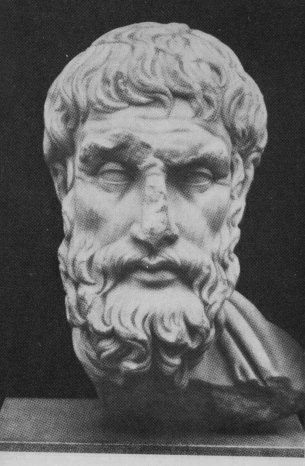
– Epicurus
– Diogenes Laertus, “Life of Epicurus”
– 14 or 18 when Alexander died
– Taos
– The ‘Mollusc’
– Taught in the ‘Garden’
– Hetaerae
– ‘Discourses’ by Epicurus
– Epicurus b. 323 BC d. 270 BC in Samos or Attica
– “Letters”
– Diet consisted of bread and water
– ‘send me some cheese’, he writes
– 20 bucks a years
– ‘Happy on the rack’ – Epicurus
– Dogmatic
– A dictator they were not allowed to challenge
– Designed to secure ‘tranquility’
– Pleasure
– Lucretious, “Poetry”
– Epicurus, ‘ Principle Doctrines’
– Laertus, ‘The End of Life‘
– Control and virtue
– Prudence in the pursuit of pleasure
– Social contract
– ‘absence of pain’ as the goal of the wise man
– The greatest good of all is ‘prudence’
– A secure and happy life
– ‘flee from every form of culture’
– Live ‘unoticed’
– Sex: ‘under the ban’
– Friendship
– Bentham
– Common sense
– ‘On Holiness’
– A ‘valetudinarian’s philosophy’ -BR
– His Credo p.246
– Fear: stems from religion and dread of death
– Religion no compensation ; in fact, it’s opposite
– Eddington
– ‘soul-atoms’ – distributed about the body
– Sensation and ‘thin – films’
– Dreams
– Superstitions – i.e. Hades
– Science
– ‘Death is nothing to us’
– To a man impressed with human misery, it sufficed to inspire enthusiasm – BR
– No genuine interest in anything outside of human happiness – BR
– Only eminent disciple is Lucretius (99-55 B.C.)
– Contemporary of Julius Caesar
– Suicide and insanity p.248
When prostate upon earth lay human life
Visibly trampled down and foully crushed
Beneath religions cruelty, who meanwhile,
Out of the regions of the heavens above
Showed forth her face lowering on mortal men
With horrible aspect first did a man of Greece
Dare to lift up his mortal eyes against her;
The first was he to stand up and defy her.
Him neither story of the gods, nor lightenings,
Nor heaven with muttering menaces could quell,
But all the more did he arouse his soul’s
Keen valour, till he longed to be the first
To break through the fast bolted doors of Nature,
Therefore his fervent energy of mind
Prevailed, and he passed onwards, voyaging far
Beyond the flaming ramparts of the world;
Ranging in mind and spirit far and wide
Throughout the unmeasured universe and thenc
A conqueror he returns to us, bringing back
Knowledge both of what can and what cannot
Rise into being teaching us in fine
Upon which principle each thing has its powers
Limited, and its deep-set boundary stone
Therefore now has Religion been cast down
Beneath men’s feet and trampled on in turn
Ourselves heaven-high his victory exalts.
– Lucretius
– Religion ‘cast down’
– Keats
– Human sacrifice
– Jane Harrison
– Orphism
– Hell not a Christian invention p. 249
– Even Olympian gods had demanded occasional human sacrifice
– Fear of punishment after death was common in 5th century B.C.
– Methodism
– Boswell
– Sir Joshua Reynolds
– ‘Grecian Urns’
Each man flies from his own self;
Yet from that self in fact he has no power
To escape: he clings to it in his own despite
An loathes it to, because he is sick,
He perceives not the cause of his disease:
Which if he could but comprehend aright,
Each would put all things else aside but and first,
Study to learn the nature of the world,
Since is our state during eternal time,
Not for one hour merely that is in doubt,
That state wherein mortals will have to pass
The whole time that awaits them after death.
-Lucretius (Trevelyan’s translation Bk. III, 1068 – 7)
– The French and Bentham p.251
– Synopsis of Christianity vs. Epicureanism (survived 600 yrs. Then revived in 18th century)
Stoicism chpt. XXVIII p.252
– Combination of Cynicism and Heraclitus
– Marcus Aurelius
– Ethics
– Seneca
– Epictetus
– Aurelius
– Books survive
– Early Stoics were mainly Syrian
– Later ones mostly Romans
– Tarn, ‘Hellenistic Civilization’

– Chaldean – nearly all succesors of Alexander
– Kings, professors, themselves Stoics
– Socrates: ‘chief saint of Stoics’
– Soul composed of material
– Fire
– Virtue
– Common sense
– Materialism
– Empirical (belief in senses)
– Existence of ‘real’ world
– Murray, ‘The Stoic Philosophy’ (1915) p.25
– Zeno (late 4th cent B.C.)
– A Phoenician
– Cyprus
– Was hurried by an anti-metaphysical zeal into a metaphysic of his own.” BR
– Cosmic determination and human freedom
– No such thing as chance
– Natural laws
– Countless cycles into fire and out again, not a final fire, but a recurring one
– ‘everything has a purpose connected with human beings’
– Even bedbugs are useful (to wake us up)
– Supreme power? Either Zeus or God
– Virtue consists of a will that is in agreement with nature
– Virtue is the sole ‘good’
– Like Socrates: power is within the individual
– ‘obvious logical difficulties’ – BR
– Concise criticsm of Stoicism p.255
– the ‘wicked’ do so involuntarily, like a ‘dog tied to a cart and compelled to go wherever it goes
– a certain ‘coldness’ in Stoic conception of virtue
– self-centered
– Stoic: not virtuous in order to do good, but does good in order to be virtuos.
– ‘Love’ is absent from Stoics conception of virtueKant
– Moral law enjoins kindness
– Zeno and History of Stoicism
– ‘god runs through the material world as honey runs through the honeycomb
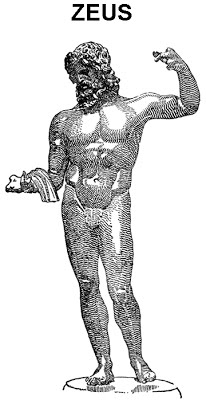
– Zeus: ‘the Supreme head of the universe’
– believed in astrology and divination
– attributed a divine potency to the stars
– Chrysippus (wrote 705 books)
– Cleanthes of Assos: immediate successor of Zeno
–
Lead me, O Zeus, and thou, O Destiny
Lead thou me on,
To whatsoever task thou sendest me,
Lead thou me on.
I follow fearless, or, if in mistrust
I lag and will not, follow I must
– Cleanthes of Assos, from ‘Hymn to Zeus’
– Cleanthes wanted to persecute Aritarchus for making the Sun, ot the earth the center of the universe
– Very Christian like much of which might have been written by Pope. –BR
– Hypothetical and disjunctive syllogism are due to Stoics
– Also the study of Grammar and the invention of ‘cases’
– Declension
– An empirical theory of knowledge
– Zeno as well as the Roman Stoics regarded all theoretical studies as subhordinate to ethics, he says, ‘Philosophy is: like an orchard, in which logic is the walls, physics the tree, ethics the fruit.” or, ‘like an egg, ‘Logic is the shell, physics the white and ethics the yolk
– Posidinius (135-51 B.C.)
– A Syrian Greek
– Curious
– Science – studied the tides
– Astronomy
– Historian
– Polybius
– Affinity to Plato
– i.e. soul, life after death, soul continues to live in air
– There is no hell
– Neo-pythagorean
– Orphic
– Seneca (3 B.C. – A.D. 65)
– A Spaniard
– Seven years banished to Corsica
– Recalled by Agrippina (Claudius’ wife)
– Tutored her eleven year old son Nero
– Very rich – acquired by lending in Britain
– According to Dio, his excessive rates were supposedly the cause for revolt in that country.
– Queen Boadicea
– Seneca was accused of conspiring against Nero to place himself upon the throne – graciously permitted to commit suicide
– Supposedly corresponded with St. Paul
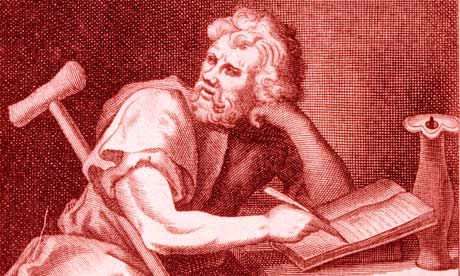
– Epictetus
– Greek
– Originally a slave
– Taught in Rome
– Emperor Domitian banished all philosophers
– Marcus Aurelius (A.D. 121 – 180)
– Adopted
– His son Commodus – turned out to be one of the worst of many bad emperors – BR
– Persecuted Christians because they rejected the State religion which he felt politically necessary
– He is a pathetic figure: in a list of mundane desires to be resisted, the one that he finds most seductive is the wish to retire to a quiet country life. For this, the opportunity never came. Some of his Meditations are dated from the camp, on distant campaigns, the hardships of which eventually caused his death. – BR
– Epictetus and Aurelius ‘completely
‘at one’
– Gibbon thought the age of the Antonines to be a ‘Golden Age’, Russell disagrees
– Slavery, gladiators, bad economic system
– Submission to Emperor
– Poverty rampant
— Communion with god. P. 264
– ‘love our enemies’
– Arrian
– In some respects, i.e. in regards to slaves and the ‘brotherhood of man’, superior to anything to be found in Plato or Aristotle. – BR
– His ideal world is as superior to that of Plato as his real world is inferior to that of Athens in the fifth century B.C., says Russell.
– Aurelius’ childhood p.265
– Doubtful about immortality
– Yet you should lead as virtuous a life as possible (in case he’s wrong)
– Harmony with universe, much like Augustine’s ‘City of God’
– Didn’t waste time with history , syllogism or astronomy
– Aurelius, ‘Meditations‘
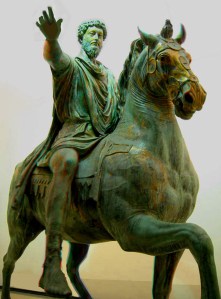
– Obedience to the will of god
– God gives each man a daemon as his guide (reappears in the Christian guardian angel
– Believes in close-knit universe
– Determinism
– Pre-ordained
– ‘spinning the thread of thy being’ –Aurelius p. 266
– The Stoic contradiction: free will vs. determinism
– Universe : a single animate being
– This being has a soul, namely god or reason
– Stoic defence of his beliefs p.267
– ‘Universal being is free god decided from the first, he would act according to fixed antural laws (ones that would have the best results). These results are not wholly desirable, but this inconvenience is worth enduring (as in human codes of law) for the sake of the advantage of legislative fixity.
– Torture, cocaine, morphia used by tyrants, i.e Hitler, Mao p.267
– Aurelius explains his own virtue as owing to good influences, i.e. parents, grandparents, teachers (referred to by Russell as ‘Previous causes’)
– Russell maintains that the “good will’ is just as much a result of ‘previous causes’ as the ‘bad will.’”
– The realization that virtue and sin alike are the inevitable result of ‘previous causes (as the Stoisc should have held) is likely to have a somewhat paralyzing effect on moral effort.
– Two systems of ethics – a superior one for themselves and inferior one for the ‘lesser breeds’ without the law.
– Kant’s ethic ‘very similar to Stoics’ – BR
– Stoic philosophical ethic doesn’t ‘gel’ with the mundane duties of Aurelius as administrator and his duty to feed and protect his subjects.
– Doctrine is neither quite true or quite sincere – BR
– The waxen pomegranate p. 269
– Ptolemy and Sphaerus the Stoic
– Descartes
– An element of ‘sour grapes’ in Stoicism –BR
– Stoic theory of knowledge based on perception and probability
– Both sane and scientific, says Russell
– A belief in innate ideas and principles
– Greek logic wholly deductiveand depended on blind acceptance of general ‘first premisses’ without proof. Just ‘obvious’ therefore true.
– Natural law derived from first principles of the kind held to underlie all general knowledge.
– Belief in a polity of equality and freedom could not be consistently realized in Roman times, but it influenced legislation, improving the status of women and slaves.
The Roman Empire in Relation to Culture chpt. XXIX p. 270
– Carthage and Syracuse dominated until Punic Wars (264-261 B.C.) and (218 – 201 B.C.)
Alexander’s conquests had left Western Mediterranean ‘untouched’
– North Africa p.271
– Senate
– Panaetius the Stoic
– Cicero
– Polybius
– Roman Imperialism
– Rome stable and peaceful for over two hundred years
– From Augustus to the third century disasters
– An ideal combination of Monarchical. Aristosratic and democratic elements
– Upper middle class called ‘knights’
– Small self-run farms became huge estate run enterprises with a huge slave labour force
– Rich vs. poor
– Senate vs. people
– Augustus
– Adopted son of Julius Caesar
– So completely victorius that no competition remained to challenge his claims to power
– A period of ‘happiness’
– Organized
– Zest and savour diminished in Greek culture
– Loss of ‘anarchic’ freedom
– Augustus the God
– After his death took pains to disguise the military origins of his government
– Contented, not creative
– Both Horace (fled) and Virgil lost their farms
– 3rd century disastrous
– Appalling disaster
– Byzantium
– Augustus in (somewhat insincerely) restoring stability with ancient piety- was therefore rather hostile to free inquiry.
– Rome/Byzantium
– Diocletian, Constantine good emperors
– Redistributed power to individual cities
– Tax problems
– Serfs
– Constantine adopts Christianity p.275
– Constantine Constantinople, Christianity
– Germans 5th century: adopt Christianity and preserving so much of ancient civilization as had been absorbed by the Church
– Eastern Empire survived until 1453 (Turks)
– Arabs from 6th to 11th century preserved Greek Literature and civilization
– Polybius
– Panaetius
– Contempt mingled with fear
– Unscrupulous
– Polybius a prisoner
– History of Punic Wars p.276
– Scipio
– Polybius, ‘History of Punic Wars‘
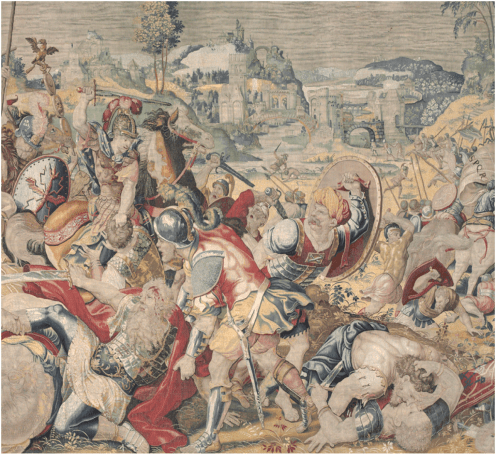
– Plutarch’s ‘Lives’
– Rome a ‘blight’ on Greek thought and art
– Justinian shuts down Academy A.D. 529 due to Christian bigotry
– Hadrian
– Plutarch (A.D. 46 – 120)
– At first Greeks immeasurably superior to Rome (except in military tactics and social cohesion)
– To the end Rome was culturally ‘parasitic’ on Greece
– Nabobs
– Rome : Good roads, systematic legal codes and efficient armies, for the rest – they looked to the Greeks
– Decay of civilization 3rd century
– Barbarian generals made poor emperors
– Education disappeared
– Divination: i.e. ‘marry the moon’
– Hecatombs
– Emperor Elogabulus
– Effeminate, oriental despotism
– Mithras – appealed to soldiers
– Roman – not so effeminate
– A god concerned with war, war between good and evil
– Gibbon ‘Decline and Fall of Roman Empire’
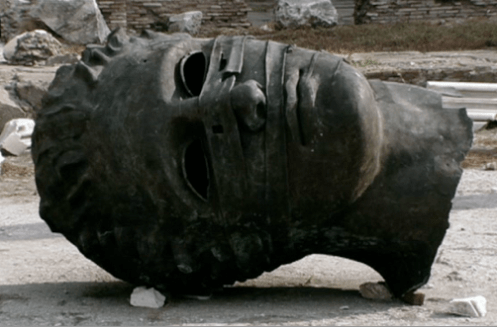
– Zoroaster
– Mithras in Germany (west) men seeking otherworldly hopes due to despair
– Genghis Khan
– Christianity absorbed much from Greece
– Western conquerors (Macedonians, Romans) had the good sense to admire the civilization they governed (i.e. Greece from Aeschylus to Plato) but did their utmost to preserve.
– Buddha
– Confuscious p.282
– Catholic world –wide
– Conception of one human family
– Mohammedans conquer Spain 8th century
– Arabs and preservation of Aristotle p. 283
– Arabic words: i.e. Algebra, alcohol (not booze) alchemy alembic, alkali,azimuth, zenith to name a few
– Mohammedans in Spain
– Aristotle and a revival in learning leads to Scholatic Philosophy
– algebra – invented by ancient Greeks, carried further by Arabs (Mohammedans)
Plotinus (204 -270 A.D.) chpt. XXX p. 284
– Neo-platonism
– Last of the great philosophers of antiquity
– Causes of decline of Rome p. 284
– One of the most disastrous periods of Roman history
– Plotinus – never mentions the chaos around him – looks to Eternity- the ‘Kingdom of Heaven’
– St. Augustine
– St. Thomas Aquinas
– American Christianity p. 265
– Innocent of metaphysics i.e. primitive Christianiy
– Dean Inge, ‘On Plotinus’

– The Synoptic Gospels
– Plotinus: an important type of theory
– Sapphire coloured throne
To our high-wrought fantasy present
That undeserved song of pure concent
Aye sung before the sapphire – coloured throne
To him that sits thereon
– Samuel Butler – a ‘cheerful pessimist’
– Plotinus – a ‘melancholy optimist’
– Spinoza
– Among men who have been unhappy in amundane sense but resolutely determined to find a higher happiness in the world of theory, Plotinus holds a very high place.
– Impossible not to love him as a man
– Porphyry, ‘ Biography of Plotinus‘
– Ammonius Saccas
– A.D. 244
– Refers to Plato as “He”
– Emperor Gordian the third
– Emperor Gallineus
– ‘Platonopolis’
– Parmenides
– Plato’s Merit p.288
– Plotinus’ Holy Trinity
– 1) The One
– 2) The Spirit
– 3) The Soul
– Origen
– ‘The Enneads‘
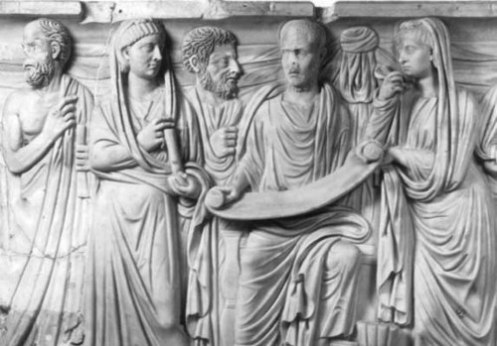
– The One: ’while it is nowhere, nowhere it is not’
– Nous : two persons – spirit and mind
– Spirit
– Logos of St. John of gospels linked to Plato’s religion
– Logos = Reason
– Mackenna (Plotinus’ translator) calls nous- ‘Intellectual Principle’
– Divinely possessed and inspired
– The ‘presence’
– Beyond words
– There is no power whatever…p.290
– The ‘Vision’
– Bringing light
– Proof of the light is proof of the advent
– ‘ecstacy’ standing outside one’s body
– This happened frequently to Plotinus
– Soul third and lowest
– Soul is offspring of divine intellect
– It is double inner and another which faces the external
– Association with downward movement
– Soul generates its image which is: Nature
And the world of sense
– Nature not associated with god but with the lowest sphere
– Just ‘less good’ not ‘evil’
– World is beautiful and is the abode of blessed spirits emanating from the soul when it forgets to look up.
– Painting: less good than the intellectual world
– Aesthetic
– Reverent awe of nature i.e. stars
– Heavenly bodies are the bodies of god-like beings
– Timaeus
– Christian fathers i.e. Origen also held this view
– Imaginatively attractive – BR
– Beauty (after Plotinus) comes to be regarded as of the Devil – pagans as well as Christians
– Came to glorify ugliness and dirt
– ‘if in this life you have murdered your mother, you will, in the next life be a woman and be murdered by your son'[.
– After death – no memory of personality, only contemplate the inheritable realm
– Plotinus, ‘Fourth Ennead‘
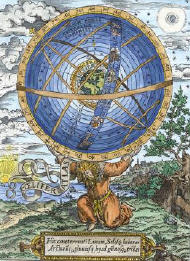
– deals with immortality
– Sound has appetite like composer
– Soul is Essence and essence is eternal
– Soul is immortal because ideas are eternal
– This becomes explicit in Plotinus
– Soul becomes chained to a body
– Tractate on Knowledge p.294
– The ‘All’ is no amorphous structure
– A copy – a reproduction of the intellectual
– Universe: unfathomable wisdom
– ‘double act’
– Infinite – the ‘Glory’
– Sin – a ‘consequence of ‘free will’”
– Not as deterministic as astrologers or magicians
– Porphyry relates that a rival philosopher tried to put a spell on Plotinus but that because of his holiness and wisdom the spells recoiled on the rival.
– Evil of brutality i.e. barbarians and their super abundant energy
– Science no longer cultivated only ‘virtue’ was thought important
– Less desire to understand the physical world or improve the world of human institutions
– Christians: in the importance of spreading Christian faith gave a practicable object for moral activity, confined to perfecting of ‘self’.
end of book I
 tomreading
Leave a comment