Introduction to Mathematical Philosophy by Bertrand Russell
1) extension/intension
“the traits by which Swift delineates the”Yahoos”
class of classes
bundle of bundles
converse domain
reflexive/symmetrical/transitive/similarity
-class of fathers >what it is to be a father of somebody
-the class of fathers will be all those who are somebody’s father
Finitude & mathematical induction
successor
how we define “0”, number & successor
and so on changed to
“the natural numbers are the posterity of “0” with respect to the relation “immediate predecessors” (which is the converse of successor)
“null classs”
“0” is the class whose only member is the null class”
Peano’s five axioms
1) “0” is a number
2) The successor of any number is a number
3) No two numbers have the same successor
4) “0” is not the successor of any number
5) Any property which belongs to zero “0”, and also the successor of every number which has the property belongs to all numbers.
Finitude and Mathematical Induction (cont.)
R- hereditary
R- ancestor only if…..
R- posterity
Infinite succession of jerks – train analogy
The Definition of Order
Members of a series
Order
Integers rational fractions, all real numbers have an order of magnitude
Essential to most of their mathematical properties
Order of points on a line essential to geometry
Order of lines through a point in a plane, or of planes throughout a line (in geometry) Dimensions are a development of order
Fixed stars
Order: one preceded & the other follows
Serial relations
-transitive
-connected
aliorelative (C.S.Peirce)
P xPy
Less than excluding equal to
Proper fractions
Proper R ancestor must be aliorelative, transitive, and connected
Kinds of Relations
Transitive relations
-such series are vital for the importance of the understanding of continuity, space, time. and motion
“between”
cyclic >order is separation of couples
need a relation of four terms
-generation of serial relations
Kinds of Relations
-relations
serial relations: asymmetry. Transitiveness, and connexity
Asymmetry > very greatest interest and importance
-relation of husband is asymmetrical to that of wife
spouse is “symmetrical”
-similarity between classes
“ultimate logical nature of relations”
– square of, sine of
one-many relations
“the so and so of such and such”
“the wife of Socrates”
“the father of John Stuart Mill”
all mathematical functions result from one-many relations: the logarithm of x, the cosine of x, etc. are like the father of x; terms described by means of a one-many relation (logarith), cosine, etc) to a given term(x)
function
“the”
“R-step” or “R-vector”
y is referent and y relatum
permutations
Similarity of Relations
One-one correlation
A map – corresponding places
Climate some redundancies
We know much more about form than about matter
Some interpretations of our terms
-grammar and syntax
-nomenclature
“cardinal numbers”
“ordinal numbers”
P and Q
Obeys associative law, one form of distributive law and two of the formal laws for powers
“featherless Biped “ or “man”
“phenomena”
Rational, Real and Complex numbers
Extensions of the idea of number
Extensions to negative, fractional, irrational and complex numbers
Various extensions:
Denominator, numerator
Irrational numbers = sq. root of 2
Complex numbers: numbers involving the sq. root of – 1
Inductive
“the infinity of rationals”
“The Cantorian Infinite”
“the understanding of it opens the way to whole new realms of mathematics and philosophy” p. 65
Zero is one-many, and infinity is many –one
-compact series – generated purely logically, without any appeal to space or time or any other empirical datum
“incommensurable”
-discovery by Pythagorus
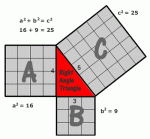
Euclid tenth book m2/n2 = 2, ie., m2=2n2
Algebra
-the square of an odd number is odd
m2 must divide by four, for if m=2p, then m2 =4p2 thus 4p2 =2n2 where P is ½ of m
Triangle with two sides being 1”(one inch)
“this seems like a challenge thrown out by nature to arithmetic’
as soon as algebra was invented the same problem arose as regards the solution of equations, though here it took on a wider form, since it also involved complex numbers
a”Dedekind” cut
gap
limits
quantitative
upper boundary, lower boundary
-axiom
postulating, eliciting
“real” numbers
segment
square of a negative number is positive
erroneous
Infinite Cardinal numbers
Inductive: numbers which obey mathematical induction starting from zero “0”
Inductive:
Georg Cantor and Frege
“axiom of infinity”
fallacious p.77
transitive generators of progression
is a serial number, it is in fact the smallest of infinite serial numbers
Cantors”w”
Cardinal numbers
Name of smallest of infinite cardinal numbers is “n”(Hebrew aleph)
In actual fact the number of ratios (or fractions) is exactly the same as the number of inductive numbers namely “n(aleph)0”
Domain
“2n0” is a very important number
“reflexive”
Cantor used reflexiveness as the definition of the infinite and believes it is the equivalent to”non-inductiveness”; he believes that every class and every cardinal number is either inductive or reflexive
These proofs are fallacious” the multiplcative axiom” BR
“a finite class or cardinal is one which is inductive”
An infinite class or cardinal is one which is not inductive
Chpt x
An “infinite series
“multiplicative axiom”
“limit”
condensed in itself (insichdicht)
“closed” (abgeschlossen)
perfect condensed in itself and closed
limit and continuity
Dedikind and Cantor
“continuity, “flux”
limit of a function
continuous function
argument continuous
“the birthplace of the youngest person living at time “t”
“ultimate oscillation”
“ultimate section”
thus the “ultimate oscillation” consists of all real numbers from –1 to 1, both included
H.G. Wells
Infinitetisimals
Infinity and continuity
‘Zermelo’s axiom”
proof
“Zermelo’s Theorem”
truth or falsehood
fallaciously
inductive
Peano
Hocus pocus
Prima facie
Reflexive classes
“We have no reason except prejudice for believing in the infinite extent of space and time”
“also that there is at present no empirical reason to believe the number to be finite”
demonstrable logically (see pg. 141)
substance
symbols by which they are symbolized
metaphysics
“but whether the axiom is true or false, there seems no known method of discovering”
Socrates = master of Plato
Philosopher who drank hemlock
Husband of Xanthippe
Logical /empirical the diversity of colours
“quanta”
infinite is not demonstrable logically
nothing can be known “a priori”
Liebnizian phraseology – “some of the possible worlds are finite, some infinite and we have no way of knowing to which of these two kinds our actual world belongs”
The old scholastic definition of substance
Chpt xiv
“Incompatibility and the Theory of Deduction”
1) the theory of deduction
2) propositional functions
3) descriptions
deduction – premises
from which we infer a proposition called the conclusion
implication
disjunction expressed by p or q
incompatible – if one is true the other is false
i.e. from the falsehood p we may infer the falsehood of q when q implies p
cases of “influence”
1) disjunction p or q
2) conjunction p and q
3) incompatibility p and q are not both true
4) implication p implies q or if p then q
5) negation unless p is false or q is true or either p is false or p implies q = not –p or q
could have added 6) joint falsehood not p and not q
truth function
new way “all our form functions are defined in terms of incompatibility
(p/p) I (q/p) ; pI (q/q)
p/q I p/q
in principia mathematica 5 propositions are
1) p or q implies p i.e. if either p is true or p is true then p is true
2) 2) q implies p or q i.e. the disjunction “p or q is true when one of it’s alternatives is true.
3) 3) p or q implies q or p . This would not be required if we had a theoretically more perfect notation, since in the conception of disjunction there is no order involved, so trust p or q , and q or p should be identical, but since our own symbols in any convenient form, inevitably introduce an order, we need suitable assumptions for showing that the order is irrelevant
4) If either p is true or q or r is true then either q is true or p or r is true ( the twist in this proposition serves to increase it’s deductive power”
5) If q implies r then p or q implies p or r
FORMAL principle of deduction
P =p implies q, P2 =q implies, and p3 = p implies r
If q implies r, then p implies q implies p implies r
i.e. P2 implies that p implies p3
call this proposition “A”
if p implies q implies r, then q implies that p implies r
if p2 implies that p implies p3, then p implies that p2 implies p3
call this “B”
p implies that p2 implies p3
P/22/7/Q
Theory of types
Formal deductibility
Not –p or q should not be called “implication”
Intuition
“what can be known in mathematics and by mathematical methods is what can be deduced from pure logic”
empirically
not “a priori”
chpt xv Propositional Functions
proposition: “primarily a form of words which expresses what is either true or false”
significant
“It is part of the definition of logic (but not the whole of its definition) that all its propositions are completely general, i.e. they all consist of the assertion that some prepositional function containing no constant terms is always true.”
Propositions containing no apparent variables are called “elementary propositions”
“formal implications”
p.163
the notion of “existence”
modality: necessary, possible, and impossible.
“there was never any clear account of what was added to truth by the conception of necessary”
“In clear thinking, in very diverse directions, the habit of keeping prepositional functions sharply separated from propositions is of the utmost importance, and the failure to do so in the past has been a disgrace to philosophy.’
Descriptions chpt. Xvi p.167
“ a so and so” indefinite description
“the so and so” definite description”
“ a robust sense of reality”
“a correct analysis”
Socrates “is” human
Socrates “is” a man
Law of identity x=x
“the present King of France is bald”
“the present King of France is “not” bald
Occam’s razor: “entities are not to be multiplied without necessity”
1) every prepositional function must determine a class,
consisting of these arguments for which the function is true p.184
2) two formally equivalent propositional functions must determine the same class, and two which are formally equivalent must determine different classes
3) We must find some way of defining not only classes, but classes of classes etc.
4) It must under all circumstances be meaningless (not false) to suppose a class member of itself or not a member of itself
5) Lastly. …… it must be possible to make propositions about all the classes that are composed of individuals, or about all the classes that are composed of objects of any one logical “type”, etc. (p.185)
Phoenix…….
“ Thus we are led to consider statements about functions, or (more correctly) functions of functions.”
‘All men are mortal’
‘Socrates is human’
‘Socrates is mortal”
classes of (men, mortals)
truth value is unchanged if we substitute
x is human
or x is mortal …..or any formally equivalent function.
-extensional
or if not then…. Intensional
“ If axiom is a generalized form of Liebniz’s “identity of discernibles”
“true in all possible worlds”
The theory of classes, reduces itself to one axiom and one definition:
“There is a type “t” such that if “0” is a function which can take a given object as an argument, than there is a function “Y” of this type”t” which is formally equivalent to “0””
The definition is
“If 0 is a function which can take a given object “a” as argument and “T” the type mentioned in the above axiom, then to say that the class determined by “0” has the property “f” is to say that there is a function of type ‘T”, formally equivalent to 0, and having the property “f”
chpt xvii Mathematical Logic
a set of new deductive systems
case of the syllogism:
“If all men are mortal
Socrates is a man
Socrates is mortal
Argument is valid in virtue of its “form”
Substitute “a” for “men” “b” for “mortals” and “x” for Socrates
Proposition of logic “the substitution”
“formal reasoning”
thus the absence of all mention of particular things or properties in logic or pure mathematics is a necessary result of the fact that the study is as we say “purely formal”
Socrates is before Aristotle
xRy
x has the relation “R” to y
we have certain constituents and a certain form
proceed to general assertions: i.e.
xRy is sometimes true
“We should not need to know any words” p.201
“but after all, there are words that express form, such as “is” and than and in every symbolism hitherto invented for mathematical logic there are symbols having constant formal meanings
We may take as an example the symbol for incompatibility which is employed in building up truth-functions, such words or symbols may occur in logic. The question is; “how are we to define them?”
Logical constants
“a fundamental logical constant will be that which is in common among a number of propositions…..(p.201)
“term for term substitution”
“ In this sense all the “constants” that occur in pure mathematics are logical constants.”
“But although all logical (or mathematical) propositions can be expressed wholly in terms of logical constants together with variables,
it is not the case that conversely all propositions that can be expressed in this way are logical
“the law of contradiction is merely one among logical propositions it has no special preeminence; and the proof that the contradictory of some propositions is self contradictory is likely to require other principles of deduction besides the law of contradiction”
“tautology”
“it is meaningless to argue from” this is the so-and-so and the “so-and –so exists” to: this exists”
…we seem driven to conclude that the existence of a world is an accident –i.e. it is not logically necessary. If that be so, no principle of logic can assert “existence” except under a hypothesis, i.e. none can be of the form “the prepositional function so-and-so is sometimes true.
“the complete asserted proposition of logic will all be such that some propositional function is always true.
p.204
…. all have characteristics…….tautology.
This combined with the fact that they can be expressed wholly in terms of variables and logical constants (a logical constant being something which remains constant in a proposition even when all its constituents are changed) will give the definition of logic or pure mathematics
At this point, therefore for the moment, we reach the frontier of knowledge on our backward journey into the logical foundations of mathematics
Language is misleading p.205
The labour of mastering the symbols- a labour which is in fact much less than might be thought.
 tomreading
Leave a comment