‘Our Knowledge of the External World
—
– Bertrand Russell (1914)
Introduction by Amit Hagar
– A thoughtful exposition of his logically motivated epistemology
– Bertrand Russell (1872 -1970)
– born the grandson of Lord John Russell – twice prime-minister
– raised by his grandparents (but mainly by his grandmother Lady Russell)
– married four different wives
– led a life ‘marked with controversy’
– Russell, ‘Free Man’s Worship’ (1902)
– Russell, ‘Political Ideals’ (1918)
– politically, morally and intellectually left-wing radical point of view
– temporarily saved from poverty by a five -year contract to lecture at the Barnes Foundation in Pennsylvania
– ‘History of Western Philosophy’ (1945)
– immediate bestseller and his main source of income for many years.
– awarded the Nobel Prize in literature (1950)
– Russell’s, ‘Our Knowledge of the External World’ is concerned with the long-standing epistemological question about our relation, as perceivers of everyday phenomena, to the natural world around us, and the possibility of acquiring knowledge about it.
– ‘Rationalists’: – Descartes, Leibniz, Spinoza
– ‘Empiricists’: – Locke, Berkeley, Hume
– The ‘Kantian Revolution’ : epistemology merged out of the stalemate between Rationalists and Empiricists
– if Kant is right then ‘we can only know how things ‘appear’ and there is no point in looking for knowledge of how things are ‘in themselves’
– Russell’s career shifted from embracing Kant to rejecting him
– Function of logic in philosophy is….. ‘all-important’ – Russell
– ……it liberates imagination as to what the world may be, it refuses to legislate what the world is.
– Russell, ‘The Relation of Sense-Data to Physics’ 1914
– Question : what is the object of perception?
– Russell, ‘Problems of Philosophy’ (1912)
– A mental image formed in the mind i.e. tomato round and red
– whenever possible, ‘logical constructions are to be substituted for inferred entities’
– Sense-data ‘construct’ the physical object. Sense-data don’t just testify to the existence of physical objects, they essentially create the physical world
– Russell defends phenomenalism:
– the view that translates all physical statements to phenomenal statements about mental appearances.
– ‘sensibilia’:
– ‘unsensed sense data’
– Locke and Berkeley
– ‘theory of ideas’
– developed further by the philosopher A.J. Ayer
– appealing to such phenomena as perspectival variation, illusion and hallucination.
– Critics of sense-data have objected to the theory’s commitment to mind-body dualism, its difficulty to locating sense-data in physical space, and its apparent commitment in some cases to sense-data that have indeterminate properties.
– as Donald Davidson a famous contemporary philosopher has put it, solving the riddle of perception by introducing mythological entities such as sense-data is simply replacing one mystery with another.
– Russell, ‘On Denoting’ 1905 – his ‘landmark article’
– ‘Scott’, ‘blue’, ‘number 2’ , ‘golden mountain’ denoted or referred to an existing entity
– while logically proper names (words such as ‘this’ or ‘that’ which refer to sensations of which an agent is immediately aware) do have referents associated with them, descriptive phrases (such as ‘the smallest number less than pi’) should be viewed as a collection of quantifiers (such as ‘all’ and ‘some’) and propositional functions (such as ‘x is a number’). As such, they are not to be viewed as referring terms, but rather, as ‘Incomplete symbols’. In other words, they should be viewed as symbols that take on meaning within appropriate contexts, but are meaningless in isolation.
– Ultimately Russell saw the philosopher’s task as discovering a logically ideal language that would exhibit the true nature of the world in such a way the speaker will not be misled by the casual surface structure of natural language.
– The common view among philosophers today is that Russell’s theory of sense-data has led to a dead-end, but it is also clear that Russell’s new methods cleared the way for a whole new generation of metaphysicians, epistemologists, and analytical philosophers.
– From an historical perspective, ‘Our Knowledge of the External World’ is yet another example of Russell’s clear thinking and rigor which puts him at the top of the distinguished and short list of mathematician philosophers – Frege, Husserl, Gödel
– whose treatment of philosophical questions through logical and mathematical reasoning has, for better or worse, widened the gap between modern analytic philosophy and the traditional continental philosophy of the nineteenth century
– Amit Hagar – Indiana University, University of BC Vancouver. the conceptual Foundations of modern Physics
Preface
– The writings of Frege
– Something perfectly definite
– To yield whatever objective scientific knowledge is possible to obtain
– The problem of the relation between the crude data of sense and the space, time and matter of modern physics
– points, instants, things
– The world of physics as a ‘construction’ rather than an ‘inference’
– The absence of any satisfactory theory of the mathematical infinite
– Georg Cantor
– Dr. Whitehead’s work
– The benefit of vitally important discoveries by my friend Mr. Ludwig Wittgenstein (not yet published)
– Cambridge (1914)
Current Tendencies
– Philosophy, from the earliest times, has made greater claims and achieved fewer results than any other branch of learning
– Thales said that ‘all is water’
– …… contradicted by Anaximander
– Classical tradition
– Kant and Hegel
– From Plato downwards
– Evolutionism
– Darwin
– Herbert Spenser
– William James and Henri Bergson
– Logical atomism
– ‘new realism’ which owes its inception to Harvard
– Galileo
a) The Classical Tradition
– held almost unquestioned sway in all Anglo-Saxon universities
– those whose extra-philosophical knowledge is literary rather than those who have felt the inspiration of science
– making our age one of bewildering groping
– The native faith of the Greek philosophers in the omnipotence of reasoning
– They would prove, for instance, that ‘all reality is one’, that there is no such thing as change that the world of sense is a mere illusion, and that the strangeness of their results gave them no qualms because they believed in the correctness of their reasoning.
– by mere thinking
– reinforced, in the Middle Ages and almost our own day, by systematic theology
– that a priori reasoning could reveal otherwise undiscoverable secrets of the universe and could prove reality to be quite different from what, to direct observation appears to be
– as hitherto the main obstacle to a scientific attitude in philosophy
– Mr. Bradley’s ‘Appearance and Reality’

– What is real is one single, indivisible timeless whole, called ‘The Absolute’, which is in some sense spiritual, but does not consist of souls, or of thought, as we know them
– Seems calculated to produce bewilderment rather than conviction
– So patent a fact as the interrelatedness of the things in the world
– Even when it led to the strangest conclusions
– But to us, our methods of experiment and observation, our knowledge of the long history of a priori errors refuted by empirical science, it has become natural to suspect a fallacy in any deduction of which the conclusion appears to contradict patent facts
– The ‘empirical’ outlook
– The function of logic in philosophy
– All important
– Thus the world is constructed by means of logic, with little or no appeal to concrete experience
– Analytic rather than constructive
– While it liberates imagination as to what the world may be, it refuses to legislate as to what the world is
– an internal revolution in logic
– the universe, he tells us, is an ‘organic unity’ like an animal or a perfect work of art.
– if we know ourselves thoroughly, according to this doctrine, we should know everything
– …people (say) – in China…
– living beings on Mars
– from only one of many universes
– the doctrine that all reality is what is called ‘mental’ or ‘spiritual’
– relation of knower and known is fundamental, and that nothing can exist unless it either knows or is known
– It is thought that there are contradictions in an unknown reality
– logic shows rather what may happen, and refuses to decide as to what must happen
– the classical tradition in philosophy is the last surviving child of the two very diverse parents. The Greek belief in reason and the medieval belief in the tidiness of the universe.
– the universe of Thomas Aquinas or of Dante is as small and neat as a Dutch interior.
– to us, whom safety has become monotony, to whom the primeval savageries of nature are so remote as to become mere pleasing condiments to our ordered routine, the world of dreams is very different from what it was amid the wars of Guelfs and Ghibellines.
– hence William James’ protest against what he calls the ‘block universe’ of the classical tradition.
– hence Nietzsche’s worship of force
– hence the verbal bloodthirstiness of many quiet literary men.
– the barbaric substratum of human nature, unsatisfied in action, finds an outlet in imagination. In philosophy, as elsewhere this tendency is visible; and it is this, rather than formal argument, that has thrust aside the classical tradition for a philosophy which fancies itself more virile and more vital.
– b) Evolutionism
– Evolutionism
– it dominates our politics, our literature and not least our philosophy
– Nietzsche, pragmatism, Bergson are phases in its philosophic development….
– consonance with the spirit of the age
– something of Hellenism must be combined with the new spirit before it can emerge from the ardor of youth into the wisdom of manhood. And it is time to remember that biology is neither the only science, nor yet the model to which all other sciences must adapt themselves
– the true scientific philosophy is something more arduous and more aloof, appealing to less mundane hopes, and requiring a severer discipline, for its successful practice.
– Darwin’s ‘Origin of Species’
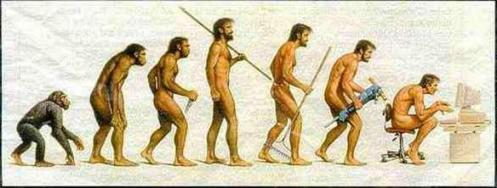
– Philosophy of Evolution
– obviously a ‘progress’
– …as revealing a law of development towards good in the universe
– Laplace
– ever since the seventeenth century, those whom William James described as ‘tender minded’ have been engaged in a desperate struggle with the mechanical view of the course which physical science seems to impose.
– the doctrine of ‘teleology’
– Leibniz
– All is given
– Finalism
– The doctrine of ‘final causes’
– M. Bergson’s form of finalism depends upon his conception of life. Life, in his philosophy, is a continuous stream, in which all divisions are artificial and unreal
– …the reader is like the child who expects a sweet because it has been told to open its mouth and shut its eyes.
– Logic, mathematics and physics disappear in this philosophy, because they are too ‘static’; what is real is an impulse and movement towards a goal, which, like the rainbow, recedes as we advance, and makes every place different when we reach it from what it appeared to be at a distance.
– Philosophy in general
– …that gives no ground for believing that progress is a general law of the universe
– …….that we cannot understand the world unless we can understand change and continuity. This is even more evident in physics than it is in biology… But the analysis of change and analysis of change and continuity is not a problem upon which either physics or biology throws any light; it is a problem of a new kind, belonging to a different kind of study.
– in assuming, dogmatically, a certain answer to this question evolutionism ceases to be scientific, yet it is only in touching on this question that evolutionism reaches the subject-matter of philosophy.
– ….a desire for the kind of knowledge which philosophy really can give is very rare
– Philosophy is not a short cut to the same kind of results as those of the other sciences; if it is to be a genuine study, it must have a province of its own, and aim at results which the other sciences can neither prove nor disprove
– we must, therefore, renounce the hope that philosophy can promise satisfaction to our mundane desires. What it can do, when it is purified from all practical taint, is to help us understand the general aspects of the world and the logical analysis of familiar but complex things.
– notably mathematics, physics and psychology
– but it does not offer or attempt to offer, a solution of the problem of human destiny or of the destiny of the universe.
– we will begin with the problem of the physical conceptions of space and time and matter
– Bergsonian lines
– his rejection of logic
– ….say something at the onset in justification of the scientific against the mystical attitude. Metaphysics, from the first, has been developed by the union or the conflict of these two attitudes
– Pythagoras
– a haunting flavor of mysticism over much Greek mathematical speculation, and in particular over Plato’s views on mathematics
– the mystical attitude is distinctly the stronger of the two, and secures ultimate victory whenever the conflict is sharp. Plato moreover adopted from the Eleatics the device of using logic to defeat common sense, and thus to leave the field clear for mysticism
– but the more thoroughgoing mystics do not employ logic, which they despise, they appeal instead directly to the immediate deliverance of their insight.
– to seek such moments, therefore, is to them the way of wisdom, rather than, like the man of science, to observe coolly, to analyze without emotion, and to accept without question the equal reality of the trivial and the important.
– of the reality or unreality of the mystic’s world I know nothing.
– ….is that insight untested and unsupported is an insufficient guarantee of the truth. In spite of the fact that much of the most important truth is first suggested by its means
– …under the influence of Rousseau and the Romantic Movement instinct was given preference….
– Bergson, under the name of ‘intuition’ has raised ‘instinct’ to the position of sole arbiter of metaphysical truth
– Reason is a harmonizing, controlling force rather than a creative one. Even in the most purely logical realms, it is insight that first arrives at what is new.
– Instinct, like all human faculties, is liable to error.
– it is such considerations rather that necessitate the harmonizing mediation of reason
– in this there is no opposition to instinct as a whole, but only to blind reliance upon some one interesting aspect of instinct to the exclusion of the more commonplace but not less trustworthy aspects. It is such one-sidedness, not instinct itself, that reason aims at correcting
– The relative
– The absolute
– Intellectual sympathy
– Even in the most civilized societies men are not put to death for mathematical incompetence
– The fact is, of course, that both intuition and intellect have been developed because they are useful, and that, speaking broadly, they are useful when they give truth and become harmful when they give falsehood.
– But those who find in these facts a recommendation of intuition ought to return to running wild in the woods, dying themselves with woad and living on hips and haws.
– apart from self-knowledge , one of the most notable examples of intuition is… love
– …people think they see into another soul as they see into their own.
– …that the supposed insight was illusory, and that the slower, more groping methods of the intellect are in the long run more reliable.
– the hen with the brood of ducklings
– Intuition in fact, is an aspect and development of instinct.
– the theoretical understanding of the world, which is the aim of philosophy….
– …intuition at its best. In such matters as self-preservation and love, intuition will act sometimes (though not always) with a swiftness and precision which are astonishing to the critical intellect.
– a certain liberation from the life of instinct, and even, at times, a certain aloofness from all mundane hope and fears,
– …more almost than anywhere else, proves superior to intuition, and that quick unanalyzed convictions are least deserving of uncritical acceptance.
– thus the ethical interests…
– ….some kind of ethical interest may inspire the whole study, but none must obtrude in the detail or be expected in the special results which are sought.
– Astronomy, for e.g., was studied because men believed in astrology…
– Physics, as it appears in Plato’s ‘Timaeus’, for e.g., is full of ethical notions: it is an essential part of its purpose to show that the earth is worthy of admiration.
– In psychology, the scientific attitude is even more recent and more difficult than in the physical sciences; it is natural to consider that human nature is either good or bad, and to suppose that the difference between good and bad, so all important in practice, must be important in theory also. It is only during the last century that an ethically neutral science of psychology has grown up.
– Newton and Darwin
Logic as the Essence of Philosophy
– Problems of logic
– Aristotle had spoken
– “Will the sun rise tomorrow?”
– ‘what is the principle of inference by which we pass from past sunrises to future ones? The answer given by Mill is that the inference depends upon the ‘law of causation’ an empirical generalization
– ‘induction by simple enumeration’
– we shall have to say at most, that the data render the result ‘probable’
– terrible difficulties in the notion of probability
– every instance of a proposition being true increases the probability…
– how is your principle known to be true?
– it cannot itself be justified empirically
– this logical knowledge is not derivable from experience alone, and the empiricists’ philosophy can therefore not be excepted in its entirety, in spite of its excellence in many matters which lie outside logic.
– Hegel and his followers widened the scope of logic in a quite different way
– Fallacious
– In their writings, logic is practically identical with metaphysics
– Hegel believed that by a means of a priori reasoning, it could be shown, that the world must have various important and interesting characteristics, since any world without these characteristics would be impossible and self-contradictory.
– I should not regard Hegel’s reasoning, even if it were valid, as properly belonging to logic, it would rather be an application of logic to the actual world.
– ‘categories’
– ‘qualities of reality as a whole’
– The ‘Absolute’ is such and such
– Such essentially Hegelian conceptions as the ‘concrete universal’ and the ‘union of identity in difference’ – will be found where he explicitly deals with formal logic
– Logistic or mathematical logic
– In both respects it is the fulfillment of a hope which Leibniz cherished throughout his life and pursued with all the ardor of his intellectual energy
– respect for Aristotle prevented Leibniz from realizing this was possible
– the modern development of modern logic dates from
Boole’s ‘Laws of Thought’
– The invention of a mathematical symbolism for deducing consequences from premises which the newer methods shared with those of Aristotle
– Peano and Frege
– Transitional logic regarded the two proposition’s ‘Socrates is mortal’ and ‘all men are mortal’ as being the same form, Peano and Frege showed that they are utterly different in form.
– Peano and Frege, who pointed out the error, did so for technical reasons, and supplied their logic mainly to technical developments, but the philosophical importance of the advance which they made is impossible to exaggerate.
– Philosophizing
– …and could never have been imagined without it.
– Frege’s theory of number
– ‘the principle of abstraction’
– ‘Membership of the group will serve all the purposes of the supposed common quality, and that therefore, unless some common quality is actually known, the group of class of similar objects may be said to replace the common quality’
– a certain ‘form’
– I say ‘Socrates is mortal’, ‘Jones is angry’, ‘the sun is hot’, there is something indicated by the word ‘is’. What is common is the ‘form’ of the proposition not an actual constituent.
– ‘Coleridge ate opium’, ‘Socrates drank the hemlock’, ‘Coleridge drank opium’
– This ‘form’ is not another constituent but is the way the constituents are put together. It is forms, in this sense, that are the proper objects of philosophical logic.
– ‘Rorarius drank the hemlock’
– …will understand the ‘form’.
– if a thing has a certain property, and whatever has this certain property has a certain other property, the thing in question also has that other property.
– the proposition is absolutely general
– this thing is round, and red and so on
– in the interests of a super-sensible ‘real’ world.
– certain ‘moods’
– of the great philosophers who were mystics – notably Plato, Spinoza, Hegel
– Mr. Santayana – ‘malicious’
– The logic of mysticism
– while the mystic mood is dominant
– …as the mood fades
– a certain hatred of the daily world
– ‘asymmetrical’ relations
– ‘Symmetrical’
– Thus a relation is symmetrical if, whenever it holds between A and B it also holds between B an A
– ‘Non –symmetrical’
– a relation is called asymmetrical, when if it holds between A and B, it never holds between B and A
– thus husband, father, grandfather etc. are asymmetrical relations. So are before, after, greater, above, to the right of, etc. All the relations that give rise to ‘series’ are of this kind.
– transitive, intransitive, and merely non-transitive relations defines as follows:
– ‘Transitive’: a relation holds between A and B and also between B and C, it holds between A and C.
– Thus before, after, greater, above are transitive.
– ‘Non-transitive’: whenever it is not transitive. Thus brother is non – transitive, because a brother of one’s brother may be oneself. All kinds of dissimilarity are non-transitive.
– a relation is said to be ‘intransitive when’: if A has the relation to B, and B to C, A never has it to C.
– thus ‘father’ is intransitive. So is such a relation as ‘one inch taller’ or ‘one year later’
– Equality
– Inequality
– Different magnitudes
– P.34
– Asymmetrical relations are involved in all series – in space and time, greater and less, whole and part, and many others of the most important characteristics of the actual world.
– the recognition of the reality of relations
– Jealousy
– Professor Royce
– Recondite or rare
– A classification of the logical form of facts
– When I speak of a ‘fact’, I do not mean one of the simple things in the world, I mean that a certain thing has a certain quality, or that certain things have a certain relation
– Napoleon
– A ‘fact’ that he was ambitious or that he married Josephine
– The constitution of facts
– A and B and also between A and C
– E.g. a man is the son of his father and also the son of his mother. This constitutes two distinct facts; if we choose to treat it as one fact, it is a fact which has facts for its constituents. But the facts I am speaking of have no facts among their constituents, but only things and relations.
– E.g. when A is jealous of B on account of C, there is only one fact, involving three people. There are not two instances of jealousy, but only one. It is in such cases that I speak of a relation of three terms
– “Charles I was executed”
– a denial
– “Charles I died in his bed”
– We may either assert or deny this form of words: in one case we have a positive assertion, in the other a negative one. A form of words which must be either true or false, I shall call a ‘proposition’.
– Atomic proposition
– Atomic facts
– …thus atomic facts are what determine whether atomic propositions are to be asserted or denied
– the facts of sense perception……p 37
– in pure logic , no atomic fact is ever mentioned : we confine ourselves wholly to forms
– thus pure logic is independent of atomic facts, but conversely, they are, in a sense, independent of logic
– Pure logic and atomic facts are the two poles, the wholly ‘a priori’, and the wholly ‘empirical’
– but between the two lies vast intermediate region…..
– ‘molecular’ propositions are such as contain conjunctions – if, or, and, unless, etc. – and such words are the mark of a molecular proposition
– consider such an assertion as ‘if it rains, I shall bring my umbrella’
– such propositions are important to logic because all inference depends upon them
– ‘All men are mortal’
– ‘Some men are philosophers’
– We will call propositions containing the word ‘some’, negative general propositions, and those containing the word ‘all’, positive general propositions.
– peculiarity and complexity
– i.e. unless we knew
– all things belong to this collection of things I have examined
– but all empirical evidence is of particular truths. Hence if there is any knowledge of general truths at all, there must be some knowledge which is independent of empirical evidence, i.e. does not depend upon the data of sense.
– the ‘inductive principle’
– if anything has a certain property and whatever has this property has a certain other property then the thing in question has the other property’’
– this proposition is absolutely general.
– it applies to all things and all properties. And it is quite self –evident. thus in such propositions of pure logic we have the self- evident general propositions of which we were in search
– a proposition such as “if Socrates is a man, and all men are mortal, then Socrates is mortal’’, is true in virtue of ‘form’ alone.
– …and can be known, theoretically, without any experience of particular things or their qualities and relations
– Logic, we may say, consists of two parts.
– the first part investigates what propositions are and what forms they may have, this part enumerates the different kinds of atomic propositions, of molecular propositions of general propositions, and so on.
– the second part consists of certain supremely general propositions, which assert the truth of all propositions of certain forms. This second part merges into pure mathematics, whose propositions all turn out, on analyses, to be such general formal truths-
– the first part, which merely enumerates forms, is the more difficult, and philosophically the more important; and it is the recent progress in this first part, more than anything else , that has rendered a truly scientific discussion of many philosophical problems possible
– it is therefore necessary in analyzing a belief , to look for some other logical form than a two-term relation
– the old logic put thought in fetters, while the new logic gives it wings
– Galileo
– …and what kinds must be abandoned as beyond human powers
– … but must command the assent of all who are competent to form an opinion
– 3. On Our Knowledge of the External World
– In Indian mysticism, In Greek and modern monistic philosophy from Parmenides onward, in Berkeley, in modern physics, we find sensible appearances criticized and condemned for a bewildering variety of motives
– Modern physics

– The mystic
– questions as to what he means by ‘reality’
– Parmenides
– Plato and the Idealist tradition
– the Bradleian sample
– concentrate our attention on such matters as its objections to the continuity of motion and the infinity of space and time
– ….a manner constituting as abiding triumph for the method of logical analysis in philosophy.
– Berkeley’s attack
– The instrument of discovery throughout is modern logic
– In every philosophical problem, our investigation starts from what may be called ‘data’
– There is first our acquaintance with particular objects of daily life – furniture, houses, towns, other people, and so on. Then there is the extension of such particular things outside our personal experience, through history and geography, newspapers, etc.
– Physical science
– Powers of foretelling the future
– We may accept this mass of common knowledge as affording data for our philosophical analysis
– There is not any superfine brand of knowledge, obtainable by the philosopher, which can give us a standpoint from which to criticize the whole of the knowledge of daily life
– The philosophic scrutiny, therefore though skeptical in regard to every detail, is not skeptical as regards the whole p. 45
– It is not that common knowledge must be true, but derived from what we possess – no radically different kind of knowledge – some other source
– The evidence of the senses is proverbially the least open to question
– Doubts as to the existence of Napoleon can only be maintained for a joke, whereas the historicity of Agamemnon is a legitimate subject of debate
– In science…
– The law of gravitation, at least as an approximate truth, has acquired by this time the same kind of certainty as the existence of Napoleon, whereas the latest speculations concerning the constitution of matter would be universally acknowledged to have as yet inly a rather slight probability in their favor.
– ….some of it is derivative while some is primitive
– Thus the first step in the analysis of data, namely the discovery of what is really given in sense, is full of difficulty
– Psychologically, a belief may be called derivative whenever it is caused by one or more other beliefs, or by some fact of sense constantly arise without any process of logical inference, merely by associating ideas or some equally extra-logical process
– If we call a belief ‘logically primitive’ when it is not actually arrived at by a logical inference, then innumerable beliefs are logically primitive which psychologically are derivative. The separation of these two kinds of primitiveness is vitally important to our present discussion
– There is accordingly more need of justifying our psychologically derivative beliefs than of justifying those that are primitive
– ‘hard’ data and ‘soft’ data
– ‘soft’ data – those which, under the operation of this process become to our minds more or less doubtful
– Real doubt , in these two cases, would, I think, be pathological
– Without this assumption, we are in danger of falling into that universal skepticism which, as we saw, is as barren as it is irrefutable.
– Let us confine ourselves to the hard data…
– Our data now are primarily the fact of sense (i. e. of our own sense data) and the laws of logic.
– Spatial and temporal relations must sometimes be included
– Also, we must remember that the distinction of hard and soft data is psychological and subjective so that if there are other minds than our own- which at the present stage must remain doubtful – the catalogue of hard data may be different for them from what it is for us.
– ….in the doubt as to whether other people have minds at all
– Descartes arrived by a similar process, since that world contained nothing except himself and his thoughts.
– Let us briefly consider what the world is not
– Thus our knowledge of what is external in this sense is not open to doubt.
– ‘Can we know of the existence of any reality which is independent of ourselves?’
– To take the self first: the question as to what is to be reckoned part of the Self and what is not, is a very difficult one
– 1) the bare subject which thinks and is aware of objects
– 2) the whole assemblage of things that would necessarily cease to exist if our lives came to an end
– …we hardly know what things depend upon our lives for their existence.
– The word ‘depend’
– ‘Independent’
– ….it is logically possible for the one to exist without the other, or that there is no causal relation between the two such that the one only occurs as the effect of the other
– The existence of a book, for example, is logically dependent upon that of its pages: without the pages there would be no book.
– ‘Can we know the existence of any reality which is independent of ourselves?’ Reduces to the question, ‘Can we know of the existence of any reality of which our Self is not a part?’
– The question of causal dependence is much more difficult.
– ‘independent’
– ‘thing in itself’
– ‘sense – datum’
– ‘sensible object’
– Russell, ‘The Analysis of Mind’
– I have come to regard the distinction as not valid, and to consider the sense-datum as identical with sensation.
– A ‘sensible object’
– Both the ‘thing in itself’ of philosophy and the matter of physics present themselves as causes of the sensible object as much as the sensation (if these are distinct)
– This is what we really know by experience, when we have freed our minds from the assumption of permanent ‘things’ with changing appearances. What is really known is a correlation of muscular and other bodily sensations with changes in visual sensations
– Blue spectacles
– If there is a fog or rain or sunshine physiological changes also alter the appearance of things
– Changes in the intervening medium
– Blue spectacles
– Objects seen through it, we must know how to correlate the space of touch with the space of sight
– Touch-space
– Sight-space
– P.56
– Is verifiable
– astronomers tell us there will be an eclipse of the moon….
– If I look at the moon and immediately afterwards hear a train coming, there is no very close causal connection between my two sense-data; but if I look at the moon on two nights a week a part, [and afterwards hear a train coming] there is a very close causal connection between the two sense –data.
– The simplest, or at least the easiest statement of the connection is obtained by imagining a ‘real’ moon which goes on whether I look at it or not, providing a series of possible sense-data of which belongs to moments when I choose to look at the moon.
– at our present level of doubt, we are not at liberty to accept testimony.
– ..so infected with philosophy as not to be quite certain that his friend has felt the same kind of pain as he himself would feel
– Degree of verification which is possible by one man’s unaided observations which will not carry us very far towards the establishment of o whole science
– ‘Can the existence of anything other than our own hard data be inferred from these data?’
– ‘The effects of sensible objects persist’
– Verification consists merely in the occurrence of an expected sense –datum
– Our knowledge of the other minds
– The thing in itself….
– But what remains far from clear is that the nature of the reconstruction required
– The first thing to realize is that there are no such things as illusions of sense
– They are every bit as real as the objects of waking life
– Dreams and waking life, in our first efforts at construction, must be treated with equal respect…
– If we press one eyeball, we shall see two tables
– Warranted in saying in this case, the manner of correlation of touch and sight is unusual. What does the critic of the table mean by the same place?
– Let us imagine that each mind looks out upon the world as in Leibniz’s monadology
– We say that two people see the same thing, we always find that owing to differences, however slight, between their immediate sensible objects
– The three-dimensional world…
– …there are an infinite number of such worlds which are in fact unperceived:
– The newly arrived man; but we can reasonably suppose that some aspects of the universe existed from that point of view, though no one was perceiving it
– The ‘system of perspectives’
– …expression ‘private worlds’ to such views of the universe are actually perceived. Thus a ‘private world ‘is a perceived ‘perspective’ but there may be any number of unperceived perspectives.
– They say they see the same table, because the differences between the two tables they see are slight and not practically important.
– In this way the space which consists of relations between perspectives can be rendered continuous, and (if we choose) three-dimensional
– We can now define the momentary common sense ‘thing’…
– Thus an aspect of a ‘thing’ is a member of the system of aspects which ‘is’ the thing at that moment. (the correlation of the time of different perspectives raises certain complications, of the kind considered in the theory of elasticity
– …the thing is a merely logical construction
– There is only one space in which the perspectives themselves are the elements
– ….but there is only one perspective–space whose elements are single perspectives
– Perspective space is the system of ‘points of view’ of private spaces (perspectives) or since ‘points of view’ have not been defined, we may say it is the system of the private spaces themselves
– Appearance of a circular aspects
– …the same spatial order if perspectives would have resulted
– ….we have first to explain what is meant by ‘the place (in perspective space) where a thing is’
– We can form another straight line of perspectives in which the penny is seen head in and looks like a straight line of a certain thickness
– These two lines will meet in a certain place in a perspective space, i.e. in a certain perspective, which may be defined as ‘the place (in perspective space) where the penny is.’
– Because, so far as experience goes the penny ceases to present any appearance often we have come so near to it that it touches the eye.
– We correlate the place where this aspect is in the place private space with the place where the thing is in perspective space
– ‘here’
– …that our private world is inside our head; for our private world is a place in perspective – space, and be part of the place where our head is’
– ….two places
– …..the place where the thing is and the place which is the perspective of which the aspect in question forms a part
– 1) the various aspects of the thing, of which at most one appears in any given perspective
– 2) the perspective of which the given aspect is a member i.e. that in which the thing has the given aspect, the physicist naturally classifies aspects in the first way , the psychologist in the second
– at which
– from which
– The place at which
– The place from which
– Place is affected by the intervening medium
– Construction
– The crude facts of sense, the facts of physics, and the facts of physiology
– Hypothetical construction
– The question of testimony
– It must be conceded to begin with that the argument in favor of the existence of the other people’s minds cannot be conclusive.
– A phantasm of our dreams will appear to have a mind……p. 65
– ….we do not believe that the phantasm was, like the appearances of people in waling life, representative of a private world to which we have no direct access
– Waking life may be only an unusually persistent and recurring nightmare
– Our imagination
– This may be true, since it cannot be shown to be false, yet no one can really believe it
– The minds of other people are among our data
– Psychologically derivative belief, since it results from observation of people’s bodies
– ‘look out!’
– When we are (as we think) awake like the man in Calderon’s plays finds it difficult to decide which was the dream-world and which was the so-called ‘real world’.
– It is only the failure of our dreams to form consistent whole either with each other or with waking life that males us condemn them
– Certain uniformities are observed in waking life, while dreams seen quite erratic. The natural hypothesis would be that demons and spirits of the dead visit us while we sleep; but the modern mind , as a rule, refuses to entertain this view; though it is hard to see what could be said against it
– Phantasmal
– Who shall condemn him? Who shall justify him? Or who shall justify seeming solidity of the common objects among which we suppose ourselves to live
– There is therefore nothing to be said against the truth, and good reason, to use it as a working hypothesis.
– Most writers, consciously or unconsciously have assumed that the testimony others is to be admitted, and therefore (at least by implication) that others have minds
– Hypothetical constructions
– Points, instants and particles
The World of Physics and the World of Sense
– …..necessary to find some way of bridging the gulf between the world of physics and the world of sense, and it is this problem which will occupy us……(presently)
– to indicate the kind of methods by which a solution is to be sought
– since the time of Berkeley….
– but tables and chairs stones and mountains, a not quite permanent or quite rigid. Tables and chairs lose their legs, stones are split by frost. And mountains are cleft by earthquakes and eruptions
– Breath, smoke, clouds, are examples of such things- so, in a lesser degree, are ice and snow; and rivers and seas, though fairly permanent, as not in any degree rigid
– The usual mark of a ghost p.67
– This billiard ball view of matter dominated the imagination of physicists until quite modern times, until, in fact, it was replaced by the electromagnetic theory, which, in its turn, has developed into a new kind of atomism.
– Apart from the special form of the atomic theory which was invented for the needs of chemistry, some kind of atomism dominated the whole of traditional dynamics, and was implied in every statement of its laws and axioms.
– Electrons and protons, both indestructible
– The theory of quanta. Here , the indivisible limit is a limit of ‘action’
– i.e. energy multiplied by length, multiplied by velocity
– relativity has introduced a wholly novel analysis of physical concepts, and has made it easier than it formerly was to build a bridge from physics to sense –data
– in the world if immediate data nothing is permanent; even the things that we regard as fairly permanent, such as mountains, only become data when we see them
– but the correlation of one private time with another is a matter of great difficulty
– space and time
– permanent things, space and time have ceased to be, for relativity physics, part of the bare bones of the world, and are now admitted to the constructions
– there is no reason except prejudice for regarding both as appearance of the same substance
– We say, for example, that things change gradually – sometimes very quickly, but not without passing through a continuous series of intermediate states, or at least an approximately continuous series; if the discontinuities of quantum theory should prove ultimate.
– If we watch… p. 72
– Thus, is a thing may be defined as a certain series of appearances, connected with each other by continuity and by certain causal laws;
– Define the wallpaper
– Series of aspects
– ….will merely mean that it is one of those, which, taken serially, are the thing
– …our language is so interpreted as to avoid an unnecessary metaphysical assumption of permanence.
– P.72
– Occam’s razor: ‘Entities are not to be multiplied without necessity.’
– …starting from a world of helter-skelter sense data
– a comedy of errors
– This shows that something more is involved, for two different things may have any degree of likeness, up to exact similarity
– Another sufficient criterion of one thing is continuity
– …so it comes to be thought that continuity of change is necessary and sufficient to constitute one thing
– …sensibly continuous gradation from any one drop of the sea to any other drop
– Quantum phenomena
– Causal laws
– When I speak of ‘causal laws’ I mean any laws which connect events at different times, or even, as a limiting case, events at the same time provided the connection is not logically demonstrable
– Things are those series of aspects which obey the laws of physics
– Verifiability of physics
– For a proposition to be verifiable it is not enough that it should be true, but it must also be such as we can discover to be true. Thus verifiability depends upon our capacity for acquiring knowledge, and not only upon the objective.
– ‘actual’ private world
– ‘Ideal’ when it is merely constructed on principle of continuity.
– Kant who was unusually ignorant of psychology….
– Another respect , in which the spaces of immediate experience differ from the space of geometry and physics is on regard to points
– Logical construction
– Dr. Whitehead, ‘Principle of Natural Knowledge’
– and ‘Concept of Nature’
– Dr. Whitehead’s abstract logical methods are applicable equally to psychological space, physical space, time and space-time
– Jean Nicod’a ‘La Geometrie Dans Le Monde Sensible’ (Paris 1923)

– The mathematical theory of motion…
– Instants, therefore, are not among the data of experience, and, if legitimate must be either inferred or constructed
– With a cynical smile he pointed the revolver at the breast of the dauntless youth. ‘At the word three, I shall fire, he said. The words one and two had already been spoken with a cool and deliberate distinctness. The word three was forming on his lips. At this moment a blinding flash of lightning rent the air. ’Here we have simultaneity….

– One and two come earlier than the flash
– Earlier, simultaneous, and later, are not consistent with each other when we are concerned with events which last for a finite time, however short, they only become inconsistent, when we are dealing with something instantaneous
– The events, ordered by the relations of simultaneity and succession, are all that experience provides.
– Superfluous metaphysical entities
A. __________________________
B. ————————————–
C. ——————-
– Whole group as an instance of time
– A series
– Compact i.e. given any two instants, there ought to be other instants between them.
– ‘initial contemporaries of the given event’
– Compactness
– A ‘compact’ series
– The theory of relativity
– It is impossible validly to construct one all-embracing time having any physical significance
– Particles, points instants
– The ‘space-time’ of physics
– Correlated
– It is through history and testimony together with causal laws’
– In the same place in space –time
– Thus in this respect relativity theory has complicated the relation between perception and physics
– Logic, mathematics and physics
– Poincare, “Science and Hypothesis”
– Mach, “The Analysis of Sensation”
– especially Mach
– Symmetrical and transitive
– A relation is said to be symmetrical when, if one term has this relation to another, then the other also has it to the one.
– Thus brother or sister is a symmetrical relation
– If one person is a brother or a sister of another then the other is a brother or a sister of the one
– Simultaneity again, is a symmetrical relation, so is equality in size. A relation is said to ‘transitive’ when…..if one has this relation to another, and the other to a third, then the one has it to the third
– P 87
– But many relations are transitive without being symmetrical – for instance such relations as
‘greater’, ‘earlier’, to the right of, ‘ancestor of’, in fact all such relations give rise to series.
Owing to the fact that possession of a common property gives rise to a transitive symmetrical relation, we come to imagine that wherever such
– Relation occurs it must be due to a common property
– ‘being equally numerous’
– ‘existing at a given instant’
– ‘being states of a given thing’
– Metaphysical entities’
– ‘The Theory of Continuity’ lecture 5
– A purely mathematical subject – very beautiful, very important and very delightful…
– ….space and time are treated by mathematics as consisting of points and instants, but they also have a property, easier to feel than to define, which is called continuity, and it is thought by many philosophers to be destroyed when they are resolved into points and instants
– Therefore space and time if real at all, must not be regarded as composed of points and instants
– ‘Apprehended logically’
– ‘feel’ it
– …. The continuity of actual space and time may be more or less analogous to mathematical
– Continuity, in mathematics is a property only possible to a series of terms, i.e… to terms arranged in an order, so that we can say of any two terms that one comes before the other
– Continuity ….is essentially a property of an order.
– Thus the essence of continuity must not be sought in the nature of the set of terms, but in the nature of their arrangement in a series.
– But for philosophical purposes. all that is important in continuity is introduced by the lowest degree of continuity, which is called ‘compactness’. A series is called ‘compact’ when no two terms are consecutive, but between any two there are others. One of the simplest examples of a compact series is the series of fractions on order of magnitude.
– Mathematical space and time also have this property of compactness
– ….terms must be infinite
– The speck
– One perfectly definite velocity with which all motions must take place, no motion can be slower
– The difficulty to imagination lies chiefly, I think, in keeping out the suggestion of infinitesimal distances and times.
– This however is an error
– Gives us always ‘finite ‘distances
– But every one of this infinite series of diminishing distances is finite
– But it may be said, in the end, the distance will grow infinitesimal.
– ‘No’ – because there is no end
– Zeno’s Arrow
– ________________P1_________P______P2_________Q__________________
–
– A slow motion
– Observe the motion
– We see something as directly sensible as color
– 1. The psychological answer:
– when any nerve is stimulated
– A flash of lightning
– Sensations, however as they die away, grow gradually fainter…
– Diminishing vividness
– Physiology can account for our perception of motion
– ….to the psychological answer about motion…….
– ….make logical constructions…
– If this can’t be done, then all the propositions of physics can be translated by a sort of dictionary, into propositions about the kinds of objects which are given in sensation
– 2. The mathematical infinite
– I wish only to maintain that it is essentially incapable of being proved by immediate experience
– ‘may’
– ‘must’
– ‘interpretation’
– The confusion between ‘acquaintance’ and ‘knowledge about’
– There is merely ‘acquaintance’ and ‘non-acquaintance’
– Thus it is a mistake to say that if we were perfectly acquainted with an object we should know all about it.
– ‘knowledge about’ is knowledge of propositions
– It is undeniable that the visual field, for example, is complex;
– Two different questions to be distinct
– It is necessitated….
– Newton
– Occam’s Razor
– In practice, the refusal to assume points and instants has the same effect as the denial of them.
– The persistence of things through time is to be regarded as the formal result of a logical construction
– …..a point–instant particle. But such objects as well as the articles of physics are not data. The same economy of hypothesis, which dictates the practical adoption of material elements which have a finite extension and duration.
– Thus so far as the use of points and instants is concerned, the mathematical account of motion can be freed from the charge of employing fictions
– It is quite impossible to decide between different theories which only differ in regard to what is below the margin of discrimination
– Like a cinematograph
– …..that we do not ‘perceive’ a difference, even in regard to immediate data, this is no reason for denying that there is a difference….by small infinite jumps.
– …..there can never be any empirical evidence to demonstrate that the sensible world is continuous, and not a collection of a very large number of elements of which each differs from its neighbors in a finite though very small degree
– ‘there can never be two facts concerning the same thing’ p.105
– The discussion of this question, however, involves so many logical subtleties, and is so beset with difficulties , that I shall not pursue it further at present
– ….when there is no change; there must be a succession of states.
– …..unless there is something different at one time from what there is at some other time. Change, therefore, must involve relations and complexity and must demand analysis.
– …..if it is to be complete it must end with terms that are not changes, but are related by a relation of earlier and later.
– Conception of instants without duration
– We have only been concerned to show that nothing in the crude facts is inconsistent with the mathematical doctrine of continuity, or demands a continuity of a radically different kind from that of mathematical motion.
6) The Problem of Infinity Considered Historically
– George Cantor
– There is no longer any reason to struggle after a finitist explanation of the world
– Kant’s first two antinomies:
– 1. Kant’s First Antinomy
“The world has a beginning in time, and as regards space is enclosed within limits. The antithesis states: ‘The world has no beginning and no limits in space, but is infinite in respect of both time and space.
– Kant’s arguments in regards to space here rests upon his argument in regards to time
– A beginning of the world is a necessary condition….
– Antinomy
It is a mistake to define the infinity of a series as impossibility, of a completion by successive synthesis
– When Kant says an infinite series can ‘never’ be completed by successive synthesis, all that he has even conceivably a right to say is that it cannot be completed in a finite time.
– This series is obviously one which has no end. But the series of events up to the present has an end since it ends with the present Owing to the inveterate subjectivism of his mental habits, he failed to notice that he had reversed the sense of the series by substituting backward synthesis for forward happening, and thus it was necessary to identify the mental series, which had no end, with the physical series, which had an end but no beginning….
– 2. Kant’s Second Antinomy:
– ‘Every complex substance in the world consists of simple parts, and there exists nothing but the simple or what is composed of it’. The antithesis states: ‘no complex thing in the world consists of simple parts, and everywhere in it there exists nothing simple.’
– ‘Space does not consist of simple parts, but of spaces?’…
– Why then did Kant think it impossible that space should be composed of points?
– His ignorance of the logical theory of order and his oscillation between absolute and relative space.
– Thus the infinite division of space gives no ground for denying that space is composed of points
– We may therefore conclude that the antithesis of the second antinomy is unproved.
– The solution is definitive
– Peculiarly apt for illustration of method.
– Pythagoras and his followers
– The application of number to geometry (Descartes, Euclid)
– They , or their contemporaries the atomists, believed, apparently, that space is composed of indivisible points, while time is composed of indivisible – instants
– …..accompanied by another belief, that the number of points in any finite area or of instants in ant finite period must be finite.
– …..in explanation of the phrase ‘finite number’
– I mean 0 and 1 and 2 and 3 and so on forever- in other words, any number that can be obtained by successively adding ones.
– whether Pythagoreans themselves believed this is a debatable question
– an atomistic view
– The Pythagoreans
– differentiation
– the void
– Their statement that ‘things are numbers’
– Pythagoras, as we learned in youth, discovered the proposition: the sum of the squares on the sides of a right angled triangle is equal to the square on the hypotenuse.
– Sacrificed an ox
– But the theorem was soon found to have a consequence fatal to his whole philosophy. P.112
– Consider the case of a right angled triangle whose two sides are equal….such a triangle as is formed by two sides of a square and a diagonal. Here, in virtue of the theorem, the square on the diagonal is double of the square on either of the sides. But Pythagoras or his early followers easily proved that the square of one whole number cannot be double of the square of another. Thus the length of the side and the length of the diagonal are ‘incommensurable’, that is to say, however small a unit of length you take, if it is contained an exact number of times in the side, it is not contained an exact number of times in the diagonal and vice versa.
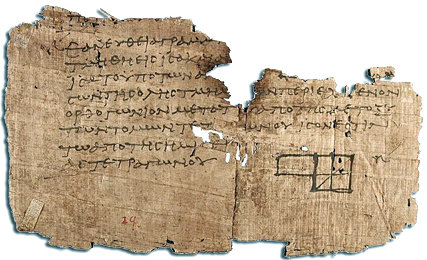
– to the Philosophy of Pythagoras it was absolutely fatal.
– The Pythagoreans it is said, resolved to keep the existence of incommensurable a profound secret, revealed only to a few of the supreme heads of the sect, and one of their number, Hippasus of Metapontion, is even said to have been shipwrecked at sea for impiously disclosing the terrible discovery to their enemies.
– …..and perhaps even eat beans, which according to Pythagoras was considered ‘taboo’.
– The problem raised by incommensurables
– …..most far reaching problems that have confronted the human intellect in its endeavor to understand the world.
– Set to work to reconstruct geometry on a basis which did not assume the universal possibility of numerical measurement- a reconstruction which, as may be seen in Euclid, they effected with extraordinary skill and with great logical acumen. The moderns, under the influence of Cartesian geometry, have reasserted the universal possibility of numerical measurement, extending arithmetic, partly for that purpose, so as to include what are called ‘irrational’ numbers, which give the ratios of incommensurable lengths
– The property of being unable to be counted as characteristic of infinite collections, and it is a source of many of their paradoxical qualities
– The impossibility of infinite collections
– Broadly speaking, the difficulties were stated by Zeno, and nothing material was added until we reach:
Bolzano’s, ‘Paradoxien des Unendlichen’ (1847-48)
– pub. 1851
– Georg Cantor
– To understand Zeno
– Parmenides
– ‘the way of opinion’
– ‘the way of truth’
– Bradley’s “Appearance and Reality”
– The opinion of mortals
– Revealed by a goddess who tells Parmenides what really is
– Reality, she says, is ‘uncreated, indestructible, unchanging, indivisible; it is immovable in the bonds of mighty chains, without beginning and without end; since coming into being and passing away have been driven afar, and true belief has cast them away.’
– ‘thou canst know what is not- that is impossible-nor utter it; for it is the same thing that can be thought and that can be.’
– And again:
– ‘it needs must be what can be thought and spoken of is; for it is possible for it to be, and it is not possible for what is nothing to be.’
– The impossibility of change follows from this principle, for what is past can be spoken of, and therefore, by the principle, still is.
– The great conception of a reality behind the passing illusions of sense, a reality one, indivisible and unchanging, was thus introduced into Western Philosophy by Parmenides the great metaphysical systems – notably those of Plato, Spinoza and Hegel – are the outcome of this fundamental idea.
– A truer image of the world, says Russell, is obtained by picturing things as entering into the stream of time from an eternal world outside, than from a view which regards time as the devouring tyrant of all that is , both in thought and in feeling, to realize the importance of time is the gate of wisdom
– All is one
– There is ‘many’
– ….one of you affirming the one and the other denying the many
– Zeno meant to protect the arguments of Parmenides
– …by retorting upon them that their hypothesis of the many if carried out appears in a still more ridiculous light than the hypothesis of the one
– Zeno’s Four Arguments:
– To support the Parminidian doctrine that reality is unchanging. Unfortunately, we only know his arguments through Aristotle, who stated them on order to refute them.
– Some maintain that they were aimed at the Pythagoreans, while others have held that they were intended to refute the atomists.
– Zeno, anxious to prove that motion is really impossible, and that he desires to prove this because he follows Parmenides in denying plurality.
– The hypothesis of indivisibles the treatise ‘On Indivisible Lines’ attributed to Aristotle
– Zeno’s polemic is directed against the view that space and time consists of points and instants; and that as against the view that a finite stretch of space of time consists of a finite number of points and instants, his arguments are not sophisms, but perfectly valid
– The conclusion which Zeno wishes us to draw is that plurality is a delusion, and space and time are really indivisible. The other conclusion which is possible, namely that the number of points and instants is infinite was infested with contradictions.
– …..they will be finite in number
– And so things are infinite in number
– If there are many things, this number of them must be both infinite and finite, which is impossible; hence we are to conclude that there is only one thing
– They are not, however, on any view, mere foolish quibbles: they are serious arguments, raising difficulties, which it has taken two thousand years to answer, and which even now are fatal to the teachings of most philosophers. P,.118
– ‘you cannot get to the end of a race course’
– Ad infinitum, so that there are an infinite number of points in any given space, and you cannot touch an infinite number one by one in a finite time
– Aristotle represents him as arguing. you cannot touch an infinite number one by one on a finite time
– No two points are next each other, but distance between the two there are always an infinite number of others, which cannot be enumerated one by one.
– by observing that T is beyond the whole of the infinite series ½, ¾, 7/8, 15/16,……
– ‘Achilles will never overtake the tortoise’
– If Achilles ever overtakes the tortoise , it must be after an infinite number of instants have elapsed since he started, this is in fact true; but the view that an infinite number of instants make up an infinitely long time is not true, and therefore the conclusion that Achilles will never overtake the tortoise does not follow.
– ‘the arrow in flight is at rest’
– It is never moving but in some miraculous way, the change of position has to occur between the instants, that is to say, not at any time whatever. This is what M. Bergson calls the ‘cinematographic representation of reality’, the more the difficulty is meditated, the more real it becomes. The solution lies in the theory of continuous series, we find it hard to avoid supposing that, when the arrow is in flight, there is a next position occupied at the next moment; but in fact there is no next position, and no next moment, and when once this is imaginatively realized, the difficulty is seen to disappear,
– ‘the argument of the stadium’
– Half the time may be equal to double the time
– The fallacy of the reasoning lies in the assumption that a body occupies an equal time in the passing with equal velocity a body that i s in motion and a body of equal size that is at rest, an assumption which is false.
– First Position Second Position
– see fig. (p.)
– When then did B pass C1?
– The above difficulty, that B must have passed C1 at some time between two consecutive moments, is a genuine one, but it is not precisely the difficulty raised by Zeno
– What Zeno professes to prove is that ‘half of a given time is equal to double that time’.
– Zeno’s arguments, in some form, have afforded grounds for almost all the theories of space and time and infinity which have been constructed from his day to our own.
– We may therefore escape from his paradoxes either by maintaining that, though space and time do consist of points and instants, the number of them in any finite interval is infinite, or by denying the reality of space and time altogether.
– Zeno , a supporter of Parmenides, drew the last of these three possible deductions, at any rate, in regard to time,
– In this , a very large number of philosophers have followed him
– If we are to solve the whole class of difficulties derivable from Zeno’s by analogy, we must discover some tenable theory of infinite numbers
– Etymology
– Etymologically, ‘infinite’ should mean ‘having no end’ p.124
– Regarded as either endless or having ends
– The series of instants from the beginning of time to the present moment has no end , but is infinite
– Kant holds – nothing infinite can be completed
– It is odd that he did not see that the future too has one end at the present and is precisely on a level with the past.
– …..just that kind of slavery to time which, as we agreed in speaking of Parmenides, the true philosopher must learn to leave behind him.
– The ‘true’ infinite is a notion totally irrelevant to the problem of mathematical infinite to which it has only a fanciful and verbal analogy.
– So remote is it …….as to confuse the issue
– It is the ‘false’ infinite that concerns us
– To show that the epithet ‘false’ is undeserved
– E.g. – every number that we are accustomed to, except 0, has another number immediately before it, from which it results by adding 1; but the first infinite number does not have this property. The numbers before it form an infinite series containing all the ordinary finite numbers having no maximum, no last finite number, after which one little step would plunge us into the infinite.
– The first infinite number is, in fact, beyond the whole unending series of finite numbers, but……’there cannot be anything beyond the whole of an unending series.’
– Beyond the whole of this series is the moment when he reaches the goal. Thus there certainty can be something beyond the whole of an unending series. But it remains to show that this fact is only what might have been expected.
– The idea of ‘counting’
– …..it is not essential to the existence of a collection, or even to knowledge and reasoning concerning it, that we should be able to pass its terms in review one by one. This may be seen in the case of finite collections: we can speak of ‘mankind’ or ‘the human race’ though many of the individuals in this collection are not personally known to us.
– In this sense, an unending series may nevertheless form a whole, and there may be new terms beyond the whole of it.
– For instance, an infinite number is not increased by adding one to it or by doubling it. The whole difficulty of the subject lies in the necessity of thinking in an unfamiliar way, what we thought inherent to finite numbers are really in fact peculiar to finite numbers.
– ……if this is remembered the positive theory of infinity,…..will not be found to be so difficult as it is to those who cling obstinately to the prejudice instilled by the arithmetic which is learned in childhood.
The Positive Theory of Infinity
– Lecture seven
– The positive theory of infinity, and the general theory of number to which it has given rise, are among the triumphs of scientific method in philosophy
– Also of real importance in understanding the functions of philosophy
– But in philosophy we follow the inverse direction: from the complex and relatively concrete we proceed towards the simple and abstract by means of analysis , seeking in the process, to eliminate the particularity of the original subject matter and to confine our attention entirely to the logical form of the facts concerned
– Between philosophy and pure mathematics there is a certain affinity, in the fact that both are general and a priori. Neither of them asserts propositions which like these of history and geography depend upon the actual concrete facts being just what they are. We may illustrate this characteristic
– By means of Leibniz’s conceptions of many possible worlds, of which one only is actual.
– Deductive analysis
– Logical analysis
– The question , “what is a number?” is the prominent philosophical question in this subject
– What is a number?
– Philosophers were content with some vague dictum such as ‘number is unity in plurality.’
– Sigwart’s, ‘Logic‘ :
– ‘Every number is not merely a plurality, but a plurality thought as ‘held together and closed, and to that extent as a unity’.
– Now, there is in such definitions a very elementary blunder, of the kind that would be committed if we said, ‘yellow is a flower’, because some flowers are yellow.
– The number 3 is something which all collections of three things have in common, but it is not itself a collection of three things.
– the number three is something more abstract than any collection of three things
– ‘on the consciousness of the laws of counting’, says Sigwart……’rests the possibility of spontaneity prolonging the series of numbers ad infinitum’. It is this view of number generated by counting which has been the chief psychological obstacle to the understanding of infinite numbers.
– In fact, a highly complex process
– And infinite numbers cannot be reached at all in this way. The mistake is of the same kind as if cows were defined as what can be bought from a cattle merchant.
– To a person who knew several cattle-merchants, but had never seen a cow, this might seem an admirable definition, but if in his travels he came across a herd of wild cows, he would have to declare that they were not cows at all , because no cattle-merchant could sell them. So infinite numbers were declared not to be numbers at all, because they could not be reached by counting.
– as we count, we cannot be said to be discovering the number of the objects counted unless we attach some meaning to the words one, two, and three…….
– The operation of counting, in fact, can only be intelligently performed by a person who already has some idea what the numbers are; and from this it follows that counting does not give the logical basis of number.
– ……those who wish to be logicians must acquire the habit of dwelling upon such facts. There are two propositions involved in this fact. First that the number of numbers from 1 up to any given number from 1 to 100 is a hundred; secondly, that if a set of numbers can be used as names of a set of objects, each number occurring only once, then the number of numbers used as a name is the same as the number of objects, the first of these propositions is capable of an easy arithmetical proof so long as finite numbers are concerned; but with infinite numbers, after the first, it ceases to be true.
– Infinite numbers have, while finite numbers have not, , a property which I shall call ‘reflexiveness’; secondly finite numbers have, while infinite numbers have not, a property which I shall call ‘inductiveness’.
– 1. Reflexiveness
– at first astonishing
– In virtue of this property, given any infinite collection of objects can be added or taken away without increasing or diminishing the number of the collection
– 0, 1, 2, 3, … n …
– 1, 2, 3, 4, … n +1…
– Thus, the number of terms in the top row is obtained by adding one to the number of the bottom row
– The example given by Leibniz to prove that there can be no infinite numbers
– He maintained that infinite collections do not have numbers.
– ‘The number of all numbers’, he says, “implies a contradiction, which I show thus:…..the whole is not greater than its parts’.
– But the word ‘greater’ is one which is capable of many meanings; for our purpose, we must substitute the less ambiguous phase “containing a greater number of terms.’ In this sense, it is not self-contradictory for whole and part to be equal; it is the realization of this fact which has made the modern theory of infinity possible.
– Galileo’s, “Dialogues on Motion”
– ……there are as many square Numbers as there are Numbers
– Salv. – Numbers, for count to an hundred you’ll find 10 squares, viz. 1,4,9,16,25,36,49,64,81,100 which is the same as to say the 10th Part are Squares, in Ten thousand only the 100th Part are Squares; in a million, only the 1000th , and yet in an infinite number, if we can but comprehend it, we may say the Squares are as many as all the Numbers taken together.
– Sag. – What must be determined then in this Case?
– Salv. – I see no other way but to say that all the Numbers are infinite.
– The proportions of squares tends towards zero as the given finite numbers increases.
– …….that the ‘limit’ of a function as the variable ‘approaches’ a given point may not be the same as its ‘value’ when the variable actually ‘reaches’ the given point.
– The number of points is the same in a long line and in a short one being in fact the same as the number of points in all space.
– Congruence
– Non-inductivenesss
– ‘mathematical induction’
– Let us first consider what is meant by calling a property ‘hereditary’ in a given series.
– “and so on”
– The hereditary property of being greater than 99 belongs to 100 and all greater numbers
– But not to any smaller numbers. Similarly, the hereditary property of being called Jones belongs to all descendants (in the direct male line) of those who have this property, but not to all their ancestors, because we reach at last a first Jones, before whom the ancestors have no surname, it is obvious, however, that any hereditary property possessed by Adam must belong to all men; and similarly any hereditary property possessed by 0 must belong to all finite numbers, this is the principle of what is called ‘mathematical induction’
– Thus an inductive property of numbers in one which is hereditary and belongs to 0.
– We may define the ‘inductive numbers as ‘all those that possess all inductive properties’ they will be the same as what are called the ‘natural’ numbers, i.e. the ordinary finite whole numbers.
– In other words, they are all the numbers that can be reached by counting.
– But beyond all these numbers, there are the infinite numbers, and infinite numbers do not have all inductive properties. Such numbers, therefore, may be called ‘non-inductive’
– The first of the infinite numbers has no immediate predecessor, because there is no greatest finite number; thus no succession of steps from one number to the next will ever reach from a finite number to an infinite one, and the step by step method of proof fails.
– The supposed contradictions are seen to contradict, not logic, but only prejudices and mental habits.
– The reflexive numbers, which lie beyond those attainable in this way, are as a matter of fact not increased by the addition of 1.
– Fallacious proofs of this have been published by many writers [Russell includes himself among them] but up to the present no valid proof has been discovered. The infinite numbers actually known, however, are all reflexive as well as non-inductive; thus in mathematical practice, if not in theory, the two properties are always associated.
– May be non-inductive, non – reflexive numbers, since all known numbers are either inductive or reflexive.
– The logical definition of numbers
– Georg Cantor (1882-3)
– The definition of number
– Gottlieb Frege of Jena
– ‘Begriffschrift’ (1879)
– ‘Die Grundlagen der Arithmetik, eine logisch-mathematische Untersuching uber den Begrift der Zahl’
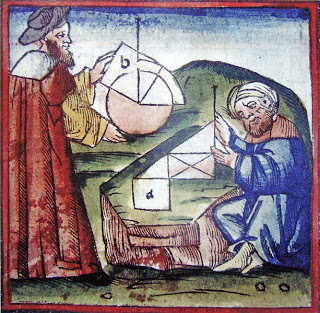
– A critical investigation of the definition of number. He proceeds to show the inadequacy of previous philosophical theories, especially of the ‘synthetic a priori’ theory of Kant and the empirical theory of Mill.
– If a tree has a thousand leaves they may be taken altogether as constituting its foliage, which would count as one, not as a thousand; and one pair of boots is the same object as two boots. It follows that physical things are not the subjects of which number is properly predicated.
– ….the proper subjects, the number to be ascribed must be ambiguous. This leads to a discussion of the very prevalent view that number is really something psychological and subjective a view which Frege emphatically rejects, ‘Number, he says,……is as little an object of psychology or an outcome of psychical process as the North Sea……there is therefore a certain similarity between number and color, but this does not consist in the fact that both are sensibly perceptible in external things, but in the fact that both are objective.’
– ‘I distinguish the objective’, he continues, ‘from the palpable, the spatial, and the actual. The earth’s axis, the center of mass of the solar system, are objective, but I should not call them actual, like the earth itself.’
– He concludes that number is neither spatial and physical, nor subjective, but non-sensible and objective. This conclusion is important, since it applies to all the subject-matter of mathematics and logic.
– Frege has the merit of accepting both denials, and finding a third assertion by recognizing the world of logic, which is neither mental nor physical.
– The fact is, as Frege points out, that no number, not even 1, is applicable to physical things, but only to general terms or descriptions, such as ‘man’, ‘satellite of the earth’, satellite of Venus’.
– The general term ‘man’ is applicable to a certain number of objects: there are in the world so and so many men.
– ‘satellite of the earth’
– But ‘one’ is not a property of the moon itself.
– It is a property of the general term, ‘earth’s satellite.’ Similarly ‘0’ is a property of the general term ‘satellite of Venus’ because Venus has no satellite.
– Numbers are properties of general terms or general descriptions, not of physical things or of mental occurrences.
– ‘mankind’
– ‘man’ and ‘featherless biped’
– ‘this and that and the other’
– When do two collections have the same number of terms?
– The relation of husband and wife relates one man to one woman and one woman to one man. A relation of this sort is called a one-one relation (in Christian countries).
– Now, whenever there is a one-one relation between all the terms of one collection and all the terms of another severally, as in the case of English Husbands and English wives, the number of terms in the one collection is the same as the number in the other but when there is not such a relation, the number is different. This is the answer to the question: when do two collections have the same number of terms,
– ‘The number of terms in a given class’ is defined as meaning ‘the class of all classes that are similar to the given class’.
– It shows that it is not physical objects, but classes or the general terms by which numbers can be asserted; and it applies to 0 and 1 without any of the difficulties which other theories find in dealing with these two special cases
– It defines the number 2, for instance, as the class of all couples, and the number three as the class of all triads.
– So far, the simplest set known to fufill this requirement is the set introduced by the above definition.
– None of these theories are any the worse for the doctrine that classes are fictions,
– I was led to the view that nothing that can be said significantly about things, i.e. particulars, can be significantly (i.e. either truly or falsely) about classes of things.
– ‘Adam is fond of apples’
– ‘Mankind is fond of apples’
– In the third or fourth century B.C. there lived a Chinese philosopher named Hui Tzu, who maintained that ‘a bay horse and a dun cow are three, because taken separately they are two, and taken together they are one: two and one make three.’

– Hui Tzu was particularly fond of the quibbles which so delighted the sophists or unsound reasoners of ancient Greece.
– If x is interested in mathematical logic, and also y is interested, and also z is interested then x is identical with y , or x is identical with z or y is identical with z
– Here there is no longer any reference at all to class.
– All that is wanted, therefore in order to render the verbal use of classes legitimate, is a uniform method of interpreting propositions in which such a use occurs, so as to obtain propositions in which there is no longer any such use.
– ….numbers are not actual entities, but that propositions in which numbers verbally occur have not really any constituents corresponding to numbers, but only a certain logical form which is not part of propositions having this form, this is in fact the case withal the apparent objects of logic and mathematics. Such words, as or, not, if, there is, identity, greater, plus, nothing, everything, function, and so on, are not names of definite objects like ‘John’ or “Jones’, but are words which require a context in order to have meaning.
– ‘logical constants’
– This fact has a very important bearing on all logic and philosophy, since it shows how they differ from the special sciences.
– 8) On the Notion of Causes with Application to the Free-Will Problem
– By a causal law I mean my general propositions in virtue of which it is possible to infer the existence of one thing or event from the existence of another or of a number of others. If you hear thunder without having seen lightning you infer that there nevertheless was a flash, because of the general proposition ‘all thunder is preceded by lightning’
– When Robinson Crusoe sees a footprint, he infers a human being, and he might justify his inference by the general proposition ‘all marks in the ground shaped like a human foot are subsequent to a human being’s standing where the marks are.’
– The word ‘thing’ here is to be understood as only applying to particulars…including sense data.
– Not an abstract object such as virtue or the square – root of two
– ‘Relation’ between what is given and what is inferred.
– ‘same cause, same effect’
– The ‘same’ cause never recurs exactly
– Since all known things are in time, a causal law must take account of temporal relations
– It must not be content with a vague ‘earlier’ or ‘later’
– The time relation of the thing given and the thing inferred ought to be capable of an exact statement.
– ‘A quarter of an hour ago this man was alive; an hour hence he will be cold.’
– Involves two causal laws
– Whenever things occur in certain relations to each other (among which their time-relations must be included) then a thing having a fixed relation to these things will occur at a date fixed relatively to their dates.
– The thing given will each occupy some finite time
– What are the grounds which lead to a belief in causal laws
– Expectation that it will be repeated on future occasions, i.e. that where one of the correlated events is found, the other will be found also.
– This affords a psychological account of what may be called the animal belief in causation, because it is something which can be observed in horses and dogs, and is rather a habit of acting than a real belief.
– Hume
– ….where an observed uniformity fails, some wider uniformity can be found, embracing more circumstances, and subsuming both successes and the failures of the previous uniformity.
– The principle of mechanics
– There is much that is hypothetical and more or less artificial in the uniformity affirmed by mechanics, because when they cannot otherwise be made applicable, unobserved bodies are inferred in order to account for observed peculiarities.
– The law of gravitation as a sample of the kind of law that appears to be verified without exception.
– …..the motion of planets and their satellites have at every instance acceleration compounded of accelerations towards all the other bodies in the solar system, proportional to the matters of these bodies and inversely proportional to the squares of their distances.
– If the mechanical account of matter were complete, the whole physical history of the universe past and future, could be inferred from a sufficient number of data concerning an assigned finite time, however short.
– Psychology cannot boast of any triumph comparable to gravitational astronomy
– Unsupported bodies fall in air
– The word ‘cause’
– ‘arsenic causes death’
– ‘cause ‘ and the subsequent event as the ‘effect’
– It is still possible to employ the words ‘cause’ and ‘effect’
– The ‘law of universal causation’
– ‘there are such invariable relations between different events at the same or different times that, given the state of the whole universe throughout any infinite time, however short, every previous and subsequent event can theoretically be determined as a function of the given events during that time.
– Such expectations, as Hume pointed out, explain only too well the common sense beliefs as to the future.
– no reason to believe that the sun will rise tomorrow. p.153
– That all inferences as to the future are in fact invalid, and I do not see how such a view could be disproved
– But, while admitting the legitimacy of such a view, we may nevertheless inquire: if inferences as to the future are valid, what principle must be involved in making them?
– The principle involved is the ‘Principle of Induction‘
– …..as the number of instances increases, the probability approaches indefinitely nearer to certainty.
– If, in a great number of instances, a thing of a certain way with a thing of a certain kind is always similarly associated with a thing of the other kind; and…It is thus the principle of induction, rather than the law of causality….
– The principle has not received the attention which its great importance deserves
– Their own darling
– The definition of ‘a causal law’ is found to be far from simple.
– If it is true, such inferences are valid, and if it is false, they are invalid.
– The typical cause would be the fiat of a king, the cause is supposed to be ‘active’ the effect ‘passive’
– Teleology replaces causation in the explanation of nature. But all such ideas, as applied to physics are mere anthropomorphic superstitions. It is as a reaction against these errors that Mach and others have urged a purely ‘descriptive’ view of physics: physics they say does not aim at telling us ‘why; things happen, but only ‘how’ they happen.
– From the observed to the unobserved
– Orthodox metaphysics
– Kind which we naturally imagine, it is necessary to shut out, by an effort, everything that differentiates between past and future
– Replaced by cumbrous periphrases Consider such a statement as ‘Brutus killed Caesar’
– The killing
– More accurately, the desire and the belief jointly cause the act.
– Every act which realizes a purpose involves two causal steps in this way
– C is desired…….p. 155
– If belief was incorrect we have disappointment
– Gives him [Brutus] a sense of power and freedom.
– It is equally true that if the effects had not occurred, his desires would have been different, since being what they were the effects did occur.
– Thus the desires are determined by their consequences just as much as the consequences by the desires, but as we cannot [in general] know in advance the consequences of our desires, this form of inference is uninteresting as applied to our own acts, though quite vital as applied to those of others.
– A cause considered scientifically, has none of the analogy with volition which makes us imagine that the effect is ‘compelled’ by it.
– We shall do better to allow the effects to be before the cause or simultaneous with it, because nothing of any scientific importance depends upon its being after the cause.
– In the common notion of causation, the cause is a single event we say the lightning causes the thunder, and so on.
– A probable causal connection what is actually known as a matter of empirical science, is that certain constant relations are observed to hold between the member of a group of events at a certain times , and that when such relations fail as they sometimes do, it is usually possible to discover a new more constant relation by enlarging the group
– A very common causal group consists of volitions and the consequent bodily acts, though exceptions arise, (for example) through sudden paralyses.
– ….between a bodily act and the realization of the purpose which led to the act.
– Psychologist
– The problem of free will
– The fear that the will might not be fee has been to some men a source of great unhappiness
– A cool analysis
– P.157
– We do not wish to feel ourselves in the hands of fate
– We do not like to think that other people , if they knew enough could predict our actions, though we know that we can often predict those of other people, especially if they are elderly
– Much as we esteem the old gentleman who is our neighbor in the country, we know that when grouse are mentioned he will tell the story of the grouse in the gun room.

– But we ourselves are not so mechanical: we never tell an anecdote to the same person twice, or even once unless he is sure to enjoy it; although we met (say) Bismarck, we are quite capable of hearing him mentioned without relating the occasion when we met him.
– In this sense, everybody thinks that he himself has free will, though he knows that no-one else has.
– We thus have two questions to consider
– 1) Are human actions theoretically predictable from a sufficient number of anecdotes?
– 2) are human actions subject to external compulsion
– Bergson
– He infers that every mental event is a genuine novelty, not predictable from the past, because the past contains nothing exactly like it by which we could imagine it. And on this ground he regards the freedom of the will as unassailable
– Bergson’s contention…….p.159
– Knife or revolver
– Kind of act which will be performed can be foreseen within narrow limits; it is of little practical interest that there are finite shades which cannot be foreseen.
– It states rather that there is a constant relation between causes of certain kinds and effects of certain kinds.
– In fact what is found to be repeated is always the ‘relation’ of cause and effect, not the cause itself….
– And the prophecy of boredom is none the less true for being more or less general
– A priori
– We cannot, therefore feel any a priori certainty that ‘causation’ must apply to human volitions.
– ….regarding it as probable that they all have causes. ‘The state of all minds in the world could be inferred, while conversely the state of all the matter in the world could be inferred if the state of all the minds were given.’
– The most extreme claims of determinism and of correlation of mind and brain, still the consequences inimical to what is worth preserving in free will do not follow.
– ….entirely from the assimilation of causes and from the notion that causes compel their effects in some sense analogous to that in which a human authority can compel a man to do what he would rather not do. This assimilation, as soon as the true nature of scientific causal laws is realized, is seen to be a sheer mistake.
– 2) external compulsion
– The supposed inconsistency of these two springs from the habit of conceiving causes as analogous to volitions
– If a cause is analogous to volition; outside causes will be
– Analogous to an alien will, and acts predictable from outside causes will be subject to compulsion.
– There is a mutual relation…..
– The geologist infers the past state of the earth from its present state…..
– The apparent indeterminateness of the future….
– It is a mere accident that we have no memory of the future…….
– Freedom, in short, in any valuable sense, demands only that our volitions shall be, as they are the result of our own desires, not of an outside force compelling us to will what we would rather not will.
– A help in acquiring a philosophical habit of mind and a guide in looking for solutions of philosophic problems.
– Aims at what is general, and the special sciences , however they may suggest large generalizations, cannot make them certain
– Spencer and evolution
– A hasty generalization of the latest scientific theory
– A certain peculiar mental discipline is required
– Desire to know philosophical truth
– Very rare – in its purity, it is not often found even among philosophers
– Pythagoras invented a system which fitted admirably with all the facts he knew except the incommensurability of the diagonal of a square and the side; this one little fact stood out, and remained a fact even after Hippos of Metapontion was drowned for revealing it.
– No doubt, it is commoner to wish to arrive at an agreeable result than to arrive at a true result, but only those in whom desire to arrive at a “true’ result is paramount can hope to serve any good purpose by the study of philosophy
– Methodological doubt, like Descartes, in order to loosen the hold of mental habits; and it is necessary to cultivate logical imagination….
– In order to have a number of hypotheses at command and not to be the slave of the one which common-sense has rendered easy to imagine. These two processes, of doubting the familiar and imagining the unfamiliar, are correlative and from the chief part of the mental training required for a philosopher
– To acquire fertility in imagining abstract hypotheses
– Physics , which from Plato to the Renaissance was an unprogressive, dim and superstitious as philosophy, became a science through Galileo’s fresh observation of facts and subsequent mathematical manipulation, so philosophy, in our own day, is becoming scientific through the simultaneous acquisition of new facts and logical methods
– An apparatus of precise conceptions as general and as free from complexity as possible
– …..here, only genius will prevail….
– Number, infinity, continuity, space and time
– The creation of a school of men with scientific training and philosophical interests, unhampered by the traditions of the past, and not misled by the literary methods of those who copy the ancients in all except their merits.
Finis p.169
Originally published 1914
 tomreading
Leave a comment