Illustration by J. Hillis Miller
Dartmouth School of Criticism and Theory
Walter Benjamin, The Work of Art in the Age of Mechanical Reproduction’
Fascism
Communism
Jean Joseph Goux
Aestheticization
Politicization
Katmandu , Nepal – VCR movies – L.A. Law, Miami Vice
Althusser
Impensee’
A blindness
What Are Cultural Studies?
New historical studies as applied to Renaissance or Victorian English Literature
1) Cultural studies
Works historical context
Henry James – study the conditions of the publishing industry during the time which James wrote, i.e.
2) cross-disciplinary and multi-media
Anthropology and ethnography, i.e.
3) Breakdown the assumption that there is an agreed upon canon of works that ought to be the center of humanistic studies.
4) relation to some specific and local people
The expression of African-American or Chicano people, or those who wrote for the theatre or attended it in Shakespeare’s England
Chicano’s murals
Abdul JanMohammed – ‘a performative utterance/event’ as opposed to its existence as an aesthetic object.
David Lloyd
Theory is an essential part of minority discourse
Rhetorical reading deconstruction reading
Active and interventionist reading
A wrestling with what might be called the material dimension of signs, will work, that is, effect changes in the real institutional and social worlds
5) cultural studies are explicitly political
Minorities, women, gays, and lesbian all those disadvantaged, silenced, without power.
Preserving the minority cultures
Who could oppose the righting of injustice, and the enfranchising of the disenfranchised
Furthering the cause of universal justice
The modern Western University
Reason reigns
Rationalized
Perpetuation of the dominant white, male Eurocentric ideology
The University is already political through and through
Those hegemonic custodians of the old University cannot bring themselves to take cultural studies seriously, though it is beginning to change
Scientist
A further danger is the appropriation of cultural studies by the dominant culture
United States Information Service
British Council
i.e. twenty –five best records by British Rock groups for diffusion abroad as examples of the vitality of British culture.
Benjamin
aporias
Benjamin’s essay depends on the opposition between the person embedded in a tradition, on the one hand, and the masses on the other aura of the unique work of art and the lack of aura in the reproduced work.
Benjamin’s commitment to Marxist dialectical materialism
Reine sprach or pure speech
‘The Task of the Translator’
Aura
Erscheninung
Sheinen
‘The Origin of German Tragic Drama’

Hegel’s definition of Beauty as ‘das sinnliche Scheinen der Idee’
For traditional men and women the work of art was unique made once only, impossible to reproduce, except in degraded form, since the copy would lack the authenticity and aura of the original work, so to be worthless.
Unapproachability [Unnahbarkeit] is indeed a major quality of the cult image
That word Erscheinung, with its link to Idealist theories of art.
Mass production, on the other hand….
Or the masses, the aura of the work of art has disappeared in universal familiarity and closeness.
It is the opposite of Erscheinung
Closeness
The ‘cult value’ [Kultwert] of works of art has been replaced by ‘exhibition value’ [Ausstellungswert]
Advertisement (not mentioned by Benjamin)
The opposition between Kultwert and Ausstellingswert
Photography
Cult still remains in early portrait photography
The cult of remembrance of loved ones
The product of prosopopoeia, traditionally defined as the ascription of a name, or a face, or a voice to the absent, the inanimate or the dead
Portrait photographs bring near in their distance, ‘loved ones, absent or dead’
‘melancholy’ and ‘beauty’
Benjamin, ‘The Origin of German Tragic Drama’
The definition of Hegel of Beauty as the sensible appearance of the Ideal.
Photography caused a historical crisis or turning point in which cult value vanished forever, to be replaced by exhibition value for the first time shows its superiority to the ritual value
Photographs made by Atget around 1900 of deserted Paris streets
The photographs by Charles Langdon Coburn used as illustrations for the New York edition of Henry James’ works
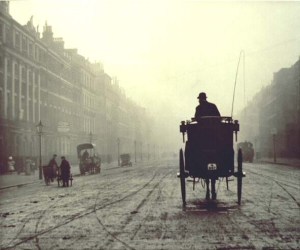
As if they were scenes of a crime
Photographs become, as they certainly are for us today, standard evidence for historical occurrences and they acquire a hidden political significance
Spelt out in so many words –
American Public Television of a series called ‘Making Sense of the Sixties’

A passage of 1932 from Rudolf Arnheim describing how in film the actor is a stage prop characteristically chosen….. Inserted at the proper place.
Benjamin, ‘The Work of Art in the Age of Mechanical Reproduction’

The relation of picture and word
Victorian Illustrated novels
Photographs of Atget, says Benjamin ‘demand a specific kind of approach – ‘free-floating contemplation’
He feels he must seek a determined, settled or appointed way to them.
Captions…are necessary ‘signposts’ (Wegweiser) that determine for the viewer the way to approach a modern photograph or silent film.
…this seems an extremely dubious idea.
Why is a caption [Beschriftung] – a word related of course to vorgeschrieben necessary?
In the age of aura the picture spoke for itself
Once upon a time there was aura, cult, tradition possessed
Now there is exhibition, film, popular media catering to the masses and keeping them in a state of mystification
Their real material and ideological conditions of life are hidden from them by the mass media. The media mediate delusions, delusions often uncritically shared by the makers of mass-culture products
The reading of Nietzsche’s ‘The Birth of Tragedy’ in Paul de Mans’ ‘Genesis and Genealogy’
To say that the big computer databases will allow understanding of the genesis of a work like Thoreau’s ‘Walden’ is to yield to the attraction of one form or another of the genetic thinking that remains an almost irresistible trap for thought
Changes wrought by the invention of photography then of moving pictures. His essay is one of the first important reflections on the significance of cinema
The basic pre-supposition of Benjamin’s essay is a Marxist dialectical material one.
He asserts that ‘as a rule no other revolutionary merit can be accredited to today’s film than the promotion of a revolutionary criticism of traditional concepts of art.’ (E, 231; G 163)
Benjamin’s observations about film anticipate Michel Foucault’s insights into the policing power of technology. Foucault speaks of ‘new procedures of power, which operate not by right but by technique, not by law but by normalization, not by punishment but by control, which are exercised on levels and forms which exceed the state and its apparatuses
We are all, to some degree, members of what Benjamin invidiously calls the ‘masses’
The Technology of Cultural Studies
Benjamin’s ideal of scholarship, one might think, is still apparently the codex book or the essay, the latter not greatly changed since Montaigne
Benjamin was a great book collector
Suicide when Nazis forced him to flee without his collection
‘The Origin of German Tragic Drama’
‘The Origin’ notoriously explodes the genre of the dissertation from within.
‘close-ups’
Dada in painting
In film
Derrida’s ‘Glas’
comic books
The computer
The use of different fonts and type sizes, the juxtaposition of parallel columns to make a dialogical text (in the literal sense of ‘subject to a double logos’) the use of inserted sidebar or ‘jalousies’ that add more text to the basic doubling.
Derrida, ‘Glassary”
Derrida, ‘The Truth in Painting”
Section called ‘Restitutions’
Mark Poster
Digital reproduction
The primary instrument of the new technology of scholarly reproduction is the personal computer
Ghirlandaio
Rembrandt
Shakespeare
Thoreau
Toni Morrison
Papers (but they are not really papers) written in the new medium will be able to reproduce photographs, film and video clips, paintings, music, sound – tracks and any other material that can be digitized
….what Richard Lanham calls the electronic book’. The electronic book is a multimedia production
Copyright laws developed for the printed book do not apply at all easily to the electronic book
Collective or ‘polylogical’ thought
Strong ‘uneasiness’ is generated but the notion that the computer is going to do my thinking for me, or that a vast sea of anonymous digitized thought is going to think itself through me by way of the computer.
‘The Thoreau Prototype’
Donald Ross and Austin Meredith at the University of Minnesota
Henry David Thoreau
CD-ROM
IRIS Project at Brown University
Someone working at an obscure junior college anywhere in the country will have at his or her fingertips the equivalent of the Widener and the British Library combined.
Assemblage and juxtaposition
Tennyson’s ‘The Lady of Shallot’
‘Walden’ or ‘A Week on the Concord and Merrimack Rivers’

Associative, linked, hierarchical, dynamic, visual, and genetic
Free association
Association by analogy or by contingency; by metaphor or by metonymy
These links
Browse
Ross and Meredith
Dynamic variorum
Thoreau study
Primary-Secondary Text Links
Boolean search engines
The word genetic
Problematic force of the genetic paradigm
Machine translation has, on occasion been wrecked on the reefs of the same problem as in the notorious case in which ‘the spirit is willing but the flesh is weak’ was translated into Russian to mean ‘the vodka is good , but the meat is rotten.’
A different drummer
Clapper’s genetic text of ‘Walden’
Prototype for what will no doubt be an immense proliferation of such programmers and databases
This proliferation will transform humanities research in the coming years
The Aporias of Cultural Studies
The case of Dada and Film
Computer revolution
These children of the Sixties
Abdul JanMohammed and David Lloyd
….an overgeneralized model of its contents
…to put Paul Klee back into Germany or Switzerland

Attempt to categorize Anthony Trollope as no more than a representation of Victorian middle class capitalist ideology aiding the police in their work of repression
Maybe in danger of putting everything on the same plane of instant availability, a symphony of Beethoven and Africa folk music or a Picasso and a Fra Angelica and Chicano’s murals
The illustrations in this book are an example of that
Stephen Greenblatt’s work on Shakespeare and D.A. Miller’s work on Victorian fiction are examples of this
‘subject’ positions
National Association of Scholars
‘peripheral’ programmes like women’s studies or African American studies
Benedict Anderson, for example, in ‘Imagined Communities, Reflections on the Origin and Spread of Nationalism’
As Marx says in a striking aphorism: ‘Whoever has a programme for the future is a reactionary’
‘negation’, ‘dialectical’ and ‘sublation’
How for example can the culture of the Palestinians, the Kurds, the Croats, the Quebecois of Canada or the Catholics of Northern Ireland, be preserved?
Irvine, California
….in teaching them American English as Quickly as possible, assimilation them into American middle class television watching culture and thereby erasing the cultural legacies carried by those languages
Certain conservative officials of the N.E.H. or the Department of Education
To liberate us into that new digitalized world of one universal culture that is by traditional standards, no culture at all
This means inventing new forms of consolidation and solidarity, for e.g. among women, or gays and lesbians, or Asian-Americans, forms that will work as a means of giving power to such marginalized groups without falling back into some form of thinking in terms of self and other, us and them, or in terms of some pre-existing unity and right to power.
Important work in this area has already been done , not only by Anderson but, for example, by Jean–Francois Lyotard, Jean-Luc Nancy, Maurice Blanchot and David Carroll
‘all efforts to render politics aesthetic culminate in one thing: war’ – Benjamin
Marinetti’s celebration of the beauty of the Ethiopian colonial war
World war II
Television treatment of ‘The Gulf War’
Anti-Semitism is on the rise again in some parts of the former Soviet Union p.52
Inaugurative Responsibility
…in holding to that distinction between binary and analogue opposition JanMohammed makes…
My concept of artwork and scholarship as inaugural performatives is fundamentally different from what Heidegger says in ‘The Origin of the Work of Art’
‘Whenever art happens….. p.55
Rather than being the revelation of pre-existing Being, what both art and criticism reveal is themselves.
Druscilla Cornell
Benjamin, ‘The Critique of Violence’
In the strong sense of the word ‘read’
The word ‘read’ in its emphasis on as interventionist and productive activity of interpretation that takes nothing for granted, is still the best available
Boolean search engine techniques
Even though , all these techniques can be programmed to produce foregone and even oppressive conclusions
Authorship and copyright
Pater Jaszi
Martha Woodmansee
Responsibility
….films, television, advertising, illustrated magazines and books, photographs with captions or with words within the photographic image

Part Two: Word and Image
‘Je suis pour-aucune illustration’ – Mallarme
‘The sun…..is new each day’ – Heraclitus
Images et Text
The graphic tradition to which Dickens’ illustrations belonged
Mark Twain did not think a picture superior or to text.
‘Life on the Mississippi’
‘Beatrice Cenci the Day Before Her Execution’

Young Girl With Hay Fever’ or ‘Young Girl with Her Head in a Bag’
‘First Interview between Lee and Jackson’ p.62
In the polemic, or paragon between show and tell….
A picture is authentic if it is copied from life
….a picture must plainly illustrate a story.
Words are necessary to indicate what story it is.
The admirable Edward Gorey
‘The Unstrung Harp’
‘Mr. Earbrass Writes a Novel’
‘The Doubtful Gas’
‘The Hapless Child’
‘The Fatal Lozenge’
‘The Gashly Crumb Tinies’
The Object Lesson’
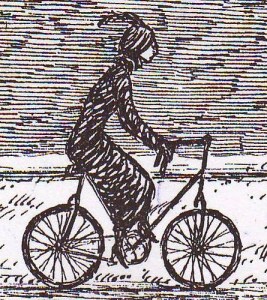
‘The Willowdale Handcar’ or the ‘The Return of the Black Doll’
Svetlana Alpers
Robert Browning
‘God’s works – paint any one…
….art was given for that p.67
Stephan Mallarme
The words on the page have a performative power of evocation
Replace
John Ruskin’s hatred of photography (expressed in Ariadne Florentine’e.g.)
Henry James, ‘The Golden Bowl’
Alvin Langdon Coburn
James’, ‘A Small Boy and Others’
Dickens’ ‘Oliver Twist’ meant more for James the powerful etchings by Cruickshank
Signifie
Coburn, ‘Portland Place’
Photographs for ‘The Golden Bowl’
Image et texte – Mallarme’s phrase
George Herbert’s ‘The Altar’
Mallarme’s ‘Un coup de des’
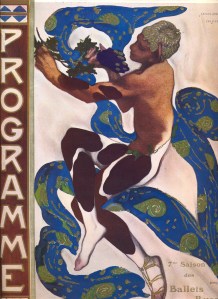
William Carlos Williams’ ‘The Yellow Smokestack’
John Hollander’s pattern poems in ‘Types of Shape’
E.g. ‘Swan and Shadow’
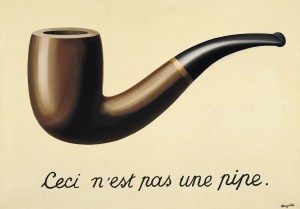
Michel Foucault ‘Ceci N’est Pas Une Pipe’
James, ‘The Sacred Fount’
‘The Ambassadors’
Sam Wellen’s valentine in Dickens’ ‘Pickwick Papers’’
‘The Pickwick Papers’ was originally conceived namely as a series of etching accompanied by Dickens’ subsidiary ‘letterpress’
Edward Gorey
In these cases picture and word have relatively equal force as they do in the work of William Blake or D.G. Rosetti, J.M.W. Turner’s own long poem ‘The Fallacies of Hope’
Witty and enigmatic titles that Paul Klee appended to his paintings
Paul Klee, ‘Ohne Titel’ (Schrift) 1940
Dutch paintings of Svetlana Alpers
-like so many twentieth century paintings from Cubism on
It may be doubted however, whether such purity can exist
Polemos
Ruskin
Why did John Ruskin call his lectures on the art of engraving ‘Ariadne Florentis’?
Ruskin makes the distinction between picture and word problematic by relating both words and pictures to the primordial material act of scratching a surface to make it a sign
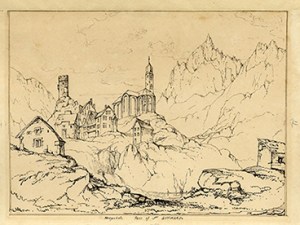
That sign, says Ruskin suggests, is always a miniature maze, and is always connected to its context by labyrinth line of filiation
Ruskin defines engraving as the ‘Art of Scratch’ p.320
Careful analyses of method of labyrinthine ornamentation
….Thesian traditions – spiral waves of water
Babylon and the Assyrian carved them
Greek vases
Arabesque
Last luxury of Venice and Rome
Assyrian representation of waves as mazes
Engraving may therefore be put, along with weaving and embroidery, under the double aegis of Penelope and Ariadne
The spirits of Penelope and Ariadne reign vivid in all the work [of the sampler] – and the richness of pleasurable fancy is as great still, in these silken labours, as in the marble arches and golden roof of the Cathedral of Monreal (p. 453)
The Cretan labyrinth, with its associated story of Ariadne, Theseus and the Minotaur.
Ruskin, ‘Fors Clavigera’
Labyrinthine ornamental design has always been ‘connected with writing’ as in the illuminated capitals or in ‘The Book of Kells’
The ‘Ludus Trojae’ in Virgil’s ‘Aeneid’ (v, 588)
…by the read of the ‘nine-men’s morris’ in ‘A Midsummer Night’s Dream‘(ii, I, 98)
All these examples of dancing or mock war as a way of engraving on the earth a sign that is also a design
Penelope’s weaving of her web both defers her choice among the suitors and makes a shroud for Ulysses ‘father Laertes.
… its surrogates may by displacement become impossible too, so that walking or writing may also be blocked
Heidegger
Resemblance to Ruskin’s theory of engraving
The Rift (Riss) trait or fissure
The Zug (drawing or abstraction)
The Zeug (production)
The Gezuge (the system that holds the traits together in a design
The fissure or Riss- made by engraver’s tool
Riss-makes a design – bringing to light – illustration
Heidegger adopts the Greek word ‘Aletheia’
‘Aletheia’ is a revelation, bringing the truth into the pen.
Since illumination is, for Heidegger, the basic function of the work of art, whether the work is graphic architectural, verbal, or the product of craftsmanship (as in the making of a pot or a pair of shoes)
Jacques Derrida, ‘Restitutions’
Van Gogh’s shoes were probably his own (as Meyer Shapiro was the first to assert)
Truth
‘essence’ or being
Man-made
Equipment – Zug
Zug words: Zeug ‘product’
Human work
Brought into existence by human work.
The equipmentality of the equipment (das Zeugin des Zeuges)
This appearance’ or Vorschein
Equipmentality (Zeugsein)
The Being of the work.
The Greeks call the unconcealedness of beings: ‘aletheia’
Kant and Hegel, with their differing emphasis on Schein, Erscheinung, Vorschein
Shining, coming into light
Hegel’s celebrated formula in the ‘Aesthetik’ about the beautiful as ‘the sensible appearance [Scheinen] of the Idea’
Benjamin’s concept of aura
‘On Some Motifs in Baudelaire’
Benjamin’s ‘aura’
The being of the beings comes into steadiness of its shining [in das Standige seines Scheinen]
World (welt)
….that danger is always present when an intellectual glorifies the life of obscure toil, for example
Claude Levi Strauss, ‘Trista Tropiques’
Conrad ‘The Nigger of the Narcissus’
If Meyer Shapiro is right then;;;; the ‘full pathos of the peasant woman’s life is projected into the painting by Heidegger himself
[Zeug]
For Heidegger, as other essays make clear, the human world is a fourfold tension among earth, sky, man and the gods
whether the making out of the furrow creates something or only reveals it
‘Holzwege’ forest paths -the book to which the ‘Origin of Art’ belongs

The French translation as ‘Chemins qui ne mement nulle part’
As Phillipe Lacoue-Labarthe and others have demonstrated: the political state is for Heidegger, and for the whole tradition of ‘German aesthetic ideology’. Another work analogous to the work of art or to the work of philosophy
Heidegger: ‘as founding art is essentially historical –this means not only that art has a history…. Appears side by side with many other phenomena
….. offering thus to science of history a series of changing aspects. Art is History in the essential sense that it grounds history (E,77 , G, 64)
Jean-Joseph Goux
The university of global civilization
Heidegger: ‘the requirement to which modern art responds is none other than the scientific world.
We hesitate to give our assent. We remain in indecision.
Albrecht Durer
The well-known remark: ‘For in truth, art lies hidden within nature [steckt die Kunst in der Natur] he who can wrest it from her, has it.
‘wrest’ mans to draw out the rift and to draw the design with the drawing pen on the drawing board (E, 70, G, 58)
Reiss en heiss heir Herausholen des Risses und den Rifts reissen mit der Reissfeder auf dem Reissbrett.
Art is here, as for Aristotle or for Wallace Stevens, both art of nature, that part of nature which has to do with mimeses as revelation, and at the same time something that supplements nature, since without art the Rifts would remain concealed
But it is equally certain, continues Heidegger, that this art hidden in nature becomes manifest only through the work because it lies [steckt] originally in the work. (E, 70, G, 58)
‘Kunst [ist] in der Natur, ad at the same time art originates something, is in itself ‘Ursprung’ rather than springing from one.
‘The Last Furrow’, Hans Holbein the Younger’

A woodcut in the series ‘The Dance of Death’, Holbein
in fact were cut by Hans Lutzelburger
Ruskin, ‘The Eagles Nest’
Sol illuminatio nostra est; sol nostra; sol sapentia nostra
As in Tenniel
Beaten gold, seven times tried in the fire.’
‘it is a long field’, says Death, ‘but we’ll get to the end of it today’ – you and I (p 355)
‘I have, God woot, a large field to ere/ and wayke been the oxen in my plough’, says the Knight in ‘The Canterbury Tales’
Ruskin’s chapter on ‘The Techniques of Wood Engraving’
…the furrow produced is at first the wedge shaped or cuneiform ravine.
Cuneiform – Babylonian cuneiform
This writing is a form of ploughing
That which thou sowest is not quenched, except it die.’ (I Corinthians 15: 36)
Phusis
Designs that are signs….
Dickens and Phiz
‘Phiz’ (Hablot K. Browne) for Charles Dickens’ ‘The Pickwick Papers’
Neither nature in itself nor man’s relation to nature is an important topic for either Dickens or Phiz
Albert Johannsen, Robert Patten, Michael Steig
Phiz’s relative independence from Dickens
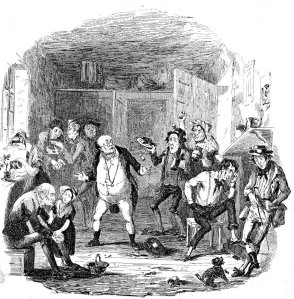
The tradition of Hogarth, Rowlanson, Cruikshank and others
Both Patten and Steig affirm the relative harmony of Phiz’s plates and Dickens’ text.
Steven Marcus in a brilliant essay
….opening sentence of ‘Pickwick Papers’ is a parody of Genesis
….the law Henry James formulates whereby a novel should always be seen as ‘putting forward illustrative claims’ (that is producing an effective illustration) by its own intrinsic virtue.
The Word, Christ
Doubled and re-doubled
…the sun has just risen, and begun to strike a light on the morning of the thirteenth of May, one thousand eight hundred and twenty seven…
The sun plays Sam Weller to Mr. Pickwick.
…there are dark shadows on the earth, but its lights are stronger in the contrast. Some men, like bats or owls, have better eyes for the darkness than for the light. We, who have no such optical powers, are better pleased to take our last parting look at the visionary companions of many solitary hours, when the brief sunshine of the world is blazing full upon them (pp.895-6)
Esther Summerson’s vision (note her name)
‘Bleak House”
Pickwick, however, is a thoroughly humanized sun, at most an indirect mediator of divine goodness.
Robert Patten
‘Mr. Pickwick in the Pound’’ (illus 22)
…..in the Hogarthian way, as the graphic representation of tropes: pun, metaphor and allegorical emblem.
Pickwick’s stomach
Turner’s paintings – dazzling white center of the vortex of colored light.
Holbein’s ‘Last Furrow’
‘Christmas Eve at Mr. Wardle’s” (illus 24)
‘Mr. Wardle and His Friends under the Influence of Salmon, in the Card Room at Bath’
‘Mr. Pickwick Sits for his Portrait’
‘Discovery of Jingle in the Fleet’ (illus 26-29)
Pickwick’s belly as solar metaphor
The appearance, or Erscheinung, of what stands for the first sun no one can ever see.
Wallace Stevens, master of the solar trajectory
Dickens’ replacement of Cruikshank by Phiz
Twain and Dickens
Turner
Paulson, ‘Turner’s Graffiti: The Sun and its Glosses’
Turner, ‘The Sun of Venice Going to Sea’
Any of Turner’s paintings are illustrations of pre-existing verbal documents
i.e. ‘Ulysses Deriding Polyphemus’
Aeneid, Regulus
‘The Angel Standing in the Sun’
The avenging Angel of the Book of Revelation
Angel of darkness in Samuel Roger’s poem ‘The Voyage of Columbus’
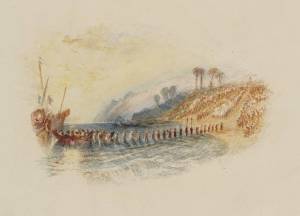
Ruskin, ‘Modern Painters’
‘Shade and Darkness – The Evening of the Deluge’
‘Light and Color (Goethe’s Theory) – The Morning after the Deluge’
‘Moses Writing the Book of Genesis’
Goethe’s ‘Zur Farbenlehre’ translated as ‘The Theory of Colour’
‘Nohbdy’
Ulysses among his other epithets is called ‘polytropo’ in the first line of the ‘Odyssey’.
Resourceful, wily, versatile’ most literally a man of many turns’
…the way ‘Regulus’ may be seen as placing the spectator in the position of Regulus with his eyelids cut off about to be blinded by the sun…
Turner’s doublings
‘Dido Building Carthage’
‘The Decline of the Carthaginian Empire’
….if Turner had not said so… the spectator would not know
Quite often this subsidiary focus involves some secondary light source made by human beings or signifying them.
This second source of the theme of the second sun
Charles Stuckey, ‘Temporal Imagery in the Early Romantic Landscape’
Xenophanes cited in reference 41
…humankind’s defiant challenge to the sun, the making of a second sun, a Prometheus stealing of fire.
‘Newark Abbey on the Wey’ (1807)
Volcanic glow
‘Staffa, Fingal’s Cave’
The echo of Gibbon’s title in the title ‘The Decline and Fall of the Carthaginian Empire’
W.J.T. Mitchell
…even though the Victorians were to boast that ‘the sun never sets on the British Empire’, sooner or later even that new Empire was to disappear
Stephen Bann
The story of Turner’s paintings tell is almost always presented from a male perspective
…this act of temerity
He will vanish, as the sun does every day, into the chasm of death that sooner or later, swallows up all figures of history and legend.
Turner as Second Sun
‘Claudian Harbours Scene’
Andrew Wilton
John Gage
….viewer of the painting is placed in the position of Regulus at the moment before he is blinded. Regulus is seeing the world for the last time
The historical Regulus, Roman general and Consul, was punished by the Carthaginians, whose prisoner he was, for having failed to negotiate an exchange of prisoners between the Romans and the Carthaginians. His eyelids were cut off and then he was exposed to the sun, thereby blinded. He was given the coup de grace by being rolled in a spiked barrel
Colour by reflection an equivalent in power of the aerial colours made by the prismatic splitting of pure white light.
Goethe
Goethe’s, ‘Zur Farbenlehre’
Is essential to the interpretation of Turner’s work.
Complex and problematic
Sir Charles Eastlake’s translation
Turner, according to Gowing, Heffeman and Jack Lindsay, believed that the colours come wholly from light whereas matter is the privation of light and colour
Prismatic order….light while the Commixture of our material colour….Darkness
Diurnal variations
Pure combinations of aerial colours p. 156
This was his theory of ‘optical fusion’
The description of Turner finishing the Regulus with nothing on his palette but a huge lump of flake-white
Goethe’s theory of colours is dialectical
For Goethe, the realm of colours is a text to be read
An unknown ‘x’ Goethe calls Nature (die Natur). Nature itself is ‘ungraspable’ (‘das Unerforschliche’)
Those ‘elements’ of nature’s language are all one trope or another. Nature speaks by synecdoche; for example when the part tells what is going on in the invisible whole. Nature has even a secret agent [eine Vertrauten; more properly: confident, intimate riend]
Goethe’s ‘Theory of Colour’ is a theory of hopes, of turnings and substitutions. It is not idly that figures of speech have traditionally been spoken of as ‘colours of rhetoric’
‘phenomena’
Nature as she speaks in different ways to different senses. And thus we descend the scale of being, nature speaks to other senses – to known, misunderstood, and unknown senses; so speaks she herself to us in a thousand modes [Erscheinung]
‘Modes’ is a close relative of the key term in Hegel’s definition already twice cited, of the Beautiful as the sensible appearance (Scheine’) of the Idea.
….that all these tropes are forms of catachresis
To apply these universal designations, this language of Nature to the subject we have undertaken; to enrich and amplify this language by means of the theory of colours and the variety of their phenomena [Erscheinung] and thus facilitate the communication of higher theoretical views, was the principle aim of the present treatise (E, xxxix –xl, G, 316)
Personification
Nietzsche ‘On Truth and Lie in a Non-Moral Sense’
Goethe’s ‘Die Wahlverwandtschaften’ (‘Elective Affinities’)
The word ‘theory’ it will be remembered, has the same root as the word ‘theatre’
Hegel, ‘Who Thinks Abstractly’
Every act of seeing , says Goethe, leads to consideration, consideration to reflection…p.141
….with irony
Goethe’s polemic against Newton in ‘Zur Farbenlehre’
The opposition of Goethe to Newton is a conflict of two theories of the sign or of symbolism…in the Coleridgean sense
Coleridge
Something hidden , something profound and ungraspable
Goethe’s ‘Faust’
Mephistopheles
‘I am part of a part that was whole at first, Part of the dark which bore itself to light, which lately durst.
Dispute her ancient rank and realm to Mother Night; and yet to no avail, for strive as it may, it cleaves in bondage to corporeal clay. It streams from bodies, bodies it lends sheen [von Korpernstrompt’s, die Korper macht es schon] (Faust 1, 1349-55)
A stupendous clangor [Ungeheures Getose] says the stage direction, proclaims the approach of the sun.
‘we have life from coloured refraction’.
Return to Turner
Turner…understood Goethe very well. – JHM
Something like the Goethean conflict of aerial colour and material colour
‘Felsentore knarren rassend Phobus Rader rollen prasselnd Welch Getose bring das Licht!’
Granite portals clatter
Wheels of Phoebus roll and spatter
What great din the dawning brings’
Ariel’s song in the sunrise scene in “Faust’
Finberg, a cataloguer of the twenty-thousand or so drawings in the Turner Bequest called ‘Colour Beginnings’
Ruskin’s identification of Turner with the Angel of the Apocalypse
‘turner’ can also be taken to mean ‘troper’
The word ‘turner’ like the word ‘pierre’ in French, is both a proper name , that is, the designation of a unique individual, and at the same time common noun. ‘Turner’ names all the things of any sort that turn other things or are themselves turning
On the other hand, to make a mock sun is the most dangerous sat of aesthetic sacrilege
…yet another turn of the screw
How beautifully, she said, the sun of God’s grace shines on Binder’s head [wie doch so schon sagsie; Gottes Grnadensorme Binder’s Haupt beglanzt]
Turner’s ‘The Sun of Venice Going to Sea’
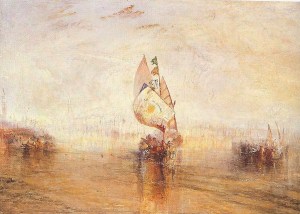
The sail of the fishing boat in Turner’s painting has on it a painted sun
Behind the two boats, off to the left, may be faintly discerned the Doge’s palace, the Campanile and St. Marks, with, according to Ruskin, the Tower of San Giorgio on the far left.
The ships are going south or south eastward in the morning, out past the Isola di San Giorgio towards Lido and the open sea, perhaps into the eye of the sun.
…as in Francis Pope’s poem: “Le Soleil Place en Abin’
….so the effect of Turner’s double triple or quadruple representation of the sun in ‘The Sun of Venice’
…that dazzling diffused white glow over all the western sky. The painting then affirms the painter’s sovereign power to replace the real sun by a painted sun of the same efficacy.
In the foreground of the painting is, like the sun on the sail of the ‘Sun of Venice’, another mock sun. the spectator, like the painter, is an organizing center of seeing and representing but not a source of light.
…a ceaseless coming and going that has no fixed source or stable standing place. This is another example of the relation Foucault calls ‘similitude’ or ‘simulacrum’ as opposed to representation’
Displacement or dis-displacement
mi rai. i……. [?]
Butler and Joll say….
Martin Heuser
What Goethe calls ‘ungraspable’
As mi ra…
mi ra
‘darken me’
Turner’s poem – ‘Fallacies of Hope’
Gray’s ‘The Bard’
…the fate of the Sun of Venice is an emblem of the fall of the Venetian Empire
‘Fair shines the morn, and
Soft the zephyrs blow,
Venezia’s fisher spreads his
Painted sail, so gay,
Nor heed the demon that
…… in grim repose
Expects his evening prey.’
Illumination in darkening
Both will vanish together when the ship is swallowed up by that demon in grim repose.
In the same way Turner himself and all political sovereigns will be swallowed up, as will any spectator of the painting
Trajectory
….justly obliterated for so boldly taking the name and the image of the sun.
The Critic as Illustrator
….this is accountability not so much for the knowledge the reading gives as for what the reading does when it is re-read.
finis
 tomreading
Leave a comment