Being and Time Martin Heidegger

Foreword
Perhaps the most celebrated philosophical work which Germany has produced in this century.
one of the most important philosophical works of modern times.
No other [twentieth century] text, besides the possible exception of
Wittgenstein’s ‘Philosophical Investigations’
has exerted such a profound and enduring influence on the way philosophy is done
Its ambition, the evocativeness and originality of its style
Intentionality
Edmund Husserl
Franz Brentano
Aristotle and the Scholastics
Kant, ‘Critique of Pure Reason’

In virtue of which entities are entities
…then, being in a sense depends on us…
‘transcendental’ philosophy
‘Analytic of Dasein’, an interpretive interrogation of the entity we ourselves are.
Useful for hammering
‘ready-to-hand’ (zubanden).
A human being, a mere object with mental properties added on, but a doer and a sufferer, an agent and a patient, not a what, but a who, not something with extra psychological features in addition but someone living a life, emerging from a history and plunging into a future.
‘Time’, Heidegger tells us, is the ’transcendental horizon for the question of Being’.
A phenomenology of human understanding
The two themes might seem unconnected
Our memories, perceptions, judgements, expectations
‘only as phenomenology, is ontology possible’
To understand why this is so, we need to understand what phenomenology was for Heidegger, and what it had been for his predecessor, and its founder, Husserl.
Consciousness
Consciousness, so construed, is the subject matter of psychology, not phenomenology. Consciousness so understood, in its ‘purity’ and ‘ideality’, is what Husserl calls ‘transcendental subjectivity’
Transcendental
Consciousness in this sense is not my current visual experience or your particular recollection or her belief state, but perception as such, memory as such, and judgement as such. Husserlian phenomenology is thus a description of subjectivity, not of the objective world, but it is emphatically not empirical psychology.
‘essences’ are for Husserl, abstract structures as indifferent to our existence as the truths of geometry are to the existence of tangible figures drawn in sand or on paper to illustrate them. Husserlian phenomenology, then, is the systematic scientific description of the ideal essences belonging to pure, transcendental subjectivity.
Heidegger embraced Husserl’s notion of phenomenology as description.
If we had to define phenomenology as study of appearances, in some sense of that word, we would have to add that the relevant contrast is not between appearance and reality, as it was for Husserl, but between appearance and disappearance – showing up and hiding, revealing and concealing.
Indeed, the fact that things conceal themselves in obscurity and indeterminacy is precisely what makes phenomenology at once possible and necessary.
Phenomenology must instead be ‘hermeneutical’ or interpretive.
A world is not an object standing over against a subject; it is where we live our lives, the milieu in which we dwell.
Existentezphilosophie
The strikingly unexistentialist-sounding claims
As ‘they’ or ‘one’ (das Man)
‘Authentic-Being one’s –Self’ is an ‘existentiell modification of the ‘they’
…of the ‘they’; as an essential existentiale’
‘guile’ (Schuld)
Death (Tod)
Heidegger radically changed our understanding of our place in the world, what a ‘world’ is, what it means to be human, and what it means to think philosophically.
Late modern thought
It is, and will likely remain, as the translators suggest,-
one of the most celebrated works of the Twentieth century.
Taylor Carman New York City March 2008

Translator’s Preface
It has often been called ‘untranslatable’
Heidegger is constantly using words in ways which are by no means ordinary, and a great part of his merit lies in the freshness and penetration which his very innovations reflect.
An elaborate vocabulary of his own
He occasionally coins new expressions from older roots, and he takes full advantage of the ease with which the German language lends itself to the formation of new compounds.
Puns are by no means uncommon
often uses abstract nouns (‘Dasein’, ‘Zeitlichkeit’, ‘Sorge’,’in – der- Welt-sein’, and so forth) as subjects of sentences where a personal subject would ordinarily be found.
Like Aristotle or Wittgenstein, he likes to talk about his words, and seldom makes an innovation without explaining it.
Also uses bracketed expressions to call attention to departures from our usual conventions, or to bring out etymological connections which might otherwise be overlooked.
In general, we have preferred the readings of the eighth edition
Hannah Arendt, J.A. Burzle, C.A. Campbell, G.M. George, Fritz Heider, Edith Kern, Norbert Raymond, Eva Schaper, Martin Scheerer, John Wild.
University of Kansas
University of Kansas Endowment Association for enabling us to work together in Scotland.
Author’s preface
Die Metaphysik
Summer semester of 1935
Frank S. Speck was Frank G. Speck’s son.
Archives file location: PA Box 48.
Being and Time
“For manifestly you have long been aware of what you mean when you use the expression ‘being’.
We, however, who used to think we understood it, have now become perplexed.”
Raise anew the question of the meaning of Being
Reawaken an understanding for the meaning of this question of the meaning of Being and to do so concretely.
Interpretation of time as the possible horizon for any understanding whatsoever of Being.
Call for some introductory remarks.
Plato (footnote)
Introduction
Exposition of the Question of the Meaning of Being
I
The Necessity, Structure, and Priority of the Question of Being
The Necessity for Explicitly Restating the Question of Being
1) First it has been maintained that ’Being’ is the ‘most universal’ concept: “…was einer am Seienden erasst.” (see ftnote p.22).
an understanding of Being is already included in the conceiving anything which one apprehends in entities.
The ‘universality’ of Being ‘transcends’ any universality of genus. In medieval ontology ‘Being’ is designated as a ‘transcendens’.
Aristotle himself knew the unity of multiplicity of the highest generic concepts applicable to things.
In Thomist and Scotist schools, without reaching clarity as to principles.
Hegel at last defines ‘Being’ as the ‘indeterminate immediate’
So it is said that ‘Being’ is the most universal concept, this cannot mean that it is the one which is clearest or that it needs no further discussion. It is rather the darkest of all.
2) It has been maintained secondly that the concept of ‘Being’ is indefinable.
We can infer only that ‘Being’ cannot have the character of an entity. Thus we cannot apply to Being the concept of ‘definition’ as presented in traditional logic…..
The indefinability of Being does not eliminate the question of its meaning; it demands that we look that question in the face.
3) …whenever one comports oneself towards entities, even towards oneself, some use is made of ‘Being’; and this expression is held to be intelligible ‘without further ado’, just as everyone understands ‘the sky is blue’, ‘I am merry’, and the like.
The very fact that we already live in an understanding of Being and that the meaning is still veiled in darkness proves that it is necessary in principle to raise this question again.
It is a dubious procedure to invoke self-evidence, if indeed the ‘self-evident’ (Kant’s covert judgements of the common reason) is to become the sole explicit and abiding theme for one’s analytic – ‘the business of philosophers’.
The Formal Structure of the Question of Being
The question of Being must be formulated.
…the question of Being can be made visible as a very special one with its distinctive character.
‘investigating’ [‘Untersuchen’]
….there lies also that which is to be found out by the asking [das Erfagle]
Intended
Footnote – das eigentlich Intendierte.
The adverb ‘eigentlich’
‘really’
‘intendieren’ is presumably used in the medieval sense of ‘intending’, adapted and modified by Brentano and Husserl.
Its very indefiniteness is itself a positive phenomenon which needs to be clarified.
What kinds of obscuration – or hindrance to an explicit illumination – of the meaning of Being are possible and even inevitable
Even if at first [zunachst] we cannot grasp it at all.
Proximally
In ‘not telling a story’
Essentially different from the way in which entities are discovered.
‘There is’.
This entity which each of us is himself and which includes inquiring as one of the possibilities of its Being, we shall denote by the term ‘Dasein’
This ‘presupposing’ of Being
Footnote – literally ‘Being there’
Laying bare the grounds for it and exhibiting them.
A remarkable ‘relatedness backward or forward’
But indeed something like a priority of Dasein has announced itself.
The Ontological Priority of the Question of Being
But its distinctive features will come fully to light only when we have delimited it adequately with regard to its function, its aim, and its motives.
Does it simply remain – or is it at all – a mere matter for soaring speculation about the most generalities, or is it rather, of all questions, both the most basic and the most concrete?
Being is always the Being of an entity.
To totter
Freshly awakened tendencies to put research on new ‘foundations’
Mathematics, which is seemingly the most rigorous and the most firmly constructed of the sciences, has reached a crisis in its ‘foundations’
Controversy between The formalists and the intuitionists…
The relativity theory arises from this tendency to exhibit interconnectedness of Nature as it is ‘in itself’.
Biology
Historiological
The history of literature is to become the history of problems.
Theology is seeking a more primordial interpretation of man’s Being towards God, prescribed by the meaning of faith itself and remaining within it.
Faith
The basic concepts are drawn, signifies nothing else than an interpretation of those entities with regard to their basic state of Being. Such research must run ahead of the positive sciences, and it can. Here the work of Plato and Aristotle is evidence enough.
Laying the foundations
Kant’s ‘Critique of Pure Reason’
…the ontological task of a genealogy of the different possible ways of ‘Being’.
Footnote – Ontological inquiry is concerned primarily with Being; ontical inquiry is concerned primarily with entities and the facts about them.
The Ontical Priority of the Question of Being
An interconnection of true propositions
In its very Being, that Being is an issue for it.
Understanding of Being is itself a definite character of Dasein’s Being. Dasein is ontically distinctive in that it is ontological.
‘being in such a way that one has an understanding of Being’.
‘Existence’ [Existenz].
‘Dasein’, a term which is purely an expression of its Being [als reiner Seinsausdruck].
To be itself or not itself.
‘existentiell’
‘world’
Within the world
Therefore fundamental ontology, from which alone all other ontologies can take their rise, must be sought in the existential analytic of Dasein.
Thus Dasein has turned out to be, more than any other entity, the one which must first be interrogated ontologically.
Aristotle said, ‘Man’s soul is, in a certain way, entities.’
Parmenides, is one which Thomas Aquinas has taken up in a characteristic discussion.
Thomas is engaged in the task of deriving the ‘transcendentia’

Our demonstration that the question of Being is ontico-ontologically distinctive.
Interrogated
the radicalization of an essential tendency-of-Being which belongs to Dasein itself- the pre-ontological understanding of Being.
II
The Twofold Task in Working out the Question of Being. Method and Design of our Investigation
The Ontological Analytic of Dasein as Laying Bare the Horizon for an Interpretation of the Meaning of Being in General
‘immediately’
‘immediately’
That which is closest: we are it, each of us, we ourselves.
That which is farthest
In terms of the ‘world’
The way the world is understood is, as we shall show, reflected back ontologically upon the way in which Dasein itself gets interpreted.
Remains concealed
Pre-ontologically it is surely not a stranger.
Dasein’s way of behavior, its capacities, powers, possibilities, and vicissitudes, have been studied with varying extent in philosophical psychology, in anthropology, ethics, and ‘political science’, in poetry, biography, and the writings of history, each in a different fashion.
We must rather choose such a way of access and such a kind of interpretation that this entity can show itself [am him selbst von ihm selbst her].
Proximally and for the most part
In its average everydayness
‘philosophical anthropology’
Temporality
But the ground will have to be prepared
Time as its standpoint
The traditional concept of time, which has persisted from Aristotle to Bergson’s thesis that the time one has in mind in this conception is space.
Interpreting Being as such includes working out the Temporality of Being
Being ancient enough for us to conceive the possibilities which the ‘Ancients’ have made ready for us.
Historicality, as a determinate character, is prior to what is called ‘history’ (world-historical historizing).
‘Historicality’
‘historizing’
Dasein simultaneously falls prey to the tradition of which it has more or less explicitly taken hold
This tradition keeps it from providing its own guidance, whether it is inquiring or choosing. This holds true – and by no means least- for that understanding which is rooted in Dasein’s own most Being, and for the possibility of developing it – namely, for ontological understanding.
‘transmits’
That it rather becomes ‘concealed’
Blocks our access to those primordial ‘sources’ ….
Dasein has had its historicality so thoroughly uprooted by tradition that it confines its interest to the multiformity of possible types, directions, and standpoints of philosophical activity in the most exotic and alien of cultures; and by this very interest it seeks to veil the fact that it has no ground of its own to stand on.
In the Middle Ages this uprooted Greek ontology became a fixed body of doctrine.
Footnote
Transmits, ‘delivers over’, ‘handed down to us’
Birth certificate
The first and only person who has gone any stretch of the way towards investigating the dimension of Temporality or has even let himself be drawn hither by the coercion of the phenomena themselves is Kant.
‘this schematization of our understanding as regards appearances and their mere form is an art hidden in the depths of the human soul, the true devices of which are hardly ever to be divined from Nature and laid uncovered before our eyes.’ -Kant
Because of this double effect of tradition the decisive connection between time and the ‘I think’ was shrouded in utter darkness; it did not even become a problem.
In taking over Descartes’ ontological position Kant made an essential omission: he failed to provide an ontology of Dasein.
This omission was a decisive one in the spirit [im Sinne] of Descartes’ ownmost tendencies.
With the ‘cogito sum’ Descartes claimed that he was putting philosophy on a new firm footing. But what he left undetermined when he began in this radical way , was the kind of Being which belongs to the res cogitans, or – more precisely- the meaning of the Being if the ‘sum’.
He regarded this entity as a fundamentum inconcussum
The ‘Present’
This is why the ancient ontology as developed by Plato turns into ‘dialectic’ as the ontological clue gets progressively worked out – namely in the ‘hermeneutic’ of the ‘logos’ – it becomes increasingly possible to grasp the problem of Being in a more radical fashion. The dialectic, which has been a genuine philosophical embarrassment, becomes superfluous.
Aristotle – no longer any understanding of it
That simple awareness of something present-at –hand in its sheer presence-at –hand, which Parmenides had already taken to guide him in his own interpretation of Being – has the Temporal structure of a pure ‘making-present’ of something
They are conceived as presence.
Aristotle’s essay on time

which may be chosen as providing a way of discriminating the basis and the limitations of the ancient science of Being
Every subsequent account of time, including Bergson’s, has been essentially determined by it.
The question of Being does not achieve its true concreteness until we have carried through the process of destroying the ontological tradition.
‘restating’ the question
The phenomenological Method of Investigation
The question of the meaning of Being
Fundamental question of philosophy
Must be treated phenomenologically
The expression ‘phenomenonology’ signifies primarily a methodological conception.
This expression does not characterize the what of the objects of philosophical research as subject-matter, but rather the how of the research.
The things themselves
phenomenology
The term’s two component’s ‘phenomenon’ and ‘logos’
The Concept of Phenomenon
‘to show itself’
That which shows itself in itself, the manifest.
Can be brought to light
Entities
‘seeming’
‘semblance’
The first signification (‘phenomenon as that which shows itself’)
The second significance ( the ‘phenomenon as semblance’)
‘merely look like so-and-so’
What both these terms express has proximally nothing at all to do with what is called an ’appearance’, or still less a ‘mere appearance’
e.g. the ‘symptoms of a disease’ [Krankheitserscheinungen]
an appearance
‘appearance’
‘appear’
‘appears’
‘appearance’ signifies the ‘showing itself’
But this showing itself belongs essentially to the ’wherein’ in which something announces itself. According to this, phenomena are never appearances, though on the other hand every appearance is dependent on phenomena.
If one defines ‘phenomenon’ with the aid of a conception of ‘appearance’ which is still unclear, then everything is stood on its head, and a ‘critique’ of phenomenology on this basis is surely a remarkable undertaking.
Appearance: a double signification appearing as announcing itself, as not ‘showing-itself’; and next, that which does the announcing [das Meldende selbst] – that which in its showing-itself indicates something which does not show itself.
And finally one can use ‘appearing’ as a term for the genuine sense of ‘phenomenon’ as showing –itself.
If one designates these three different things as ‘appearance’, bewilderment is unavoidable.
Emanates
Non-manifest
Never manifest
‘bringing forth’
‘something brought forth’
Something which does not make up the real Being of what brings it forth: in the sense of a ‘mere appearance’
As an emanation of what it announces, it keeps this very thing veiled in itself.
On the other hand, this not-showing itself is not a semblance. Kant: “Appearances are objects of empirical intuition”
An emanation of something which hides itself in that appearance – an emanation which announces.
The variant form of semblance, appearance too can become mere semblance
In a certain kind of lighting someone can look as if his cheeks were flushed with red; and the redness which shows itself can be taken as an announcement of the Being-present-at-hand of a fever, which in turn indicates some disturbance in the organism.
‘Phenomenon’ – the showing itself-in-itself, signifies a distinctive way in which something can be encountered.
‘Appearance’, on the other hand, means a reference-relationship which is an entity itself, and which is such that what does the referring (or the announcing) can fulfill its possible function only if it shows itself in itself and is this a ‘phenomenon’.
Phenomenon: ‘that which shows itself-in-itself’
The formal conception of phenomenon” ‘that which shows itself’
The ordinary conception of phenomenon
Kant
the ‘forms of the intuition’
the ‘phenomena’ of phenomenology
for manifestly space and time must be able to show themselves in this way
if Kant is claiming to make a transcendental assertion grounded in the facts when he says that space is the a priori ‘inside-which’ of an ordering.
In what sense phenomenology can be a science of phenomena at all.
The Concept of the Logos
In Plato and Aristotle the concept of the logos has many competing significations, with no basic signification positively taking the lead.
If we say the basic signification of logos is ‘discourse’
……what is meant by ‘discourse’ itself
‘logos gets translated’ (and this means that it is always getting interpreted) as ‘reason’, ‘judgement’, ‘concept’, ‘definition’, ‘ground’, or ‘relationship’.
‘assertion’
‘assertion as judgement’
Logos as discourse: ‘to make manifest what one is ‘talking about’ in one’s discourse.
Discourse – ‘lets something be seen’…..that is, it lets us see something from the very thing which the discourse is about.
The entities of which one is talking must be taken out of their hiddenness; one must let them be seen as something hidden; that is, they must be discovered.
Similarly, ‘Being false’ amounts to deceiving in the sense of covering up: putting something in front of something (in such a way as to let it be seen) and thereby passing it off as something which it is not.
The Greek words for ‘truth’ are compounded of the privative prefix a (not) and the verbal stem (to escape notice, to be concealed). The truth may thus be looked upon as that which is un-concealed, that which gets discovered or uncovered (‘entdeckt’)
Relation
Relatedness
Relationship
This Interpretation of ‘apaphantical discourse’ may suffice to clarify the primary function of the logos.
The Preliminary Conception of Phenomenology
Thus ‘phenomenology’ means – to let that which shows itself be seen from itself in the very way in which it shows itself from itself.
But here we are expressing nothing else than the maxim formulated above: ‘To the things themselves’
‘phenomenology’, ‘theology’ and the like
To have a science ‘of’ phenomena
Exhibiting of an entity as it shows itself in itself, may be called ‘phenomenology’ with formal justification.
…it is something that lies hidden, in contrast to that which proximally and for the most part does show itself; but at the same time it is something that belongs to what thus shows itself, and it belongs to it so essentially as to constitute its meaning and its ground.
….which shows itself only ‘in disguise’, is not just this entity or that, but rather the Being of entities, as our previous observations have shown.
Only as phenomenology is ontology possible.
Being of entities, its meaning, its modifications and derivatives.
A phenomenon can be covered up in the sense that it is still quite undiscovered. It is neither known nor unknown. Moreover, a phenomenon can be buried over [verschuttet]. This means that it has at some time been discovered but has deteriorated [verfiel] to the point of getting covered up again.
The idea of grasping and explicating phenomena in a way which is ‘original’ and ‘intuitive’ [’originaren’ und ‘intuitiven’] is directly opposed to the naiveté’ of a haphazard, ‘immediate’, and unreflective ‘beholding’. [‘Schauen’].
….while Being is in every case the Being of some entity, we must first bring forward the entities themselves if it is our aim that Being should be laid bare; and we must do it in the right way.
Our point of departure.
With regard to subject matter, phenomenology’s the science of the Being of entities – ontology.
Interpretation
The phenomenology of Dasein is a hermeneutic in the primordial signification of this word, where it designates this business of interpreting.
Being and structure of Being lie beyond every entity and every possible character which an entity may possess.
Being is the transcendens pure and simple.
We may compare the ontological sections of Plato’s ‘Parmenides’

or the fourth chapter of the seventh book of Aristotle’s ‘Metaphysics’

with a narrative section from Thuycydides;
we can then see the altogether unprecedented character of those formulations which were imposed upon the Greeks by their philosophers.
Design of the Treatise
An historilogical interpretation
Two distinct tasks and two parts:
Part One: the Interpretation of Dasein in terms of temporality, and the explication of time as the transcendental horizon for the question of Being.
Part Two: basic features of a phenomenological destruction of the history of ontology, with the problematic of Temporality as our clue.
Part One has three divisions:
The preparatory fundamental analysis of Dasein;
Dasein and temporality
Time and Being
Part Two likewise has three divisions:
Kant’s doctrine of schematism and time, as a preliminary stage in a problematic of Temporality;
The ontological foundation of Descartes’ ‘cogito sum’, and how the medieval ontology has been taken over into the problematic of the ‘res cogitans’
Aristotle’s essay on time, as providing a way of discriminating the phenomenal basis and the limits of ancient ontology.
Part One
The interpretation of Dasein in Terms of Temporality, and the Explication of Time as the Transcendental Horizon for the question of Being
Division One
Preparatory Fundamental Analysis of Dasein
Its existential meaning is care. (chapter 6)
I
Exposition of the Task of a Preparatory Analysis of Dasein67
The Theme of the Analysis of Dasein
We are ourselves the entities to be analyzed.
The ‘essence’ [‘Wesen’] of this entity lies in its ‘to be’ [Zu-sein]
The ‘essence’ of Dasein lies in its existence.
Ways for it to be
So, when we designate this entity with the term ‘Dasein’, we are expressing not its ‘what’ (as if it were a table, house or tree) but its Being.
Because Dasein has in each case mineness [Jemeinigkeit], one must always use a personal pronoun when one addresses it: ‘I am’, ‘you are’.
And because Dasein is in each case essentially its own possibility, it can, in its very Being, choose’ itself and win itself; it can also love itself and never win itself; or only ‘seem’ to do so. But only in so far as it is essentially something which can be authentic – that is, something of its own – can it have lost itself and not yet won itself.
Authenticity and inauthenticity
Characterized by mineness
Rather it is the case that even in its fullest concretion Dasein can be characterized by inauthenticity – when busy, when excited, when interested, when ready for enjoyment.
The priority of ‘existensia’ over ‘essentia’
Mine [die Jemeinigkeit]
The right way of presenting it is so far from self –evident that to determine what form it shall take is itself an essential part of the ontological analytic of this entity.
No matter how provisional our analysis may be, it always requires the assurance that we have started correctly.
Dasein ‘averages’ [Durchschnittlichkeit]
Average everydayness
Passed over
When Augustine asks:
‘but what is closer to me than myself? Assuredly I labour here and I labour within myself; I have become to myself a land of trouble and inordinate sweat.’
‘existentialia’
Sharply distinguished from what we call ‘categories’
In the ontology of the ancients, the entities we encounter within the world are taken as the basic examples for the interpretation of Being.
Nous (or the logos, as the case may be) is accepted as a way of access to them.
Kategorische – blame
This signifies, in the first instance, making a public accusation, taking someone to task for something in the presence of everyone.
The kategorische are what is sighted and what is visible in such a seeing.
Any entity is either a ‘who’ (existence) or a ‘what’ (presence-at-hand in the broadest sense).
The task of laying bare that a priori basis which must be visible before the question of ‘what man is’ can be discussed philosophically. The existential analytic of Dasein comes before any psychology or anthropology, and certainly before any biology. While these too are ways in which Dasein can be investigated, we can define the theme of our analytic with greater precision if we distinguish it from these. And at the same time the necessity of that analytic can this be proved more incisively.
How the Analytic of Dasein is to be distinguished from Anthropology, Psychology, and Biology.
Descartes
‘cogito sum’
‘ego’
He leaves the ’sum’ completely undiscussed
The perennial question of ‘life’
Wilhelm Dilthey, ‘geisteswissenschaftliche Psychologie’

Psychical elements and atoms
‘gestalten’ and ‘life as a whole’
Dilthey and Bergson but in all the ‘personalistic’ movements to which they have given direction and in every tendency towards a philosophical anthropology.
For Scheler, the person is never to be thought of as a Thing or a substance; the person is rather the unity of living-through [Er-lebens] which is immediately experienced in and with our Experiences – not a Thing merely thought of behind and outside what is immediately ‘Experienced’ the person is no Thing like and substantial Being.
The person is not a Thing, not substance, not an object.
‘But an act is never also an object; for it is essential to the Being of acts that they are Experienced only in their performance itself and given in reflection.’
Acts get performed; the person is a performer of acts. What, however, is the ontological meaning of ‘performance’?
‘body’, ‘soul’, and ‘spirit’
Compute
But what stands in the way of the basic question of Dasein’s Being (or leads it off track) is an orientation thoroughly colored by the anthropology of Christianity and the ancient world
Man here is defined as ‘zoon logon echon’ or ‘animal having word’
An animal rationale, something living which has reason.
The second clue for determining the nature of man’s Being and essence is a theological one: ‘And God said, ‘Let us make man in our image, after our likeness.’ Genesis I, 26.
‘faciamus hominem ad imaginem nostrum et similituinem’
These two clues become intertwined in the anthropology of modern times, where the res cogitans, consciousness, and the interconnectedness of Experience serve as the point of departure for methodical study. But since ven the cogitianes are either left ontologically undermined, or get tacitly assumed as something ‘self-evidently’ , ‘given’ whose ‘Being’ is not to be questioned, the decisive ontological foundations of anthropological problematics remain undetermined.
This is no less true of ‘psychology’, who’s anthropological tendencies are today unmistakable.
Biology
Life, in its own right, is a kind of Being; but essentially it is accessible only in Dasein.
……they are always ‘there’ already, even when that empirical material simply gets collected.
The Essential Analytic and the Interpretation of Primitive Dasein. The Difficulties of Achieving a ‘Natural Conception of the World’
Everydayness does not coincide with primitiveness, but is rather a mode of Dasein’s Being, even when that Dasein is active in a highly developed and differentiated culture – and precisely then.
To orient the analysis of Dasein towards the ‘life of primitive peoples’ can have the positive significance [Bedeutung] as a method because ‘primitive phenomena’ are often less concealed and complicated by extensive self-interpretation on the part of the Dasein in question.
Ethnology
A desideratum which philosophy has long found disturbing but has continually refused to achieve: to work out the idea of a ‘natural conception of the world’. The rich store of information now available as to the most exotic and manifold cultures and forms of Dasein seems favourable to our setting about this task in a fruitful way.
We shall get genuine knowledge of essences simply by the syncretistic activity of universal comparison and classification.
And if the ‘world’ itself is something constitutive for Dasein, one must have an insight into Dasein’s basic structures in order to treat the world-phenomenon conceptually.
It has a goal of its own, if indeed, beyond the acquiring of information about entities, the question of Being is the spur for all scientific seeking.
II
Being-in-the-World in General as the Basic State of Dasein
12. A Preliminary Sketch of Being-in –the –World, In terms of an Orientation towards Being-in as such.
Dasein is an entity which in each case I myself am. Mineness belongs to any existent Dasein and belongs to it as the condition which makes authenticity and inauthenticity possible. In each case Dasein exists in one or the other of these two modes, or else it is modally undifferentiated
‘Being-in-the-World’
A unitary phenomenon.
‘in-the-world’
The ontological structure of the ‘world’ and defining the idea of worldhood as such.
Here we are seeking that which one inquiries into when one asks the question ‘Who?’ By a phenomenological demonstration we shall determine who is in the mode of Dasein’s average everydayness.
Third, Being-in [in-sein] as such. We must set forth the ontological Constitution of ‘inhood’ [Inheit] itself.
The water is ‘in’ the glass, or the garment is ‘in’ the cupboard.
With regard to their location in space
This relationship of Being can be expanded: for instance the bench is in the lecture room, the lecture room is in the university, the university is in the city, and so on until we can say that the bench is ‘in world-space’.
‘categorical’: they are of such a sort as to belong to entities whose kind of Being is not of the character of Dasein.
Being-in, on the other hand, is a state of Dasein’s Being; it is an existentiale.
‘ich bin’ [I am] means in its turn ‘I reside’ or ‘dwell alongside’ the world, as that which is familiar to me in such and such a way.
‘being alongside’ the world in the sense of being absorbed in the world (a sense which calls for still closer interpretation) is an existentiale founded upon Being-in.
This Being –alongside’ must be examined still more closely. Choose
‘the table stands ‘by’ [bei’] the door or “the chair ‘touches’ [beruhrt] the wall’.
We shall translate ‘aufgehen’ by some form of ‘absorb’
‘be’ ‘alongside’
Dasein understands its ownmost Being in the sense of a certain factual Being present-at-hand.
Dasein’s ‘facticity’
Some such spiritual Thing along with a corporeal Thing.
‘metaphysically’
The multiplicity of these is indicated by the following examples: having to do with something, producing something, attending to something and looking after it, making use of something, giving something up and letting it go, undertaking, accomplishing, evincing, interrogating, considering, discussing, determining….All these ways of Being-in have concern as their kind of Being – a kind of Being which we have yet to characterize in detail
Leaving undone, neglecting, renouncing, taking a rest – these too are ways of concern; but these are all deficient modes, in which the possibilities of concern are kept to a ‘bare minimum’
‘provide oneself with something’
The expression ‘concern’
This term has been chosen not because Dasein happens to be proximally and to a large extent ‘practical’ and economic, or because the Being of Dasein itself is to be made visible as care.
Being-in-the-world belongs essentially to Dasein, its Being towards the world [Sein zur Welt] is essentially concern.
Taking up relationships towards the world is possible only because Dasein, as Being-in-the-world, is as it is.
‘having an environment’
von Baer
Ontically as well as ontologically
Familiar [bekannt]
‘soul’s relationship to the world
Knowing the world – or rather addressing oneself to the world and discussing it
As a relationship between one entity (the world) and another (the soul), ….invisible
Subject- Object-relationship
Knowing the world
Epistemology
As an existential modality of Being-in.
An entity called ‘Nature’…
In which knowing is proximally enclosed, or when one enquires how this ‘being inside [‘Innenseins’]…
The phenomenon of knowing is a mode of Being of Dasein as Being-in-the-world, a
Knowing is a kind of Being which belongs to Being-in-the-world
The constructivist ‘standpoint’
Being-in-the-world, as concern, is fascinated by the world with which it is concerned.
In this kind of ‘dwelling’ as a holding-oneself-back from any manipulation or utilization, the perception of the present-at-hand is consummated.
Interpretation
Of making determinate
This perceptive retention of an assertion about something is itself a way of Being-in-the –world…..
‘Being-outside’ alongside the object, Dasein is still ‘inside’, if we understand this in the correct sense; that is to say, it is itself ‘inside’ as a Being-in-the-world’ which knows
– ‘Aufenthalt’ as used here, and are hardly suggested by our ‘dwelling’
Even the forgetting of something, in which every relationship of being towards what one formerly knew has seemingly been obliterated must be conceived as a modification of the primordial Being-in; and this holds for every delusion and for every error.
Knowing is a mode of Dasein founded upon Being-in-the-world. Thus Being –in-the-world, as a basic state, must be Interpreted beforehand.
III
The Worldliness of the World
The idea of the Worldhood of the World in General
what can be meant by describing ‘the world’ as a phenomenon?
To enumerate the things that are ‘in’ the world
House, trees, people, mountains, stars.
That which shows itself as Being and as a structure of Being.
Now the entities within the world are Things – Things of Nature, and Things ‘invested with value’ [‘wertbehaftete’ Dinge].
The Being of Nature
Nature is itself an entity which is encountered within the world and which can be discovered in various ways and various stages.
Should we then first attach ourselves to those entities with which Dasein proximally and for the most part dwells – Things ‘invested with value’?
‘Worldhood’
Thus worldhood itself is an existentiale.
This discussion of the word ‘world’
‘World’ is used as an ontical concept, and signifies the totality of these entities which can be present-at-hand within the world.
‘World’ functions as an ontological term, and signifies the Being of those entities which we have just mentioned. And indeed ‘world’ can become a term for any realm which encompasses a multiplicity of entities: for instance, when one talks of the ‘world’ of a mathematician, ‘world’ signifies the realm of the possible objects of mathematics.
‘World’ can be understood in another ontical sense – not, however, as those entities which Dasein as such can be said to ‘live’. ‘World’ has here a pre-ontological existentiell signification. Here again there are different possibilities: ‘world’ may stand for the public ‘we-world, or one’s own’ closest (domestic) environment.
Finally, ‘world’ designates the ontological-existential concept of worldhood. Worldhood itself may have as its modes whatever structural wholes any special ‘worlds’ may have at the time; but it embraces in itself the a priori character of worldhood in general. We shall reserve the expression ‘world’ as a term for our third signification. If we should sometimes use it in the first of these senses, we shall mark this with single quotation marks.
The derivative form ‘worldly’ will then apply terminologically to a kind of Being which belongs to Dasein, never to a kind which belongs to entities present-at-hand ‘in’ the world.
Only in some definite mode of its own Being-in-the-world can Dasein discover entities as Nature.
But even the phenomenon of ‘Nature’, as it is conceived, for instance, in romanticism, can be grasped ontologicalically only in terms of the concept of the world – that is to say, in terms of the analytic of Dasein.
Point of departure [Ausgang]
That world of everyday Dasein which is closest to it, is the environment.
Course [Gang]
In Descartes we find the most extreme tendency towards such an ontology of the ‘world’, with, indeed, a counter-orientation towards the res cogitans – which does not coincide with Dasein either ontically or ontologically.
Our analysis will be completed in three stages: (A) the analysis of environmentality and worldhood in general; (B) an illustrative contrast between our analysis of worldhood and Descartes ontology of the ‘world’; (C) the aroundness [das Umhafte] of the environment, and the ‘spatiality’ of Dasein.
Analysis of Environmentality and Worldhood in General
The Being of the Entities Encountered in the Environment
‘dealings’ in the world
To assure the kind of seeing which is here required, we must first make a remark about method.
As phenomenological, looks primarily towards Being, and which, in thus taking Being as its theme, takes these entities as its accompanying theme: ‘Umgang’ a ‘going around’ or ‘going about’
‘dealings’ is by no means an accurate translation, but is perhaps as convenient as any. ‘Intercourse’ and ‘trafficking’ are also possible translations.
This is the way in which everday Dasein always is: when I open the door, for instance, I use the latch.
One may answer: ‘Things’.
Thinghood and Reality.
Being as substantiality, materiality, extendedness, side-by-side-ness, and so forth.
Proximally hidden.
What one really has in mind remains undetermined. But suppose one characterizes these ‘Things’ as Things ‘invested with value’? what does value mean ontologically?
How are we to categorize this ‘investing’?
And ‘Being-invested’?
The Greeks had an appropriate term for ‘Things’: ‘pragmata’
One’s concernful dealings – ‘praxis’
But ontologically, the specifically ‘pragmatic ‘character of the ‘pragmata’ is just what the Greeks left in obscurity; they thought of these proximally as ‘mere Things’. We shall call these entities which we encounter in concern ‘equipment’. In our dealings we come across equipment for writing, sewing, working, transportation, measurement. The kind of Being which equipment possesses must be exhibited. The clue for doing this lies in our first defining what makes an item of equipment – namely, its equipmentality.
Equipment is essentially ‘something in –order-to….’ [etwas um-zu…’]. A totality of equipment is constituted by various ways of the in-order-to’, such as serviceability, conduciveness, usability, manipulability.
In the ‘in-order-to’ as a structure there lies an assignment or reference of something to something.
The phenomenon of this term ‘assignment’
Its ontological genesis
Ink –stand, pen, ink, paper, blotting pad, table, lamp, furniture, windows, doors, room.
Ftn:
‘das Zeug’ the word ‘Zeug’ has no precise English equivalent
Instrument or tool
Heidegger uses it for the most part as a collective noun analogous to our relatively specific ‘gear’ (as in gear for fishing)
Paraphernalia
Equipment, which we shall employ throughout this translation
Um-zu ‘liegt eine Verweisung’
Verweisung’
That of turning something away from something else or pointing it away.
….or even assigns equipment to a purpose for which it is to be used.
Verweisung thus does some of the work of ‘reference’, ‘commitment’, assignment’, ‘relegation’, ‘banishment’; but it does not do all the work of any of these expressions.
‘assign’ and ‘refer’
Whichever seems more appropriate in the context.
Hammering with a hammer, for example.
‘in-order-to’ which is constitutive for the equipment we are employing at the time; the less we just stare at the hammer-Thing, and the more we seize hold of it and use it, the more primordial does our relationship to it become, and the more unveiledly is it encountered as that which it is – as equipment.
‘Being-in-itself’
And the sight with which they thus accommodate themselves is circumspection.
‘practical’ behavior is not ‘atheoretical’ in the sense off ‘sightlessness’
Theoretical behavior is just looking, without circumspection
Form of method
On the contrary, that which we concern ourselves primarily is the work – that which is to be produced at the time; and this is accordingly ready-to-hand too. The work bears with it that referential totality within which the equipment is encountered.
Ftn: Heidegger is pointing out that this is not what we have in mind in the traditional contrast between the ‘theoretical’ and the ‘practical’.
The production itself is a using of something for something
…leather, thread, needles, and the like. Leather, moreover is produced from hides. These are taken from animals, which someone else has raised. Animals also occur within the world without having been raised at all; and in a way, these entities still produce themselves even when they have been raised.
Hammer, tongs, and needle, refer in themselves to steel, iron, metal, mineral, wood, in that they consist of these.
The ‘Nature’ we find in natural products.
A work with which one concerns oneself is ready-to-hand not only in the domestic world of the workshop but also in the public world. Along with the public world, the environing Nature [die [Umweltnatur] is discovered and is accessible to everyone. In roads, streets, bridges, buildings, our concern discovers Nature as having weather; an installation for public lighting takes account of the darkness, or rather of specific changes in the absence of daylight – the ‘position of the sun’. In a clock, account is taken of some definite constellation in the world-system.
When we make use of the clock-equipment, which is proximally and inconspicuously ready-to-hand, the environing Nature is ready-to-hand along with it.
….which we have exhibited as a founded mode of Being-in-the-world. To lay bare what is just present-at-hand and no more, cognition must first penetrate beyond what is ready –to-hand I our concern. Readiness-to-hand is the way which entities as they are ‘in themselves’ are defined ontolico-categorially.
Even if we join them together, we still do not bet anything like the ‘world’ as their sum if, then, we start with the Being of these entities, is there any avenue that will lead us to exhibiting the phenomenon of the world.
How the Worldly Character of the Environment Announces itself in Entities Within the World
But in that way ‘is there’ a world?
Then does not Dasein have an understanding of the world – a pre-ontological understanding which indeed can and does get along without explicit ontological insights?
In a certain way, lit up for it
Thus discovered, equipment becomes conspicuous
Conspicuousness
We also find things which are missing – which not only are not ‘handy’ [‘hanlich’] but are not ‘to hand’ [‘zur Hand’] at all
Obtrusiveness
‘stands in the way’ of our concern
For which it has ‘no time’
Obstinacy ‘calls for our attending to it.
Such equipment still does not veil itself in the guise of mere Things. It becomes ‘equipment’ in the sense of something which one would like to shove out of the way.
….how far does this clarify the phenomenon of the world?
‘Disclose’ and ‘disclosedness’ will be used as technical terms in the passages that follow, and shall signify ‘to lay open’ and ‘the character of having been laid open.’ Thus ‘to disclose’ never means anything like ‘to obtain indirectly by inference. ‘If it is to be possible for the ready-to-hand not to emerge from is inconspicuousness, the world must not announce itself. And it is in this last that Being-in-itself of entities which are ready-to-hand has its phenomenal structure constituted
In such privative expressions as ‘inconspicuousness’, ‘unobtrusiveness’, and ‘non-obstinacy’
This is what we have our eye upon in the ‘Being in-itself’ of something
But if the world in a way, be lit up, it must assuredly be disclosed
What is it that Dasein is familiar with?
Why can the worldly character of what is within-the-world be lit up? The presence-at-hand…
To answer them we must analyses these structures more concretely.
Reference and Signs
May be laid bare
We shall take as our point of departure the Being of the ready-to-hand, but this time with the purpose of grasping the phenomenon of reference or assignment itself more precisely. We shall accordingly attempt tan ontological analysis of a kind of equipment in which one may come across such ‘references’ in more senses than one. We come across ‘equipment’ in signs.
Being –a –sign for can itself be formalized as a universal kind of relation, so that the sign-structure itself provides an ontological clue characterizing any entity whatsoever, showing or indicating
Such sign in signposts, boundary-stones, the ball for the mariner’s storm-warning, signals, banners, signs of mourning, and the like.
Indicating can be defined as a kind of referring
A relating
Among signs there are symptoms [Anzeichen], warning signals, signs of things that have happened already [Ruckzeichen], signs to mark something, signs by which thins are recognized; these have different ways of indicating, regardless of what may be serving as such a sign. From such signs we must distinguish traces, residues, commemorative, monuments, documents, testimony, symbols, expressions, appearances, significations.
Motor cars are sometimes fitted up with an adjustable red arrow, whose position indicates the direction the vehicle will take – at an intersection, for instance. The position of the arrow is controlled by the driver.
This sign ready-to-hand within-the-world in the whole equipment –context of vehicles and traffic regulations.
It is for indicating
A kind of referring
‘Towards-which’ [und bestimmt ein Zeug zu diesem].
Indicating [Zeig-zeug]
‘to give away’ or to ‘stand still’ vis a vis the car with the arrow.
This circumspective survey does not grasp the ready-to-hand; what it achieves is rather an orientation within our environment.
A sign is not a Thing which stands to another Thing in the relationship of indicating; it is rather an item of equipment which explicitly raises a totality of equipment into our circumspection so that together with it’s the worldly character of the ready-to-hand announces itself in a symptom or warning-signal, ‘what is coming’ indicates itself’, but not in the sense of something merely occurring, which comes as an addition to what is already present-at –hand; ‘what is coming’ is the sort of thing which we are ready for , or which we weren’t ready for’ if we have been attending to something else.
Possesses
The ’work’ of letting something ready-to-hand become conspicuous
Signs also arise when one takes as a sign [Zun-Zeichen-nehmen] something that is ready-to-hand already.
If, for instance the south wind ‘is accepted’ [‘gilt’] by the farmer as a sign of rain.
One might be tempted to cite the abundant use of signs’ in the primitive Dasein, as in fetishism ad magic, to illustrate the remarkable role which they play in everyday concern when it comes to our understanding of the world.
For primitive man, the sign coincides with that which is indicated. Not only can the sign represent this in the sense of serving as a substitute for what it indicates, but it can do so in such a way that the sign itself always is what it indicates.
It is all the more urgent to work out the formal’ idea of worldhood – or at least the idea of the phenomenon….in terms of what it is not.
The relation between sign and reference is threefold:
1) Indicating, as a way whereby the ’towards-which’ of a serviceability can become concrete, is founded upon the equipment-structure as such, upon the ‘in-order-to’ (assignment).
2) The indicating which the sign does is an equipmental character of something ready-to-hand, and as such it belongs to a totality of equipment, to a context of assignments or references.
3) The sign is not only ready-to-hand with other equipment, but in each case explicitly accessible for circumspection. A sign is something ontically ready-to-hand, which functions both as this definite equipment and as something indicative of [was…anzeigt] the ontological structure of readiness-to-hand, of referential totalities, and of worldhood.
Involvement and Significance; the Worldhood of the World
– In anything ready-to-hand the world is always ‘there’
Encountered
Been freed for our concernful circumspection
As definite kinds of reference we have mentioned serviceability –for-detrimentality [Abtraglichkeit], usability, and the like.
-Appropriate or inappropriate.
The character of having been assigned or referred [Verwiesenheit]. An entity is discovered when it has been assigned or referred to something, and referred as that entity which it is. With any such entity there is an involvement which it has in something.
An involvement
Involvement
To be involved in something
The relationship of the ‘with…in…’ shall be indicated by the term ‘assignment’ or ‘reference’.
The words ‘property’ and ‘appropriateness’ reflect the etymological connection of Heidegger’s ‘Eigenschaft’ and ‘Geeignetheit’]
‘es hat mit ihm bei etwas sein Bewenden’
‘es dabei bewenden lassen’ – ‘to leave it at that, to let it go at that, to let it rest there; ‘und dabei hatte es sein Bewenden’ – ‘and there the matter ended; ‘dabai muss es sein Bewenden haben’ – ‘there the matter must rest’ – ‘that must suffice’; ‘die Sachen hat eine gaz andere Bewandtnis’ – ‘the case is quite different’; ‘damit hat es seine besondere Bewandtnis’ – ‘there is something peculiar about it; thereby hangs a tale’; ‘damit hat est folgende Bewandtnis’ – ‘the matter is as follows’.
‘Involve’ or ‘involvement’
‘What it is up to’ or ‘what it is doing’, not a person’s involvement in circumstances in which he is ‘caught’ or ‘entangled’
In Bewandtnis legit: bewenden lassen mit etwas bei etwas. Der Bezug des ‘mit…bei…’
Letting something ‘be’
In this totality of involvements which has been discovered beforehand, there lurks an ontological relationship to the world. Signifying
Dasein ’signifies’ to itself
‘significance’
Submission
…lurks…
The Being of those entities within-the-world which we proximally encounter – readiness-to-hand;
The Being of those entities which we can come across and whose nature we can determine if we discover them in their own right by going through the entities proximally encountered –presence-at-hand;
The Being of that ontical condition which makes it possible for entities within-the-world to be discovered at all – the worldhood of the world.
The third kind of Being gives an existential way of determining the nature of Being-in-the –world, that is of Dasein.
The other two concepts of Being are ‘categories, and pertain to entities whose Being is not the kind which Dasein possesses.
The phenomenal content of these:
‘Relations’ and ‘Relata’
‘System of Relations’
B. A Contrast between our Analysis of Worldhood and Descartes’ Interpretation of the World
Present briefly the basic features of Descartes ontology of the ‘world’
The extension
Extension
The Cartesian ontology of the ‘world’ will provide us likewise with a negative support for a positive explication of the spatiality of the environment and of Dasein itself. With regard to Descartes ontology there are three topics which we shall treat:
The definition of the ‘world’ as res extensa (section 19);
The foundations of this ontological definition (section 20);
A hermeneutical discussion of the Cartesian ontology of the ‘world’
The Definition of the ‘World’ as res extensa.
Descartes distinguishes the ‘ego cogito’ from the ‘res corporea’.
‘Nature’ and ‘Spirit’
Substantial
Substance, substantiality
A substance
20. Foundations of the Ontological Definition of the ‘World’
We still consider creation and creator alike as entities.
Res extensa
The Schoolmen
…even the ontology of the medievals has gone no further than that of the ancients in inquiring into what ‘Being’ itself may mean.
‘Being is not a Real predicate’, says Kant….
Must venture forward into the most primordial problematic of the things themselves to get such ‘nuances’ straightened out.
Hermeneutical Discussion of the Cartesian Ontology of the World
Descartes
Mathematics
Mathematical knowledge
Modern mathematical physics and it transcendental foundation
‘beholding’ in the widest sense
Or thinking’ is just a more fully achieved from of [Greek] and is founded upon it.
Doxographically
In his doctrine of the res cogitans and the res extensa, Descartes not only wants to formulate the problem of ‘I’ and the world’; he claims to have solved it in a radical manner.
Descartes, ‘Meditations’
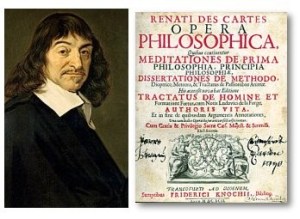
makes this plain (see especially Meditation I and VI)
This stratification
Entities
Descartes has narrowed down the question of the world to that of ‘Things of Nature’ [Naturdinglichkeit] as those entities within-the-world which are proximally accessible.
When our analytic of Dasein has given some transparency to those main structures of Dasein which are of the most importance in the framework of this problematic, and when we have assigned [zugeweisen] to the concept of Being in general the horizon within which its intelligibility becomes possible, so that readiness-to-hand and presence –at-hand also become primordially intelligible ontologically for the first time, only then can our critique of the Cartesian ontology of the world (an ontology which, in principle, is still the usual one today) come philosophically into its own. To do this, we must show several things. (See part One, Division Three).
Why was the phenomenon of the world passed over at the beginning of the ontological tradition which has been decisive for us (explicitly in the case of Parmenides), and why has this passing-over kept constantly recurring?
Why is it that, instead of the phenomenon thus passed over, entities within-the-world have intervened as an ontological theme?
Why are these entities found in the first instance of ‘Nature’?
Why has recourse been taken to the phenomenon of value when it has seemed necessary to round out such an ontology of the world?
The problematic of the world
Spatiality
Extension as praesupposition
Extension
To provide an explicit interpretation for the Being of extended entities.
The Aroundness of the Environment and Dasein’s Spatiality
The spatiality of the ready-to-hand within-the –world (section 22)
The spatiality of Being-in-the-world (section 23):
Space and spatiality of Dasein (Section 24)
The Spatiality of the Ready-to-hand Within –the –world
We have been talking about what is proximally ready—to-hand
Those which are close by.
This closeness regulates itself in terms of circumspectively ‘calculative’ manipulating and using.
Given directionality.
Equipment has its place [Platz]
An item of equipment which belongs somewhere.
This ‘whither’
We call the ‘region’
The kind of place which is constituted by direction and remoteness (and closeness is only a mode of the latter).
Thus the sun whose light and warmth are in everyday use, has its own places –sunrise, midday, sunset, midnight; these are discovered in circumspection and treated distinctively in terms of changes in the usability of what the sun bestows.
‘Indicators’ of the regions which lie in them.
These ‘celestial regions, which need not have any geographical meaning as yet, provide the ‘whither’ beforehand for every special way of giving form to the regions which places can occupy.
Character of inconspicuous familiarity
Dasein itself is ‘spatial’ with regard to its Being-in-the-world.
The Spatiality of Being in-the-world
Being in space
But its spatiality shows the characters of de-severance and directionality
Ftn:
It is as if by the very act of recognizing the ‘remoteness’ of something, we have in a sense brought it closer and made it less ‘remote’
We use the expression ‘deseverence’ in a signification which is both active and transitive
‘de-severing’ amounts to making the farness vanish – that is, making the remoteness of something disappear, bringing it close. Dasein is essentially de-severent: it lets any entity be encountered close by as the entity which it is. De-severance discovers remoteness; and remoteness, like distance, is a determinate categorical characteristic of entities whose nature is not that of Dasein. De-severance, however is an existential; this must be kept in mind.
ftn: ‘entfernen’
‘dissever’ comes the nearest
‘remoteness’
‘deseverence’
In Dasein there lies an essential tendency towards closeness.
With the ‘radio’ for example, Dasein has so expanded its everyday environment that it has accomplished a de-severance of the ‘world’ – a de-severance which, in its meaning for Dasein, cannot yet be visualized.
Above all remoteness never gets taken as a distance.
We say that to go over yonder is ’a good walk’, ‘a stone’s throw’, or ‘as long as it takes to smoke a pipe’.
A duration [Dauer]
That ‘coming before us’
The circumspective de-severing of Dasein’s everydayness reveals the Being-in-itself of the ‘true world’ – if that entity which Dasein, as something existing, is already alongside.
When for instance a man wears a pair of spectacles which are so close so him distantially that they are ‘sitting on his nose’, they are environmentally more remote from him than the picture on the opposite wall.
As Being-in-the-world, Dasein maintains itself essentially in a desevering. This de-severance – the farness of the ready-to-hand from Dasein itself o is something that Dasein can never cross over.
Dasein is essentially de-severance –that is, it is spatial.
As de-severance Being-in, Dasein has likewise the character of directionality. Every bringing-close [Naherung].
Out of this directionality arise the fixed directions of right and left…
A craftsman’s tools
….manual’ [‘handliche’] movements. So although hammers are handles just as mush with the hand as gloves are, there are no right-or left-handed hammers.
Even Kant, of course, has not taken orientation as a theme for Interpretation.
The prerequisites for working out the phenomenon of the wealth spatiality and formulating the ontological problem of space.
To free a totality of involvements is, equiprimordially, to let some thing be involved at a region, and to do so by de-severing and giving directionality; this amounts to freeing the spatial belonging-somewhere of the ready –to-hand. In that significance with which Dasein (as concernful Being-in) is familiar, lies the essential co-disclosedness of space.
Having been placed
Articulates the ‘hither and ‘thither’ within the possible ‘whither’.
Having form and direction.
‘give them space’
‘making room’ for them
Space is not in the subject, nor is the world in space. Space is rather ‘in’ the world in so far as space has been disclosed by that Being-in-the-world which is constitutive for Dasein…..
Space shows itself as a priori
Here ‘apriority’ means the previousness with which space has been encountered (as a region) whenever the ready-to-hand is encountered environmentally.
Neutralized to pure dimensions
Reduced to a multiplicity of positions for random Things. The ‘world’….becomes ‘spatialized’ [verraumlicht] to a context of extended Things…
The …Space of Nature…..discovered in such a way that the worldly character of the ready-to-hand gets specifically deprived of its worldhood.
The problematic of the Being of space….in such a direction to clarify the possibilities of Being in general
The phenomenon of space indeed space is one of the things that is constituted for the world, just as Dasein’s own spatiality is essential to its basic state of Being-in-the world.
IV
Being –In-The-World as Being-With and Being-One’s – Self. The “They”.
Being-in –the world
Proximally and for the most part Dasein is fascinated with its world. Dasein is thus absorbed in the world….
Who is it that Dasein is in its everydayness?
To do so existentially
Being-with and Dasein-with [Mitstein und Mitdasein]
Being-one’s Self [Selbststein]
What we may call the ‘subject’ of everydayness – the ‘they’
An approach to the existential question of the ‘who’ of Dasein (section 25);
The Dasein –with-of Others, and everyday Being-with (Section 26);
Everyday Being-one’s Self and the ‘they’ (section 27)
25. An Approach to the Existential Question of the ‘Who’ of Dasein
Dasein is an entity which is in each case I myself; its Being is in each case mine. This definition indicates an ontologically constitutive state but it does no more than indicate it.
The ‘Self’
It could be that the ‘who’ of everyday Dasein just is not the ‘I myself’
Ontico-ontological assertion
The phenomena in terms of the kind of Being which the entities themselves possess….
…ways of formulating problems…
The phenomenological Interpretation of Dasein…
When we come to the question we are about to formulate.
the Being of other ‘I’s’
a ‘formal phenomenology of consciousness’
the ‘I’
If it discloses Dasein at all
The ‘I’ of actions.
The ‘giving-itself’ on the part of Dasein
‘I am this entity’ ….and in the long run says this loudest when it is ‘not’ this entity.
Dasein is in each case mine…but what if this should be the very reason why. Proximally and for the most part, Dasein is ‘not itself’.
A pitfall
By mere ‘giving’
The ‘not-I’….an entity which essentially lacks ‘I-hood’ [‘Ichheit’}…such as having lost itself’ [ Selbstverlorenheit’]
An isolated ‘I’ without Others is just as far from being proximally given.
Led astray
Even optically it remains concealed
Clues?
The one according to which Dasein’s ‘Essence’ is grounded in its existence.
If the ‘I’ is an Essential characteristic of Dasein, then it is one which must be Interpreted existentially.
Dasein is itself only in ‘existing’ – then the constancy of the Self no less than the possibility of its ‘failure to stand by itself’ requires that we formulate the question existentially and ontologically as the sole appropriate way of access to the problematic.
…man’s substance is not spirit as a synthesis of soul and body; it is rather ‘existence’
26. The Dasein-with of Others and Everyday Being-with
-the question of the ‘who’
The work-world of the craftsman
The equipment to be found
Those Others for whom the ‘work’ [werk’] is destined are ‘encountered too’
‘Involvement’ possible ‘wearers’ i.e. – for whom it should be ‘cut to the figure’.
When material is put to use, we encounter its producer or ‘supplier’ as one who ‘serves’ well or badly.
The field i.e belongs to and is kept up by him
The book was bought at so and so’s shop and given by such and such a person, and so forth.
The boat anchored at the shore is assigned in its Being-in-itself to an acquaintance who undertakes voyages with it; but even if it is a ‘boat which is strange to us’, it still is indicative of Others.
The ‘Others who are thus encountered’ in a ready-to-hand, environmental context of equipment, are not somehow added on in thought to some Thing which is proximally just present-at-hand; such ‘Things’ are encountered from out of the world in which they are ready-to-hand for Others – a world which is always mine too in advance.
….one would have to say that Dasein too is ‘world’
‘the Others’
Those from whom, for the most part, one does not distinguish oneself – those among whom one is too. This Being-there-too [Auch-da-sein]
The ‘too’ means a sameness of Being as circumspectively concernful Being-in-the-world.
By reason of this ‘with-like’ [mithaften] Being –in-the –world, the world is always the one that I share with Others.
The world of Dasein is a with-world [Mitwelt]
Being-in is Being-with Others.
Their Being-in-themselves with the world is Dasein-with [mit-dasein]
Out of the world
Environmentally
What it does, uses, expects, avoids – in those things environmentally ready-to-hand with which it is proximally concerned
An even when Dasein explicitly addresses itself as ‘I here’, this locative personal designation must be understood in terms of Dasein’s existential spatiality.
Authentically spatial
As ‘Being-alongside’ the world with which it concerns itself, and as Being-alongside it spatially
Even if we see the Other ‘just standing around’, he is never apprehended as a human-Thing present-at-hand, but his ‘standing-around’ is an existential mode of Being – an unconcerned, uncircumspective tarryng alongside everything and nothing [Verweilen bei Allem und Keinem]. The Other is encountered in his Dasein-with in the world.
They are there with us.
It must be interpreted in terms of the phenomenon of care
Solicitude [Fursorge]
Leap in
Leap ahead
Authentically bound together
That which leaps in and dominates, and that which leaps forth and liberates [vorspringend-befreienden]. It brings numerous mixed forms to maturity; to describe these and classify them would take us beyond the limits of this investigation.
Considerateness
Forbearance
Inconsiderateness
That Being for the sake of which Dasein itself is as it is.
Thus as Being-with, Dasein ‘is’ essentially for the sake of Others
Knowing oneself [Sichkennen] is grounded in Being-with, which understands primordially.
Indifferent modes
Aloofness, hiding oneself away, or putting on a disguise.
The theoretical problematic of understanding the ‘psychical life of Others’ [‘’fremden Seelenbens’]
Primordially and ‘in the beginning’
‘empathy’ [Einfuhling’]
The relationship-of-Being which one has towards Others would then become a Projection of one’s own Being-towards-oneself ‘into something else’. The Other would be a duplicate of the Self.
Little ground to stand on.
Fails to hold
One may still be puzzled as to how Dasein’s relationship to itself is thus to be disclosed to the Other as Other.
Autonomous
Already is
‘empathy’
The possibility of understanding the stranger correctly presupposes such a hermeneutic as its positive existential condition.
Treated merely as ‘numerals’
This inconsiderate’ Being –with ‘reckons’ [‘rechnet’] with the Others without seriously ‘counting on them’ [‘auf sie zahit’], or without even wanting to ‘have anything to do’ with them.
27. EverydayBeing-one’s-Self and the ‘They’
In that which we concern ourselves environmentally the Others are encountered as what they are; they are what they do [sie sind das, was sie betreiben] distantiality [ Abstandigkeit]
‘are there’
The ‘who’ is the neuter, the ‘they’ [das Man]
In utilizing public means of transport and in making use of information services such as newspaper, every Other is like the next.
The real dictatorship of the ’they’ is unfolded.
‘distantiality’ averageness, which is an existential characteristic of the ‘they’. The ‘they’
The ‘levelling down’ [Einebnung] of all possibilities of Being. Distantiality, averageness, and levelling down, as ways of Being for the ‘they’, constitute what we know as ‘publicness’ [‘die Offentlichkeit’]
It is always right
…because it is insensitive to every difference of level and of genuineness and thus never gets to the ‘heart of the matter’ [‘auf die Sachen’]. By publicness everything gets obscured, and what has thus been covered up gets passed off as something familiar and accessible to everyone.
The ‘they’, as the ‘nobody’, is by no means nothing at all.
The ‘they’ is an existentiale; and as a primordial phenomenon, it belongs to Dasein’s positive constitution.
The very state of Being, in its everyday kind of Being, is what proximally misses itself and covers itself up.
Authentic Being-one’s Self does not rest upon an exceptional condition of the subject, a condition that has been detached from the ‘they’; it is rather an existentiell modification of the ‘they’ – of the ‘they’ as an essential existentiale.
A gap
V
Being-In as Such
The task of a Thematic Analysis of Being-In
The unitary primordial structure of Dasein’s Being, in terms of which its possibilities and the ways for it ‘to be’ are ontologically determined.
The ‘who’
The ‘who’
The phenomenon of Being-in
…shall also pave the way to grasping the primordial Being of Dasein itself – namely, care.
But what more is there to point out in Being-in-the-world, beyond the essential relations of Being alongside the world (concern), Being-with (solicitude), and Being-one’s Self (‘who’)?
Existential a priori of philosophical anthropology and taking a look at it. But this is not the aim of our investigation. Its aim is one of fundamental ontology.
The equiprimordiallity of constitutive items
The ‘problem of knowledge’
Its ‘there’
A ‘here’ and a ‘yonder’
‘Illuminated’ [‘erleuchter’] means that as Being-in-the-world it is cleared [gelichtet] in itself, not through any other entity, but in such a way that it is itself the clearing.
Accessible in the light or hidden in the dark.
Dasein is its disclosedness.
Being-there as a state of mind (section 29); fear as a mode of state –of-mind (section 30); Being-there as understanding (Section 31); understanding and interpretation (Section 32); assertion as a derivative mode of interpretation (section 33); Being-there, discourse, and language (Section 34)
We shall analyze idle talk (section 35), curiosity (section 36) and ambiguity (section 37) as existential modes of the everyday Being of the ‘there’
A kind of Being which we interpret as falling; and this ‘falling’ shows a movement [Bwegheit] which is existentially its own.
The Existential Constitution of the ‘There’
Being there as state-of-mind
The term state-of-mind
Our mood, our Being attuned
Psychology of moods
172
Dasein always has some mood [gestimmt ist]
Lack of mood…is far from nothing at all
Rather, it is that Dasein becomes satiated with itself. Being has become manifest as a burden. Why that should be, one does not know.
A mood of elation
A mood makes manifest ‘how one is, and how one is faring’’’’’ [;’wie eine mist und wird’]. In this ‘how one is’, having a mood brings Being to its ‘there’.
‘to be disclosed’ does not mean ‘to be known as this sort of thing’’.
‘that-it-is’
Dasein is unveiled in its Being-delivered-over to the ‘there’
The ‘throwness’
The expression ‘throwness’ is meant to suggest the facticity of its being delivered over.
It finds itself [eich befindet] in its throwness.
Delivered over.
From a fleeing
This turning-away is what it is.
‘whither’,
‘whence’
all this counts for nothing as against the phenomenal facts of the case: for the mood brings Dasein before the ‘that-it-is’ of its ‘there’, which, as such, stares it in the face with the inexorability of an enigma.
The apodictic certainty.
When irrationalism, as the counterplay of rationalism, talks about things to which rationalism is blind, it does so only with a squint.
They disclose Dasein in its throwness, and – proximally and for the most part – in the manner of an evasive turning-away.
This is shown by bad moods. In these, Dasein becomes blind to itself.
The mood has already disclosed, in every case, Being-in-the –world as a whole, and makes it possible first of all to direct oneself towards something.
We have seen that the world, Dasein-with, and existence are equiprimordially disclosed; and state-of-mind is a basic existential species of their disclosedness, because this disclosedness itself is essentially Being-in-the-world.
Circumspective
Circumspective concern
Becoming affected in some way [Betroffenwerdens]
Can ‘matter’ to it
‘matter’
grounded in one’s state-of-mind
attunement
Essentially, a state-of-mind implies a disclosive submission to the world, out of which we can encounter something that matters to us.
The fact that , even though states of mind are primarily disclosive, everyday circumspection goes wrong and to a large extent succumbs to delusion because of them, is a [non-being] when measured against the idea of knowing the ‘world’ absolutely.
The purest [theory]
In comfort and rest
P. 177
‘affects’ and ‘feelings’
Interpretation of affects that has come down to us is not treated in the framework of psychology.
Aristotle investigates the [affects] in the second book of his –
Aristotle, ‘Rhetoric’

This work of Aristotle must be taken as the first systematic hermeneutic of the everydayness of Being with one another.
What has escaped notice is that the basic ontological Interpretation of the affective life in general has been able to make scarcely one forward step worthy of mention since Aristotle. On the contrary, affects and feelings come under the theme of psychical phenomenon, functioning as a third class of these, usually along with ideation [Vorstellen] and volition. They sink to the level of accompanying phenomena.
Scheler, accepting the challenges of Augustine and Pascal, has guided the problematic to a consideration of how acts which ‘represent’ and acts which ‘take an interest’ are interconnected in their foundations.
Such evasion
The phenomenon of falling.
Later (cf. Section 40) we shall provide an Interpretation of anxiety…
In it determinate mode of fear.
30. Fear as a Mode of State –of –Mind
We shall analyze (1) that in the face of which we fear, (2) fearing, and (3) that about which we fear.
‘fearsome’
‘fearsome’
Threatening
Detrimentality
Has something ‘queer’ about it.
‘fearfulness’
Its ’There’
If we fear about our house and home, this cannot be sited as an instance contrary to the above definition of what we fear about; for as Being –in-the-world, Dasein is in every case concernful Being-alongside.
Fear discloses Dasein predominantly in a privative way.
It bewilders us and makes is ‘lose our heads’.
…fear is a mode of state-of-mind.
one can also fear about Others, and we then speak of ‘fearing for’
one can ‘fear about ’without ‘being-afraid’
fearing-about does not lose its specific genuineness even if it is not really afraid.
If something threatening breaks in suddenly….fear becomes alarm [Erschrecken]
On the other hand….that which threatens but has the character of something altogether unfamiliar then fear becomes dread [Grauen]. And where that which threatens is laden with dread, and is at the same time encountered with the suddenness of the alarming, then fear becomes terror [entsetzen].
Timidity, shyness, misgiving, becoming startled
Dasein as Being in the world is ‘fearful’ [‘furchtsam’]. This ‘fearfulness’ is not to be understood in an ontical sense as some factical ‘individualized’ disposition, but as an existential possibility of the essential state –of-mind of Dasein in general, though of course it is not the only one.
31. Being –there as Understanding
State of mind is one of the existential structures in which the Being of the ‘there’ maintains itself.
Being is understanding
Understanding is a fundamental existentiale
As a basic mode of Dasein’s Being
‘for –the-sake-of-which’ and significance are both disclosed in Dasein, means that Dasein is that entity which, as Being in-the-world,
is an issue for itself.
We sometimes use the expression ‘understanding something’ ‘being able to manage something’, ‘being a match for it’, ‘being competent to do something’.
‘come to pass’
It is essentially waiving the possibilities of its Being, or else it seizes upon them and makes mistakes.
Thrown possibility through and through
Understanding is the existential Being of Dasein’s own potentiality –for-Being; and it is so in such a way that this Being discloses in itself what its Being is capable of
We must grasp the structure of this existentiale more precisely.
We call ‘projecting’
‘become what you are’
Projection
As potentiality -for –Being, understanding is altogether permeated with possibility.
32. Understanding and Interpretation
‘in-order-to’
A-priori
A fore-having
A Being which understands
Is a fore-sight
A fore-conception
Meaning is the ‘upon-which of a projection in terms of which something becomes intelligible as something; it gets its structure from a fore-having, a fore-sight, and a fore-conception.
Hence only Dasein can be meaningful [sinnvoll] or meaningless [sinnlos]
A circulus vitiosus
This circle as a vicious one
Existential fore-structure of Dasein itself.
It is not to be reduced to the level of a vicious circle
…present –at-hand (namely, to subsistence [Bestand])
33. Assertion as a Derivative Mode of Interpretation
The primary signification of ‘assertion’ is ‘pointing out’ [Aufzeigen’]
‘Assertion’ means no less than ‘predication’.
Assertion means communication [Mitteilung], speaking forth [Herraussage]
The Other
Validity’
The time of Lotze
‘validity’ now means a ‘bindingness’, or ‘universally valid’ character.
‘assertion’
p. 200
‘The hammer is too heavy’
‘Too heavy’!
By what existential-ontological modifications does assertion arise from circumspective interpretation?
Ready-to-hand
Presence-at-hand
‘existential-hermeneutical ‘as’ in distinction from the ‘apophantical ‘as’ of the assertion.
Structure of the logos
Something present-at hand – an entity
As Plato knew p.201
The phenomenon of the copula
The existential-ontological foundation of language is discourse or talk.
Communication
State-of-mind
Being-in
Listening to……is Dasein’s existential way of Being-open as Being-with for Others.
Hearkening [Horchen]
Keeping silent
Greeks
von Humboldt
What kind of Being does language have, if there can be such a thing as a dead language? What do the ‘rise’ and ‘decline’ of a language mean ontologically
the Everyday Being of the ‘There’, and the Falling of Dasein
As thrown
Idle Talk
‘idle talk’ [Gerde’]
Of gossiping and passing the word along
‘scribbling’ [das ‘Geschreibe’]
The groundlessness of idle talk is no obstacle to its becoming public; instead it encourages this.
Something which it leaves undone
The uncanniness of this floating remains hidden from it under their protecting shelter.
‘curiosity’ [Neugier’]
The principle of Parmenides:
See appendix
Primordial and genuine truth lies in pure beholding. This thesis has remained the foundation of western philosophy ever since.
The remarkable priority of ‘seeing’ was noticed particularly by Augustine, in connection with his Interpretation of concupiscentia’ ‘Ad oculos enim videre proprie pertinent.’ (‘Seeing belongs properly to the eyes’)
The ‘lust of the eyes’
Possibility of distraction
‘never dwelling anywhere’ [Aufenthaltslosigkeit]
Ambiguity
Being ‘in on it’ with someone [das Mit-dabei-sein]
Under the mask of ‘for-one-another’ an ‘against-one-another’ is in play.
38. Falling and Throwness
‘falling’
Being-in-the-world is in itself tempting [versucherisch]
Alienating
Alienation
‘self-dissection’
‘typologies’
‘characterlogies’
To Dasein’s getting entangled [verfangt] in itself
The movement of falling is characterized by turbulence [Wirbel].
‘comprehensive’ Interpretation of Dasein’s Being as care.
VI
Care as the Being of Dasein
The Question of the Primordial Totality of Dasein’s Structural Whole
Whole
Phenomenally so manifold that it can easily obstruct our looking at the whole as such phenomenologically in a way is unified.
Throwness
Throwness
As care (cura)
The question of the meaning of Being in general
The Basic State-of-Mind of Anxiety as a Distinctive Way in which Dasein is disclosed
By the fact that what threatens is nowhere. Anxiety ‘does not know’ what that in the face of which it is anxious is.
Nowhere
Being-anxious discloses, primordially and directly, the world as world.
In anxiety one feels ‘uncanny’
‘not-being-at-home’ [das Nichtzuhause-sein]
Not-at-home’
‘unhomelike’
Dasein’s Being as Care
‘care’ [Sorge]
As ‘concern’
Solicitude
Being-alongside
Urge or addiction
Willing and wishing
A semblance of something happening
Hankering
Addiction
Urge
Pure urge
Care as something authentic
Articulated
A still more primordial phenomenon
Confirmation of the Interpretation of Dasein as Care in terms of Dasein’s Pre-ontological Way of Interpreting Itself
‘Once when ‘Care’ was crossing a river….p. 242
Bucheler
Saturn
Time
‘cura’
‘carefulness’ and ‘devotedness’
Seneca
Fulfilled by care (cura)
Burdach’s translation
Buchelor and Burdach
The ‘cares of life’ and ‘devotedness’
Ontological
Ontological Interpretation of Dasein
Dasein, Worldhood, and Reality
The question of the meaning of Being becomes possible at all only if there is something like an understanding of Being.
’Being’ acquires the meaning of ‘Reality’
The problem of Reality
(a) Reality as a problem of Being, and whether the ‘External World’ can be Proved.
‘problem of the external world’
Hidden
The phenomenon of the world
Kant’s ‘Refutation of Idealism’
‘Dasein of Things outside of us’
Kant uses the term ‘Dasein to designate the kind of Being which in the present investigation we have called ‘presence-at-hand’.
To have faith in the Reality of the ’external’ world’
Why Dasein, as Being-in-the-world, has the tendency to bury the ‘external world’.
Doxographically
Idealism
The res cogitans
(b) Reality as an Ontological Problem
Dilthey
Reality as resistance, or, more exactly, the character of resisting.
Realitat Widerstand, genauer Widerstandigkeit.
Scheler
A ‘voluntative theory of Dasein’
That cognition [Erkennen] itself is not judgment, and that knowing [Wissen] is a ‘relationship of Being’
Descartes
Ego
(c) Reality and Care
Reality is referred back to the phenomenon of care
Dependent upon care.
The substance of man is existence.
Dasein, Disclosedness, and Truth
Parmenides was the first to discover the Being of entities.
The science of the ‘truth’
As ‘a science which contemplates entities as entities’ – that is with regard to their Being.
Traditional conception of truth
Primordial
Derived from this phenomenon
The question of the kind of Being which truth possesses.
‘we must presuppose that ‘there is’ truth.
(a) The traditional Conception of Truth, and its Ontological Foundation
Aristotle
‘truth’ as ‘agreement’
Thomas Aquinas
Isaac Israeli’s tenth century ‘Book of Definitions’

‘adequatio’ (likening) the terms ‘correspondentia’ (‘correspondence’) and ‘conventia’ (‘coming together’)
Kant’s ‘Copernican Revolution’
Brentano
‘transcendental Dialectic’
Kant states: ‘Truth and illusion are not in the object so far as it is intuited, but in the judgment about it so far as it is thought.’
The number ‘6’ agrees with ’16 minus 10’. These numbers agree; they are equal with regard to the question of ‘how much?’ equality is one way of agreeing.
Subsists
Being uncovers
Being-uncovering of the assertion
Being towards Real entities, and a Being that uncovers.
The Being-there (truth) of the assertion must be understood as ‘Being-uncovering’
Being-true as ‘Being uncovering’
‘Entdeckend-sein’
‘to –be- uncovering’
And is it accidental that in one of the fragments of Heraclitus– the oldest fragments of philosophical doctrine in which the logos is explicitly handled – the phenomenon of truth in the sense of uncoveredness (unhiddeness), as we have set it forth, shows through?
Aletheia
‘self-evidently’
In citing such evidence we must avoid uninhibited word-mysticism
Being-uncovered (uncoveredness)
(1) to Dasein’s state of Being, disclosedness in general essentially belongs.
(2) To Dasein’s state of Being belongs throwness;
(3) To Dasein’s state of Being belongs projection
The truth of existence
(4) To Dasein’s state of Being belongs falling.
Because Dasein is essentially falling, its state of Being is such that it is in ‘untruth’
Dasein’s facticity
Covered up (hidden) or disguised
Entities get snatched out of their hiddenness. The factical uncoveredness of anything is always, as it were, a kind of robbery.
Altheia
The goddess of Truth who guides Parmenides, puts two pathways before him, one of uncovering, one of hiding; but this signifies nothing else than the Dasein is already both in truth and in untruth.

Thrown projection
(1) that truth, in the most primordial sense, is Dasein’s disclodsedness, to which the uncoveredness of entities within –the-world belongs; and (2) that Dasein is equiprimordially both in the truth and in untruth.
The apophantical ‘as’
The hermeneutical ‘as’
The phenomenon of agreement
What is expressed
Of something
still lurks
The Greeks
This double possibility is what is distinctive in the Being-true of the logos: the logos is that way of comporting oneself which can also cover things up.
Disclosedness
The most primordial ‘truth’ is the ‘locus’ of assertion; it is the ontological condition for the possibility that assertions can be either true or false – that they may uncover or cover things up.
Truth, understood in the most primordial sense, belongs to the basic constitution of Dasein. The term signifies an existentiale. But herewith we have already sketched out our answers to the question of what kind of Being truth possesses, and to the question of in what sense it is necessary to presuppose that ‘there is truth’
(c)The Kind of Being which Truth Possesses, and the Presupposition of Truth
Newton’s laws, the principle of contradiction, any truth whatever – these are true only as long as Dasein is. Before there was any Dasein, there was no truth; nor will there be any after Dasein is no more. For in such a case truth as disclosedness, uncovering, and uncoveredness, cannot be. Before Newton’s laws were discovered, they were not ‘true’, it does not follow that they were false, or even that they would become false if ontically no discoveredness were any longer possible. Just as little does this ‘restriction’ imply that the Being-true of ‘truths’ has in any way been diminished.
Uncovering
That there are ‘eternal truths’ will not be adequately proved until someone has succeeded in demonstrating that Dasein has been and will be for all eternity.
All truth is relative to Dasein’s Being
Why must we presuppose that there is truth?
The Being of the ‘we’
The motive for this, whether explicit or tacit, lies in the requirement that philosophy should have the ‘a priori’ as its theme, rather than ‘empirical facts’ as such.
The a priori character of that merely ‘factual’ subject Dasein.
‘eternal truths’
‘ideality’
Residues of Christian theology
Have not as yet been radically extruded.
If in care
Disclosed
Has our investigation up to this point ever brought Dasein into view as a whole?
Division II
Dasein and Temporality
The Outcome of the Preparatory Fundamental Analysis of Dasein, and the Task of a Primordial Existential Interpretation of this Entity
As care
The phenomenon of care
A primordial Interpretation
‘primordiality’
‘hermeneutical Situation’
A first sketch
‘existence’
Of authenticity and totality
Obtained an ontologically adequate conception of death
Being towards death [Sein zum Tode]
Conscience
Demands, like death, a genuinely existential Interpretation
It wants to have a conscience
Is temporality
…then care must use ‘time’ and therefore must reckon with ‘time’
‘time-reckoning’ is developed by Dasein’s temporality
I
Dasein’s Possibility of Being-A-Whole, and Being-Towards –Death
The Seeming Impossibility of Getting Dasein’s Being-a-whole into our Grasp Ontologically and Determining its Character
We must accordingly ask whether this entity, as something existing, can ever become accessible in its Being-a-whole.
In Dasein there is always something still outstanding
It is essential to the basic constitution of Dasein that there is constantly something still to be settled [eine standige Unabgeschlossheit]
As long as Dasein is as an entity, it has never reached its ‘wholeness’
The investigations relating to these topics are divided up as follows: the possibility of experiencing the death of Others, and the possibility of getting a whole Dasein into our grasp (section 47)
The existential analysis of death
Existential –ontological structure of death (section 51)
Everyday Being-towards-death and the everydayness of Dasein (section51)
Everyday Being-towards-death, and the full existential conception of death (section 52)
Authentic Being-towards –death
The Possibility of Experiencing the Death of Others, and the Possibility of Getting a Whole Dasein into our Grasp
When Dasein reaches its wholeness in death, it simultaneously loses the Being of its ‘there’. By its transition to no-longer-Dasein [Nichtmehrdasein], it gets lifted right out of the possibility of experiencing this transition and of understanding it as something experienced. Surely this sort of thing is denied to any particular Dasein in relation to itself. But this makes the death of Others more impressive.
‘objectively’ accessible
Dasein is essentially Being with Others.
As the change-over of an entity from Dasein’s kind of Being (or life) to no-longer-Dasein.
The change-over
Death does indeed reveal itself as a loss, but a loss such as is experienced by those who remain.
At most we are always just ‘there alongside’
That one Dasein can be represented by another
‘one is’ what one does
Here one Dasein can and must, within certain limits, ‘be’ another Dasein.
No one can take the Other’s dying away from him. Of course someone can ‘go to his death for another’. But that always means to sacrifice oneself for the Other ‘in some definite affair’
‘perishing’
Another kind of Being
That which is Still Outstanding; the End; Totality
We must presuppose that precisely what we are seeking in this investigation – the meaning of Being in general – is something which we have found already and with which we are quite familiar.
Existentialia
Still outstanding
For instance, the remainder yet to be received when a debt is to be balanced off, is still outstanding.
When the ‘debt’ gets paid off.
‘not-yet’
‘the last quarter is still outstanding until the moon gets full’
A fruit is unripe, it ‘goes towards’ its ripeness.
In this process of ripening.
‘not-yet’ of the unripeness
To ask in what sense, if any, death must be conceived as the ending of Dasein.
‘ending’ signifies ‘stopping’
The rain stops
The road stops
The painting is finished with the last stroke of the brush.
‘as soon as man comes to life, he is at once old enough to die.’
The phenomenon of care
How the Existential Analysis of Death is Distinguished from Other Possible Interpretation of this Phenomenon
Superordinate
Subordinate
‘perishing’
‘demise’
Moreover, a psychology of ‘dying’ gives information about the living’ of the person who is ‘dying’, rather than about dying itself.
Primitive peoples
Magic and cult
‘this –worldly’
May be after death
The ‘this –worldly’ ontological Interpretation of death takes precedence over any ontical other-worldly speculation.
Formality
Preliminary Sketch of the Existential-ontological Structure of Death
Death is something that stands before us- something impending.
For instance, a storm, the remodeling a house, of the arrival of a friend, any be impending; and these are entities which are respectively present-at-hand, ready-to-hand, and there-with-us. The death which impends does not have this kind of Being.
Its death is the possibility of no-longer-being-able-to-be-there.
Death is the possibility of the absolute impossibility of Dasein
Throwness into death reveals itself to Dasein in a more primordial and impressive manner in that state-of-mind which we have called anxiety.
Factically, Dasein is dying as long as it exists, but proximally and for the most part, it does so by way of falling.
As regards its ontological possibility, dying is grounded in care.
A preliminary sketch
Concretion
Its everydayness
51. Being-towards-death and the Everydayness of Dasein
The ‘they’
Which expresses itself in idle talk
A ‘case of death’
Someone or other ‘dies’, be he neighbor or stranger [Nashste oder Fernerstehende]. People who are no acquaintance of ours are ‘dying’ daily and hourly. ‘Death’ is encountered as a well-known event occurring within the world.
‘one of these days one will die too, in the end; but right now it has nothing to do with us.
Not-yet-present-at-hand for oneself, and is therefore no threat. The expression ‘one dies’ spreads abroad the opinion that what gets reached, as it were, by death, is the ‘they’.
For this ‘one’ is the ’nobody’
In this manner the ‘they’ provides [besorgt] a constant tranquilization about death.
Indeed the dying of Others is seen often enough as a social inconvenience, if not even a downright tactlessness, against which the public is to be guarded.
The ’they’ does not permit us the courage for anxiety in the face of death
The cultivation of such a ‘superior’ indifference alienates Dasein from its ownmost non-relational potentiality-for-Being.
But temptation, tranquilization, and alienation are distinguishing marks of this kind of Being called ‘falling’.
In thus falling and fleeing in the face of death.
Everyday Being-towards-the-end, and the Full Existential Conception of Death
The ‘they’
‘one dies too, sometime, but not right away’
Everydayness
A certainty of death
Nobody doubts that one dies.
What are we to say about the ‘certainty of death’?
p. 300
To be certain of an entity means to hold it for true as something true.
But certainty is grounded in the truth, or belongs to it equiprimordially
One mode of certainty is conviction
The apodictic
One says, ‘Death certainly comes, but not right away’.
Thus the ‘they’ covers up what is peculiar in death’s certainty – that it is possible at any moment. Along with certainty of death goes the indefiniteness of ‘when’. Everyday Being-towards-death evades this indefiniteness by conferring definiteness upon it.
Flee
The full existential-ontological conception of death may now be defined as follows: death, as the end of Dasein, is Dasein’s ownmost possibility- non-relational, certain and as such indefinite, not to be outstripped. Death is, as Dasein’s end, in the Being of this entity towards its end.
In a ‘fugitive’ manner
Existential Projection of an Authentic Being –towards-death
As a possibility
Expecting it
‘whether it comes or does not, or whether it comes after all’
‘anticipation’ of this possibility.
The possibility of authentic existence
It guards itself against ‘becoming too old for its victories’ (Nietzsche)
Others
As a whole potentiality-for-Being
Lag behind
To a constant threat
Being-towards-death is essentially anxiety.
Freedom towards death p. 311
Ontological
Attested
II
Dasein’s Attestation of an Authentic Potentiality-For-Being, and Resoluteness
Attestation
Authentic Being-one’s –Self
Making up for not choosing
But because Dasein is lost in the ‘they’, it must first find itself
‘voice of conscience’ [Stimme des Gewisssens’]
‘immediate’ consciousness of God 314
Done by way of summoning it to its ownmost Being-guilty.
‘resoluteness’
The Existential-ontological Foundations of Conscience
Understanding, discourse and falling.
If we now bring conscience into this phenomenal context…
‘there’
‘there’
Proximally and for the most part
A mood
The ‘hubbub’
The Kantian representation of the conscience as a court of justice
Ftn, : Verbs hearing and listening
When one is confronted with such a phenomenon as conscience, one is struck by the ontologico-anthropological inadequacy of a free-floating framework of psychical faculties or personal actions all duly classified.
The Character of Conscience as a Call
The call
Potentiality –for-Being-Its-Self.
Conscience
Proximally and for the most part
God
Present-at-hand
Demonstrated as present-at-hand, just is not at all
It is something like an alien voice
‘it calls me’
Conscience manifests itself as the call of care…
To alien powers
Marshalled
An attestation of Dasein’s ownmost potentiality –for-Being
The conscience’s call of ‘Guilty!’
Understanding the Appeal, and Guilt
Course as Dasein – that is, as concernful Being –in-the-world as Being with Others.
Call which comes from uncanniness
‘Guilty’!
To a possible ‘Guilty!’, or affirms, as a ‘good’ conscience, that one is ‘conscious of no guilt’?
Who says how we are guilty and what ‘guilt’ signifies
Dasein
Falling as its kind of Being
Inauthenticity
Alien
The primordial existential meaning of the ‘Guilty!’
The call of “Guilty’!
‘Being-guilty’ in the sense of ‘owing’, as ‘having something due on account’… one is to give back to the Other something to which the latter has a claim.
This ‘Being-guilty’ as ‘having debts’ [‘Schulden haben’]
Depriving, borrowing, withholding, taking, stealing
That with which one can concern oneself.
‘being-guilty’ also has the signification of ‘being responsible for’ [‘schuld sein an’]
‘making oneself responsible’
One may break a law and make oneself punishable
‘coming to owe something to Others.
Endangered
Led astray, or even ruined
‘lacking in some way’
This kind of lacking is a failure to satisfy some requirement which applies to one’s existent Being with Others.
‘Being-guilty’
Is a kind of Being which belongs to Dasein
‘having debts’, and for any ‘having responsibility for….’
In terms of Dasein’s kind of Being
Dasein’s Being is care. It comprises in itself facticity (throwness), existence (projection), and falling. As being, Dasein is something that has been thrown; it has been brought into its ‘there’, but not of its own accord.
Has heard itself and has devoted itself to itself, but not as itself.
Dasein constantly lags behind its possibilities.
Being-its Self, it is the Being of its basis
Least of all can we come any closer to the existential phenomenon of guilt by taking our orientation from the idea of evil, the malum as privation boni. Just as the bonum and its privation have the same ontological origin in the ontology of the present-at-hand, this ontology also applies to the idea of ‘value’, which has been ‘abstracted’ from these.
The primordial ‘Being-guilty’ cannot be defined by morality, since morality already presupposes it for itself.
A taking cognizance of the Fact that one is ‘guilty’.
Does not a ‘summons to Being-guilty’ mean a summons to evil?
One would not want to impose upon the conscience such a meaning for the ‘call’, even in the most violent of Interpretations. But if not, what does it mean to summon one to Being-guilty’?
Attestation
The Existential Interpretation of the Conscience, and the Way Conscience is Ordinarily Interpreted.
Uncanniness
A slave of Pharisaism
A conscience would let a man say of himself ‘I am good’; who else can say this than the good man himself, and who would be less willing to affirm it?
‘an Experienced lack of bad conscience’
That is, of my having nothing with which to reproach myself.
The ‘good’ conscience is neither a self-subsistent form of conscience, nor a founded form of conscience; in short, it is not a conscience-phenomenon at all.
‘guilt’ and ‘innocence’ [‘Unschuld’] and balancing them off.
Primordial
Which points forward and warns and one which points back and reproves
The ‘warning’ call is aimed at Dasein’s potentiality –for-Being…
A ‘Pharisaism’
Existence
Existentiality
Existential
Our ontical experience
The Existential Structure of the Authentic Potentiality –for-Being when Attested in the Conscience
That which is so attested becomes ‘grasped’
Wanting to have a conscience
The anxiety of conscience, is brought face to face with its own uncanniness. Wanting-to-have-a conscience becomes a readiness for anxiety
The third essential item in disclosedness is discourse
Reticence
The soundlessness of uncanniness
The primordial truth
Authentic
Lostness
Resoluteness, as authentic Being-one’s Self
The resolution is precisely the disclosive projection and determination of what is factically possible at the time.
The existentiell indefiniteness
Resoluteness
‘situation’
‘habitus’
‘Velleity’, Resoluteness
Taking action
The authenticity of care itself
Be based upon something which will stand any test.
III
Dasein’s Authentic Potentiality-For-Being-A-Whole, and Temporality as the Ontological Meaning of Care
A Preliminary Sketch of the Methodological Step from the Definition of Dasein’s authentic Being-a-whole to the Laying-bare of temporality as a Phenomenon
Anticipation
Resoluteness
Brought together
‘does resoluteness, in its ownmost existentiell tendency of Being, point forward to anticipatory resoluteness as its ownmost authentic possibility?
Anticipation
‘aniticipatoriness’
The idea of existence
‘self-subsistence’
Anticipatory Resoluteness as the Way in which Dasein’s Potentiality =for-Being-a whole has Existential Authenticity
Moreover, Dasein is essentially guilty – not just guilty on some occasions, and on other occasions not.
Something constant
Authenticity in it if…
Death is not ‘added on’ to Dasein at its ‘end’; but Dasein, as care, is the thrown (that is, null) basis for its death.
Potentiality –for-Being-guilty understood authenticity and wholly – that is to say, primordially
Being-certain
In other words, since it anticipates it – resoluteness thus attains a certainty which is authentic and whole.
As a constant possibility of Dasein, irresoluteness is co-certain.
Indefiniteness
It is answered by Dasein as resolute
The ‘connection’ between anticipation and resoluteness
A sober understanding of what are factically the basic possibilities for Dasein.
The Hermeneutical Situation at which we have arrived for Interpreting the Meaning of the Being of Care; and the Methodological Character of the Existential Analytic in General
The hermeneutical Situation
Existentialia
Be attested
Doing violence [Gewaltsmkeit]
Guided and regulated
Ontological Interpretation
Existential Interpretation
Ontical possibilities
Does Being-in-the-world have a higher instance for its potentiality-for-Being than its own death?
But has already understood itself
Can the distinction between Existence and Reality be accomplished? Surely, in both of them what we have in view is Being
Is itself a kind of Being which disclosive Dasein possesses
The ‘circle’
Care
A full view of Dasein’s circular Being
Artificially and dogmatically curtailed if ‘in the first instance’ we restrict ourselves to a ‘theoretical subject’, in order that we may then round it out ‘on the practical side’ by tacking on an ‘ethic’
The hermeneutical Situation
Proximally and for the most part
Care and Selfhood
Primordial Interpretation of Dasein’s
Being-towards-the-end
Existentially
Tautological
The characteristic of ‘simplicity’, ‘substantiality’, and ‘personality’, which Kant, for instance, made the basis for his doctrine ‘of the paralogisms of pure reason’, arise from a genuine pre-phenomenological experience.
Saying ‘I’ as the starting-point for the analysis of Selfhood
Eidos
If the ‘I’ is understood as the form of representation, this amounts to saying that it is the ’logical subject’
‘I think something’
If by this ‘something’ we understand an entity within-the-world,..
‘I-am-in-a-world’
Basic state of Dasein, Being-in-the-world.
The they-self
The Self of the self-forgetful
Prescribed the direction
The constancy of the Self
The constancy of the Self, in the double-sense of steadiness and steadfastness
‘is’
And it is as care that Dasein’s totality of Being has been defined.
Temporality as the Ontological Meaning of Care
Understandability [Verstehbarkeit]
What makes possible the totality of the articulated structural whole of care, in the unity of its articulation as weave unfolded it.
Future as coming towards
‘Is in the process of having been’ release from itself the present.
‘temporality’
Temporarily reveals itself as the meaning of authentic care.
Is derivative [ein abkunftiges]
‘future’, ‘past’ and ‘Present’
The primary meaning of existentiality is the future.
‘I am-as-having-been’
Temporality is the primordial ‘outside-of-itself’ in and for itself.
The ecstasies
This equiprimordiality
The primary phenomenon of primordial and authentic temporality is the future.
‘Towards-oneself’ (to oneself!)
The possibility of nullity
What does it mean to say, ‘Time goes on’ or ‘Time keeps passing away?’
In what sense is ‘time’ endless
Finitude and in-finitude
Dasein’s Temporality and the Tasks Arising Therefrom of Repeating the Existential Analysis on a more Primordial Manner
Dasein’s inauthenticity may be made visible in its temporal meaning.
Cannot be conceived either
The proposition, ‘Dasein is historical’
The development of historiology as a science.
Dasein ‘uses itself up’
‘belong in time’
‘within-time-ness [die Inner zeitkeit]
‘it is’
IV
Temporality and Everydayness
The Basic Content of Dasein’s Existential Constitution, and a Preliminary Sketch of the Temporal Interpretation of it
Our preparatory analysis has made accessible a multiplicity of Phenomena
Primordial totality of Dasein’s constitution as articulated demands on it
The Being of the ‘there’
To be bound up with that upon which understanding projects itself – namely that potentiality-for-Being or the sake of which Dasein exists.
‘proximally and for the most part’
68. The Temporality of Disclosedness in General
(a) The Temporality of Understanding’
If the term ‘understanding’ is taken in a way which is primordially existential, it means to be projecting towards a potentiality-for-Being for the sake of which any Dasein exists.
Proximally and for the most part
‘anticipation’
‘ahead of-itself’
‘moment of vision’
The ‘now’ [dem Jetzt]
[gergenwartigendesGewartigen]
‘having been’
Repetition
Forgotten
The awaiting which forgets and makes present is an ecstatical unity in its own right, in accordance with which inauthentic understanding temporalizes itself with regard to its temporality.
(b) the Temporality of State-of-Mind
‘how one is’
What should moods have in common with time? that these ‘Experiences come and go, that they run their course ‘in time’, is a trivial thing to establish. Certainly. And indeed this can be established in an ontico-psychological manner.
Fear is a fearing in the face of something threatening
The temporality of fear
the expectation of some oncoming evil
Is authentic
Aristotle rightly defines ‘fear’ as ‘a kind of depression or bewilderment’
Expecting
Remains a ‘feeling of pleasure or displeasure’
How is the temporality of anxiety related to that of fear? We have called the phenomenon of anxiety a basic state-of-mind.
‘that-it-is’
If we merely mention such phenomena as satiety, sadness, melancholy, and desperation…..
Phenomenon like hope
The pallid lack of mood –indifference
(c) The Temporality of Falling
Namely, falling-has its existential meaning in the Present. Our preparatory analysis of falling began with an Interpretation of idle talk, curiosity, and ambiguity.
Consideration of curiosity
A potentiality –for-seeing
‘bodily’
Not –tarrying
Leaps after
Possibility of distraction
Never-dwelling-anywhere
Moment of vision
Even if one has seen everything, this is precisely when curiosity fabricates something new.
Having been thrown into Being-towards-death, Dasein flees –proximally and for the most part –in the face of this throwness, which has been more or less explicitly revealed.
Authentically face to face
Unless it gets back from its lostness by a resolution
(d) the Temporality of Discourse
The ontological meaning of the ‘is’ which a superficial theory of propositions and judgments has deformed to a mere ‘copula’.
The unity of the core-structure
Temporalizing does not signify that ecstasies come in a succession. The future is not later than having been, and having been is not earlier than the Present. Temporality temporalizes itself as a future which makes present in the process of having been.
Authenticity and inauthenticity
The Temporality of Being-in-the-world and the Problem of the Transcendence of the World
Its ‘there’
The entity which bears the title ‘Being-there’ is one that has been ‘cleared’.
Ecstatical temporality clears the ‘there’ primordially.
Being-in-the-world
In what way is anything like a world possible at all?
(a) ‘dealings in and with the environment’
‘a matter of indifference’
The upbeat of this
Namely ‘involvement’
Awaiting
Retaining
Something be encountered as conspicuous?
The ‘towards-which’ and the in-order-to’
Thus in a certain manner, factically existent Dasein always knows its way about, even in a ‘world’ which is alien.
(b) the Temporal Meaning of the Way in which Circumspective Concern becomes modified into the Theoretical Discovery of the Present –at-hand Within-the –world
An existential conception of science
The meaning of Being and the ‘connection’ between Being and truth
This central problematic
The temporal Constitution of Being-in-the-world in general
The disappearance of praxis
Absence of praxis
A privation
Archeological excavation
‘Theoretical’ and ‘atheoretical’ behavior really runs!
…and which all thinking as a means has as its goal (author’s italics) is intuition. The idea of the intuitus has guided all Interpretation of knowledge from the beginning of Greek ontology until today, whether or not that intuitus can be factilly reached
Ready-to-hand
‘deliberating’ [Uberlegung]
Something or other
The as-structure
The ecstatico-horizontal unity of temporality
Phenomena of the ‘as’ a theme
Hammer is heavy
The hammer is not an easy one
The understanding of Being
Has changed over
All these objects for the science of economics
‘the hammer is heavy’
Released from such confinement [entschrankt]
Is the rise of mathematical physics
In the way in which Nature herself is mathematically projected
Force, location, and time
Discloses something that is a priori
‘thematizing’
‘throw themselves against’ a pure discovering
Dasein must transcend
A world must have been disclosed to it
(c) The Temporal Problem of the Transcendence of the World
The existential-temporal condition for the possibility of the world lies in the fact that temporality, as an ectstatical unity, has something like a horizon.
It ‘is’ with the ‘outside-of-itself’ of the ecstasies, ‘there’. If no Dasein exists, no world is ‘there’ either.
The world is already presupposed in one’s Being..
Dasein’s own ‘there’ of existence
Factical Dasein
’within-the-world’
‘Subjective’
The ecstatico-horizontal unity of temporality
The Temporality of the Spatiality that tis Characteristic of Dasein
‘space and time’
‘Dasein’, must be considered as ‘temporal’ ‘and also’ as spatial coordinately
‘In space and also in time’; this needs no further discussion. Temporality is the meaning if the Being of care.
That what is psychically present-at-hand runs its course ‘in time’
We must first remember in what way Dasein is spatial. Dasein can be spatial only as care, in the sense of existing as factically falling. Negatively this means that Dasein is never present-at-hand in space, not even proximally. Dasein does not fill up a bit of space as a Real Thing or item of equipment would, so that the boundaries dividing it from the surrounding space would themselves just define that space spatially. Dasein takes space in, this is to be understood literally.
Because Dasein is ‘spiritual’, and only because of this, it can be spatial in a way which remains essentially impossible for any extended corporeal Thing.
Later discussions of the ontological meaning of the ‘coupling together’ of space and time.
Like a region
‘wither’
Involvement
The self-directive discovery of a region is grounded in an ecstatically retentive awaiting of the ‘hither’ and ‘thither’ that are possible.
Ecstatico-horizontal
The essential structure of care- falling – makes itself known
Dasein’s ‘dependence’ on space
Language
‘spatial representations’
Clues for articulating
The Temporal Meaning of Dasein’s Everydayness
We called that kind of Being in which Dasein maintains itself proximally and for the most part ‘everydayness’
‘proximally and for the most part’
‘proximally’ signifies the way in which Dasein is ‘manifest’ in the ‘with-one-another of publicness, even if at bottom everydayness is precisely something which, in an existentiell manner, it has ‘surmounted’. ‘For the most part’ signifies the way in which Dasein shows itself for Everyman, not always, but ‘as a rule’.
Repugnant
That which will come tomorrow (and this is what everyday concern keeps awaiting) is ‘eternally yesterday’s’.
Dasein is only seemingly self-evident
Temporality is made possible by Dasein’s Being
In principle.
V
Temporality and Historicality
72 Existential –ontological Exposition of the Problem of History
Can Dasein be understood in a way that it is more primordial than in the projection of its authentic existence?
Only that entity which is ‘between’ birth and death presents the whole which we have been seeking.
Dasein stretches along
As care, Dasien is the ‘between’
The specific movement in which Dasein is stretched along and stretches itself along, we call it ‘historizing’
History becomes in principle accessible only as the Object of a science.
The researches of Dilthey were, for their part, pioneering work
The Ordinary Understanding of History, and Dasein’s Historizing
The term ‘history’
Nothing ‘fuzzy’ about it
It can still be present-at-hand ‘now’ – for instance, the remains of a Greek temple. With the temple, a ‘bit of the past’ is still ‘in the present’
‘development’, is sometimes a rise, sometimes a fall
A kind of Being – historizing
In a certain manner Nature too belongs to history
The ‘antiquities’ preserved in museums (household gear, for example)
What is ‘past’?
Manifestly, Dasein can never be past, not because Dasien is non-transient, but because it essentially can never be present-at-hand. Rather, if it is, it exists.
Having-been-there [da-gewesen]
The ontical act that in man we are presented with a more or less important ‘atom’ in the workings of world-history, and that he remains the plaything of circumstances and events.
To what extent and on the basis of what ontological conditions, does historicality belong, as an essential constitutive state, to the subjectivity of the ‘historical’ subject?
74. The Basic Constitution of Historicality
The Being of Dasein has been defined as care
As anticipatory resoluteness
Proximally and for the most part the Self is lost in the ‘they’
In terms of the heritage which that resoluteness, as thrown, takes over.
…those of comfortableness, shirking, and taking things lightly – and brings Dasein into the simplicity of its fate [Schicksals]
….in which Dasein hands itself down to itself
Ftn p. 436 – an etymological connection
‘Geschichte’ (‘our history’)
The seer’s mystical trance
The mode of fate
The very depths of its existence
The repetition
Repeating is handing down explicitly
A reciprocative rejoinder
In that authentic historizing of existence which arises from Dasein’s future
Authentic Being-towards-death – that is to say, the finitude of temporality – is the hidden basis of Dasein’s historicality
Do without a study of Dasein’s inauthentic historicality
Dasein’s Historicality, and World – History
The Others are encountered
One is ‘in the swim’ with it oneself
‘Streams of Experience’ in individual subjects?
The historizing of history is the historizing of Being-in-the-world.
Equipment and work – for instance, books, have their fates; buildings and institutions have their history. And even Nature is historical. It is not historical, to be sure, on so far as we speak of ‘natural history’, but Nature is historical as a countryside, as an area that has been colonized or exploited, as a battlefield, or as the site of a cult.
The ‘world-historical’
When, for instance, a ring gets ‘handed over’ to someone and ‘worn’, this is a kind of Being in which it does not simply suffer changes of location.
This holds for all world-historical ‘processes’ and vents, and even, in a certain manner, for ‘natural catastrophe’
Without being grasped historiologically
A verbal sophistry
First pull itself together from affairs.
Dispersion and disconnectedness
‘Experiences’
the question of the ‘connectedness’ of life.
a fleeing in the face of death. Such fleeing makes manifest that Being-towards-death is a basic attribute of care
a steadiness which has been stretched along
so that in such constancy Dasein is indeed in a moment of vision for what is world-historical in its current Situation.
in a way which is more free from Illusion
anticipated [vorweggenommen]
A temporality which has already been stretched along.
For possibilities
Deprives the ‘today’ of its character as present, and weans one from the conventionalities of the ‘they’
The Existential Source of Historiology in Dasein’s Historicality
‘prevailing world-view’.
Its roots in the historicality of Dasein
It is by no means patent that anything of the sort is the case, or how this is possible.
The kind of Being of Dasein which-has-been-there.
By way of an Interpretation of the world-historical material we have ‘received’
Even historilogical disclosure temporalizes itself in terms of the future
possibility
The history of equipment, of work, of culture, of the spirit, and of ideas.
Understands his object in an authentically historical way, and not just ‘aesthetically’
Nietzsche recognized what was essential as to the ‘use and abuse of historiology for life’ in the second of his studies ‘Thoughts Out of Season’ [‘Untimely Meditations‘](1874), and said it unequivocally and penetratingly. He distinguished three kinds of historiology – the monumental, the antiquarian, and the critical – without explicitly pointing out the necessity of this triad or the ground of its unity. The threefold character of historiology is adumbrated in the historicality of Dasein
But the ground on which authentic historiology is founded is temporality as the existential meaning of the Being of care
Historicality of Dasein
The researches of Wilhelm Dilthey seek to bring us close, and which gets illumined in a more penetrating fashion by the ideas of Count Yorck von Wartenburg
77. The Connection of the Foregoing Exposition of the Problem of Historicality with the Researches of Wilhelm Dilthey and the Ideas of Count Yorck
The labours of Dilthey
Theses of Count Yorck
‘psychology’
A relative ‘philosophy of life’
A hermeneutical foundation in terms of ‘life itself’
Dilthey’s Academy paper
Dilthey, ‘Ideen uber eine beschreibende undzergliedernde Psychologie’ [‘Ideas Concerning a Descriptive and Analytic Psychology‘](1894)
Windelband
The type
Characteristic, not of patterns,
An aesthetic demand
Ranke is a great ocularist, for whom things that have vanished can never become actualities….Ranke’s whole tribe also provides explanation for the way the material of history has been restricted to the political is dramatic
That school was by no means a Historical one aesthetically….
The genuine Philologus – he conceives of History as a cabinet of antiquities.
We must keep wholly aloof from all such rubbish, for instance, as how often Plato was in Magna Grecia or Syracuse. On this nothing vital depends. This superficial affectation which I have seen through critically, winds up at last with a big question mark and is put to shame by the great Realities of Homer, Plato, and the New Testament.
The ‘modern man’ – that is to say , the post-Renaissance man – is ready for burial’ on the other hand, ‘All History that is truly alive and not just reflecting a tinge of life, is a critique’. ‘But historical knowledge is, for the best part, knowledge of the hidden sources.
This spirit is one who did not appear to Faust in his study, or to Master Goethe either. But they would have felt no alarm in making way for him, however grave and compelling such an apparition might be. For he is brotherly, akin to us in another and deeper sense than are the denizens of bush and field. These exertions are like Jacob’s wrestling – a sure gain for the wrestler himself. Indeed this is what matter first of all’.
Just as I am nature, so I am history…
A philosophy of history – but who would be able to write it?
That is pedagogical in the broadest sense of the word. Such an aim is the soul of all true philosophy, and the truth of Plato and Aristotle.
Freedom from prejudice is what it presupposes, and such freedom is hard to gain.
It is plain from Yorck’s allusion to the kind of difficulty met with in such investigations…
The aesthetic-mechanistic way of thinking
The fundamental aim of the ‘philosophy of life’
VI
Temporality and Within-Time-Ness as the Source of the Ordinary Conception of Time
The incompleteness of the Foregoing Temporal Analysis of Dasein
‘time factor’
Dasein’s way of ‘reckoning with its time’
A state-of-Being
Primordial time
Hegel’s Interpretation of time
Dasein’s Temporality and our Concern with Time
In its projection it reveals itself as something
‘there’
The the ‘then’ – but mostly unexpressed – lies the ‘now-not-yet’
‘datability’ [Datierbarkeit]
Being alongside the ready –to-hand
The ‘now’ , the ‘then’, and the ‘on that former occasion’, is evidence that these, stemming from temporality, are themselves time.
Assigning a time
In the disclosedness of the ‘there’: ‘now that – the door slams’; ‘now that – my book is missing’, and so forth.
‘in-between’
‘span’ [‘Spanne’]
In terms of what one does ‘all day long’
In which the time we have ‘allowed’ ‘runs its course’
Phenomena
‘I have no time’
As something disclosed, Dasein exists factically in the way of Being with Others.
The Time with which we Concern Ourselves, and Within –time-ness
Dasein, as something ecstatico-temporal
As astronomical and calendrical time-reckoning
Entities ‘within-time’
The possibility of sight (and this means that it needs brightness)
Its brightness gives it the possibility of sight
In terms of its daily work
‘then, when it dawns…’
‘then, when the sun rises, it is time for so and so’
Sunset and midday
From day to day
Namely, a clock
Temporality is the reason for the clock
Is as such either appropriate or inappropriate
‘the time for something’
‘the wrong time for something’
As significance
The disclosedness of the natural clock belongs to the Dasein has at the same time already given a public character
The direction
Measurement of time
Grounded in the temporality of Dasein
‘advanced’ Dasein has the advantage of even being able to turn night into day.
‘what o’clock is it’?
‘when the shadow is so many feet long, then we shall meet yonder’
In a certain manner Dasein itself is the clock.
Special Dasein has –out of a ‘Yonder’ which has been discovered – allotted itself a ‘here’ which is of the character of Dasein.
The sky – precisely where one comes across it when one regulates oneself naturally according to it – so that ‘time’ even becomes identified with the sky.
Has it then any ‘Being’?
World-time
As temporality
Within-time-ness and the Genesis of the Ordinary Conception of Time this time is that which is counted p. 473
Aristotle’s definition of ‘time’: “For this is time: that which is counted in the movement which we encounter within the horizon of the earlier and later.”
The travelling pointer (or the shadow)
The ‘now-time’ [Jetz-Zeit]
Time shows itself as a sequence of ‘nows’
Significance belongs to the structure of the ‘now’
The ordinary interpretation of time covers them up.
As something selfsame
Even Plato, who directed his glance in this manner at time as a sequence of ‘nows’ arising and passing away, had to call time ‘the image of eternity’
The continuity of time…continuity of time or one leaves this impasse alone. In either case the specific structure of world-time must remain covered up. Together with datability (which has an ecstatical foundation) it has been spanned.
The principle thesis of the ordinary way of interpreting time – namely, that time is ‘infinite’ – makes manifest most impressively the way in which world-time and accordingly temporality in general have been levelled off and covered up by such an interpretation.
Hence time is endless ‘on both sides’
As care
Face of death
Dasein in a remarkably enigmatic way
Why do we say that time passes away, when we do not say with just as much emphasis that it arises? Yet with regard to the pure sequence of ‘nows’ we have as much right to say one as the other.
In the ordinary interpretation, the stream of time is defined as an irreversible succession. Why cannot time be reversed?
The ordinary representation of time has its natural justification
The ordinary conception of time something has been covered up
Temporality as the time which is primordial.
In terms of this kind of ‘now’
Aristotle says: in Greek xiv 479
And Saint Augustine writes: in Latin xv
82. A Comparison of the Existential –ontological Connection of Temporality, Dasein, and World-Time, with Hegel’s Way of Taking the Relation between Time and Spirit.
Fall into time?
‘physics’ of Aristotle
‘Time’, ‘location’ and ‘movement’
Hegel’s analysis of time has its locus in the second part of his ‘Encyclopedia of the Philosophical Sciences’, which is entitled ‘Philosophy of Nature’
The first division
The abstract ‘outside-of-one-another’
Hegel puts space and time together
‘philosophy combats such an ‘also’
‘It is space itself that makes the transition’. Space ‘is’ time; that is, time is the ’truth’ of space.
Space is ‘the unmediated indifference of Nature’s Being-outside-of-itself’
Space is the ‘outside-of-one-another’ of the multiplicity of points [Punktmannigfatigkeit], and it is without any differences. But it is not as if space were a point; space is rather, as Hegel says, ‘punctuality’ [‘Punktualitat’]
‘now-here’, ‘now-here’ and so on.
That through which each point, as this one here, can posit itself for itself, is in each case a ‘now’.
The ‘now’ and the Being—–outside-of-itself of the ‘now’; because of this, space ‘is’ time. How is time itself defined?
Time reveals itself as ‘intuited becoming’
‘time is ‘intuited’
If the essence of time is defined as ‘intuited becoming’, then it becomes manifest that time is primarily understood in terms of the ‘now’, and indeed in the very manner in which one comes across such a ‘now’ in pure intuition.
That Hegel interprets time in terms of this primary orientation by the ‘now’ which has been levelled off, is evidenced by the following sentences: “the ‘now’ is monstrously privileged: it ‘is’ nothing but the individual ‘now’; but in giving itself airs, this thing which is so exclusive has already been dissolved, diffused, and pulverized, even while I am expressing it.”
Thus the Present is eternity.
If Hegel calls time ‘intuited becoming’, then neither arising nor passing away has any priority in time. Nevertheless, on occasion he characterizes time as the ‘abstraction of consuming’ [Abstraktion des Verzehrens’]
The ‘stream’ of time
The negation of a negation (that is, of punctuality)
(b) Hegel’s Interpretation of the Connection between Time and Spirit
The essence of spirit is the concept.
As the grasping of the ‘not I’
As the negation of a negation
Thus the “I’ is ‘universality’, but it is ‘individuality’ just as immediately.
‘A principle of exclusion’ in this exclusion, however, that which is excluded does not get detached from the spirit; it get surmounted.
Quality of spirit.
In its development spirit aims ‘to reach its own concept’. The development itself is ‘a hard unending battle against itself’.
Time is the pure Self-external, intuited, not grasped by the Self- the concept which is merely intuited.’ Thus by its very essence spirit necessarily appears in time.
Time is ‘abstract’ negative. As ‘intuited beginning’, it is the differentiated self-differentiation which one comes across immediately; it is the concept which ‘is there’[’daseiende’] – but this means present-at-hand.
Concept is rather ‘the power of time’.
Because of this, spirit must first of all fall ‘into time’.
On the basis of primordial temporality.
Hegel’s ‘construction’
The ‘concretion’ of the spirit.
His ‘Phenomenology of the Spirit’: ‘Thus time appears as the very fate and necessity which spirit has when it is not in itself complete: the necessity of its giving self-consciousness a richer share in consciousness, of its setting in motion the immediacy of the ‘in-itself’ ( the form in which substance is in consciousness), or, conversely, of its realizing and making manifest the ‘in-itself’ taken as the inward ( and this is what first is inward) – that is, of vindicating it for its certainty of itself.’
This ‘falling’ [‘Fallen’]
The Existential-temporal Analytic of Dasein, and the Question of Fundamental Ontology as to the Meaning of Being in General.
So that which our preparatory existential analytic of Dasein contributed before temporality was laid bare, has now been taken back into temporality as the primordial structure of Dasein’s totality of Being.
Our aim is to work out the question of Being in general.
That philosophy ‘is universal phenomenological ontology, and takes its departure from the hermeneutics of Dasein, which, as an analytic of existence, has made fast the guiding-line for all philosophical inquiry at the point where it arises and to which it returns.’
A problem of principle which still remains ‘veiled’
Being of entities, such as Reality, which do not have the character of Dasein
It has long been known that ancient ontology works with ‘Thing-concepts’ and that there is a danger of ‘rectifying consciousness’
One can never carry on researches into the source and the possibility of the ‘idea’ of Being in general simply by mean of the ‘abstractions’ of formal logic – that is, without any secure horizon for question and answer.
One must seek a way of casting light on the fundamental question of ontology, and this is the way one must go.
Towards this alone the foregoing investigation is on the way. And where does the investigation stand?
Being has been disclosed in a preliminary way
Is there a way which leads from primordial time to the meaning of Being? Does time itself manifest itself as the horizon of Being?
 tomreading
Leave a comment