Concerning the Spiritual in Art W. Kandinsky
Preface
Wassily Kandinsky was born in Moscow on December 4th, 1866
an aristocratic family
father – a successful tea-merchant
many years of study
Academic success
Odessa in the Crimea
1892 appointed lecturer in jurisprudence at Moscow University
In 1896, at the age of thirty, Kandinsky turned down a professorship at the University of Dorpat in Estonia and went instead to Munich to study painting.
Fascinated by painting and music as a child played both cello and piano.
At thirteen or fourteen had saved up enough for his first box of oil paints.
Rembrandt
Wagner’s ‘Lohengrin’
Monet’s ‘Haystacks’ 1895 Impressionist exhibit in Moscow
‘I had the impression that here painting itself comes into the foreground: I wondered if it would not be possible to go further in this direction.’
The next year he moved to Germany and began formal training as an artist.
Serious art study
The Munich Secession of 1892
German style of art nouveau …came to be called:
Jugenstil (after the locally based periodical ‘Jugend‘)
studied under Anton Azbe
two years later enrolled at the Royal Academy
studied under Franz von Stuck
Arnold Bocklin
1901 having achieved some measure of success at the Academy….broke away.
Formed a new artists association called the Phalanx.
In 1902 the Phalanx opened a painting school at which Kandinsky taught.
Paris for a year during 1906-07
Attended many of the early exhibits of the Fauves
Began spending time in the Bavarian mountain resort of Murnau 1908
A ‘breakthrough’ in his work
1909 Kandinsky led a revolt against the Munich Secession that culminated in the formation of the Neue Kunsler Vereinigung [New Artists Association] or NKV
The NKV, members included Alexei von Jawlensky, Alfred Kubin, Gabriele Munter and later, Franz Marc
A style that combined Jugenstil and expressive Fauvism
…after a panel from the association excluded a painting by him in 1911, Kandinsky split off from the NKV and , with Franz Marc, formed Der Blaue Reiter [the Blue Rider]
Der Blaue Reiter exhibits included not only their own work but work by artists such as Arp, Braque, Derain, Kirchner, Klee, Nolde and Picasso.
The publication of Der Blaue Reiter Almanach in 1912
Such distinguished contributors as Schoenberg, Webern and Berg and theatrical pieces, including Kandinsky’s play,’Der gelbe Klang’ [the Yellow Sound]
‘Uber Geistige in der Kunst’ [Concerning the Spiritual in Art] published in late 1911.
The artist’s ‘inner need’
The dematerialization of an object, and this process remained in his mind as he came in contact with the neo-Impressionists, Symbolists, Fauves and Cubists during his Munich years and subsequent travels.
‘About Painting’ contains observations about the psychology of color that reflect Kandinsky’s quest for a universal means of communication apart from nature, based in this case on color perception and sensation.
‘About General Aesthetic’ includes Kandinsky’s mystical views of spiritual revolution, much of it couched in Theosophical terms
‘….we are fast approaching the time of reasoned and conscious composition, when the painter will be proud to declare his work constructive.’
….a work of paramount importance.
Places Kandinsky at the center of a major artistic revolution.
Outburst of creativity 1910-1914
He returned to Russia in 1914
After 1917 , a succession of administrative posts under the new government, culminating in a professorship at the University of Moscow
In 1921 he helped found the Russian Academy of Artistic Sciences
1922 Kandinsky left to join the Bauhaus
One of the main figure there during the peak years of 1923-28, and remained until the Nazis closed the Bauhaus in 1933
Wassily Kandinsky then moved to Paris, where he lived and worked until his death on December 14th, 1944.
Michael T.H. Sadler – translator of this edition
‘Stimmung’
Atmosphere
Mood or feeling
– Richard Stratton
Translator’s Introduction
It is no common thing to find an artist who, even if he be willing to try, is capable of expressing his aims and ideals with any clearness and moderation
Some will say that any such capacity is a flaw in the perfect artist, who should find his expression in line and color, and leave the multitude to grope it sway unaided towards comprehension.
‘L’art pour l’art’
‘The Innerer Klang’
This book of theory
The inner feeling rather than the outer reality
El Greco
Symbolist
Goya and the Spanish influence on Daumier and Manet.
Rembrandt and his contemporaries, notably Brouwer, left their mark on French art in the work of Delacroix, Decamps and Courbet, the way will be seen clearly open to Cezanne and Gaugin.
Primitive Art – archaic expression
The child has a direct vision, because his mind is unencumbered by association and because his power of concentration is unimpaired by a multiplicity of interests.
It is not often that children draw religious scenes. More often battles and pageants attract them.
The Byzantines painted almost entirely religious subjects
Daphne Allen
Cimabue’s ‘Madonna’
Gaugin’s ‘Agony in the Garden’
A bitter experience which no child can possess
…..a trained man or woman to paint as a child paints is an ’impossibility’
Symbolist
Naturalist
…..the moderns as ‘lunatics’
Certainly Rousseau’s vision is ‘childlike’
The generation immediately subsequent to Cezanne, Herbin, Vlaminck, Friesz, Marquet, etc. do little more than exaggerate Cezanne’s technique, until there appear the first signs of Cubism.
Picasso
Derain – no better example of synthetic symbolism than his first book of woodcuts
The question most generally asked of Kandinsky’s work is ‘What is he trying to do?’
…..impossible to put into words the whole of Kandinsky’s ideal….
Kandinsky’s painting is music
Color –music
A visual musician
In his book, Kandinsky states his opinion of Cubism and its fatal weakness, and history goes to support his contention
Its claim to pure emotionalism seem untenable.
Picasso makes little use of color
A champion of the freedom of art
‘Der Sturm’, a weekly paper published in Berlin in the defense of the new art. Illustrations by Marc, Pechstein, Fauconnier, Delauney, Kandinsky, etc.
From Cubism cf. Gleizes et Metzinger, ‘du Cubisme’
Guillaume Apollinaire, ‘Les Peintres Cubistes’
– Michael T. H. Sadler
About General Aesthetic
Introduction
Every work of art is the child of its age, and in many cases, the mother of our emotions.
It is impossible for us to live and feel, as did the ancient Greeks
Such imitation is mere aping.
our sympathy , our spiritual relationship with the Primitives
these artists sought to express in their work only internal truths
spark of inner life
after years of materialism
the nightmare of materialism
still in its grip
primitive phase
materialist effort
impressionist painting
a ‘Stimmung’
deepen and purify
‘key it up’
The strings of a musical instrument
1. ‘Mosaic in S. Vitale’, Ravenna
‘To send light into the darkness of men’s hearts – such is the duty of the artist’. -Schumann
‘An artist is a man who can draw and paint everything’. – Tolstoy
Connoisseurs admire the ‘skill’ (as one admires a tightrope walker), enjoy the ‘quality of painting’ (as one enjoys a pasty). But hungry souls go hungry away.
The artist
Seeks for material reward for his dexterity, his power of vision and experience. His purpose becomes the satisfaction of vanity and good.
A ‘scramble’ for good things
The spiritual life, to which art belongs and of which she is one of the mightiest elements, is a complicated but definite and easily definable movement forwards and upwards. This movement is the movement of experience. It may take different forms, but it holds at bottom to the inner thought and purpose.
Veiled in obscurity are the causes of this need to move ever upwards and forwards, by the sweat of the brow, through sufferings and fears.
But there never fails to come to the rescue, some human being, like ourselves in everything except that he has in him a secret power of vision.
Scorned and hated, he drags after him over the stones the heavy chariot of a divided humanity, ever forwards and upwards.
To recreate this body in marble.
As if there were any intrinsic value in the bodily existence of such divine martyrs and servants of humanity
The Movement of the Triangle
Beethoven, solitary and insulted
Sienkiewicz, in one of his novels, compares the spiritual life to swimming: for the man who does not strive tirelessly, who does not fight continually against sinking, will mentally and morally go under. In this strait a man’s talent (again in the biblical sense) becomes a curse – and not only talent of the artist, but also of those who eat this poisoned food.
Real spiritual gains are at best under-valued, at worst entirely ignored.
Tormented and unnerved by fear and doubt, prefer to the gradual darkening the final sudden leap into the blackness.
….so easy does the conquest of art appear
But despite all this confusion, this chaos, this wild hunt for notoriety, the spiritual triangle, slowly but surely, with irresistible strength, moves onwards and upwards.
This ‘what’ is the internal truth which only art can express by those means of expression which are hers alone.
Matter
Spirit
Spiritual Revolution
…strange words; for example, those of Virchow – so unworthy of a learned man – ‘I have dissected many corpses, but never yet discovered a soul in any of them.’
Support their ‘principles’ with numerous quotations, passing from Schweitzer’s ‘Emma’ via LaSalle’s ‘Iron Law of Wages’, to Marx’s ‘Capital’, and still further.
Science and art
Literature and music
Well-ordered security
Modern sense of insecurity
The Academies
Academies
It is realized that the most extreme principle of aesthetic can never be of value to the future, but only to the past.
‘there is no fortress that man cannot overcome’
…no longer be lied about or passed over in silence
‘non-matter’
The Indians
Mme Blavatsky was the first person, after a life of many years in India, to see a connection between these ‘savages’ and our ‘civilization’.
Theosophical Society
Theosophy, according to Blavatsky, is synonymous with eternal truth. ‘the new torchbearers of truth will find the minds of men prepared for his message a language ready for him in which to clothe the new truths he brings, an organization awaiting his arrival which will remove the merely mechanical, material obstacles and difficulties in his path.’ And then Blavatsky continues: ‘The earth will be a heaven in the twenty-first century in comparison with what it is now’.
Nietzsche
Maeterlinck
La princesse Maleine, Les Sept Princesses, Les Aveugles, are not people of the past as are the heroes in Shakespeare.
The inner note
Vibration
In the heart
Frequent repetition
The abstract message of the object…
Serres Chaudes
Maeterlinck
The theatre
Petersburg
The true inner forces
The music of Wagner
Leitmotiv
Debussy
Debussy is often classed with Impressionist painters
The suffering and tortured nerves of the present time.
Mussorgsky
Scriabin
…modern discords into the charm of more or less conventional beauty.
Arnold Schoenberg says in his ‘Harmonielehre’: ‘Every combination of notes, every advance is possible, but I am beginning to feel that there are also definite rules and conditions which incline me to the use of this or that dissonance.’
a comparison between the work of Poe and Maeterlinck shows the course of artistic transition from the material to the abstract.
Victor and Heinrich Durwegge: ‘The Crucifixion‘
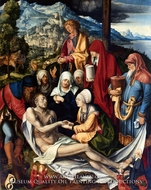
Albrecht Durer: ‘The Descent from the Cross’
In painting:
(1) Rosetti and his pupil Burne-Jones with their followers
(2) Bocklin and his school
(3) Segantini, with his unworthy following of photographic artists.
These men sought ‘inner’ by way of the ‘outer’
Cezanne
Henri Matisse
The divine
One is reminded of Manet
The Spaniard Pablo Picasso
Picasso is trying to arrive at : constructiveness by way of proportion
Matisse and Picasso stand side by side, Matisse representing color and Picasso, form.
The Pyramid
Socrates command – ‘Know thyself’
They are finding in Music the best teacher.
The most non-material of the arts.
Duration of time
….the arts are encroaching one upon another
Spiritual possibilities
Spiritual pyramid
Reach to heaven
The Stimmung
The Psychological Working of Colour
In the first place one receives a purely physical impression
Only to be of short duration
The average man
The child discovering
A knowledge of light
Various properties of flame
Balanced against each other.
Inner meaning
Spiritual harmony
Vermillion has the charm of flame
Keen lemon yellow…
Colours: their psychic effect.
Association
Flame
Blood
The soul
Keen yellow…
A lemon
Definitions – not universally possible
Tasting ‘blue’
An echo or reverberation
In harmony
Colours
Sticky
Smooth
Warm
Cold
Hard
Dry
Bass notes
Treble
Chromotherapy
Excites
The body
Keyboard
Strings
Frau A. Sacharjin-Unkowsky
The Conservatoire at St. Petersburg
Scriabin, ‘Prometheus’
It is evident therefore that colour harmony must rest only on a corresponding vibration in the human soul; and this is one of the guiding principles of the inner need.
The Language of Form and Colour
‘The man that hath no music in himself,
Nor is not mov’d with concord of sweet sounds,
Is fit for treasons, stratagems, and spoils;
The motions of his spirit are dull as night,
And his affections dark as Erebus:
Let no such man be trusted. Mark the music.
(The Merchant of Venice, Act v, Scene I.)
Musical sound acts directly on the soul and finds an echo there because, though to varying extents, music is innate in man.
‘Everyone knows that yellow, orange, and red suggest ideas of joy and plenty’ (Delacroix)
Jacques-Dalcroze, ‘The Eurhythmics of Jacques-Dalcroze’
Paul Signac, D‘Eugene Delacroix au Neo-Impressionism’
Schettler: ‘Notizen uber Farbe’ (Decorative Kunst), 1901
Painting has two weapons at her disposal:
Colour
Form
Sound of a trumpet
The many shades of red
Neighboring colours affect
Influences of form on colour
Abstract and geometrical
Acute or obtuse
Composition
Wallace Rimington
An objective shell
Spiritual values
Fresh possibilities of harmony
Intensity
Vibration of the human soul
The triangle
A stroke, a mere hint…
A circle
Innumerable forms in which both elements exist
The question of composition
Pure artistic composition has two elements
The composition of the whole picture
The creation of the various forms which, by standing in different relationships to each other, decide the composition of the whole.
Selection
Arrangement
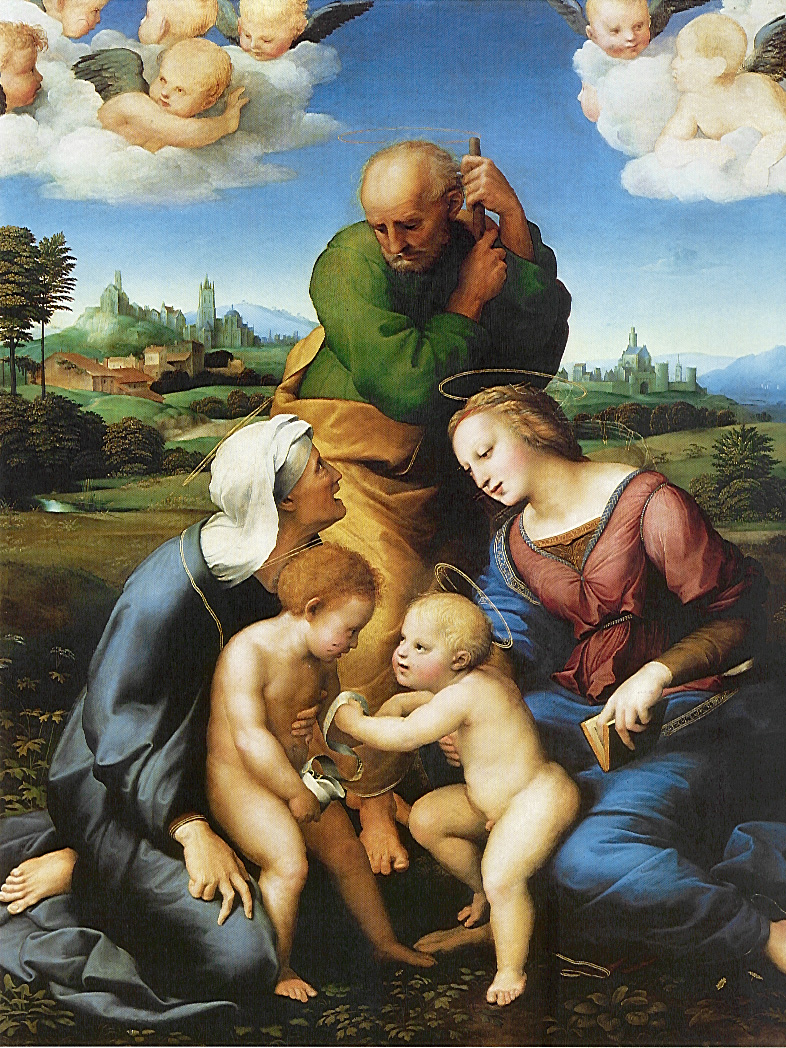
Fig . Raphael ‘The Canigiani Holy Family’ 31
Cezanne , ‘Bathing Women’
Building material
Organic form
The spiritual accord
The abstract appeal
Piano
Keys
Strings
Object
Human soul
Inner need
Dematerialized objects
Kingdom of the abstract
Inner vibration
There is no ‘must’ in art, because art is free.
Relationship
Alterations
A puff of smoke
Abstract form
Its wealth of expression
New ‘leitmotiven’
Form-arrangement
Anatomy
Artistic possibilities
Variations
Concord or discord
Combinations
Rhythmical or unrhythmical
Counterpoint
Possibilities
Expressions
Mystical elements
Personality
Spirit of his age
Servant of art
Cause of art
A rudely carved Indian column…
An Egyptian carving…
Eternal artistry
Modern
Contemporary
Nor nationality
The subjective
The objective
Element is the impulse here defined as the ‘inner need’
Spirit
The periodic
Liberty
In touch with nature
The trend of the inner need, and hearken to its words alone
A matter of feeling
A grammar of painting
The Cubists
The road
The many-sided genius of Leonardo devised a system of little spoons which different colours were to be used, thus creating a kind of mechanical harmony. One of his pupils, after trying in vain to use this system, in despair asked one of his colleagues how the master himself used the invention. The colleague replied: ‘The master never uses it at all’ (Mereschowski, Leonardo da Vinci).
The study of colour
Fundamental
Light or dark
Figure 1. 37
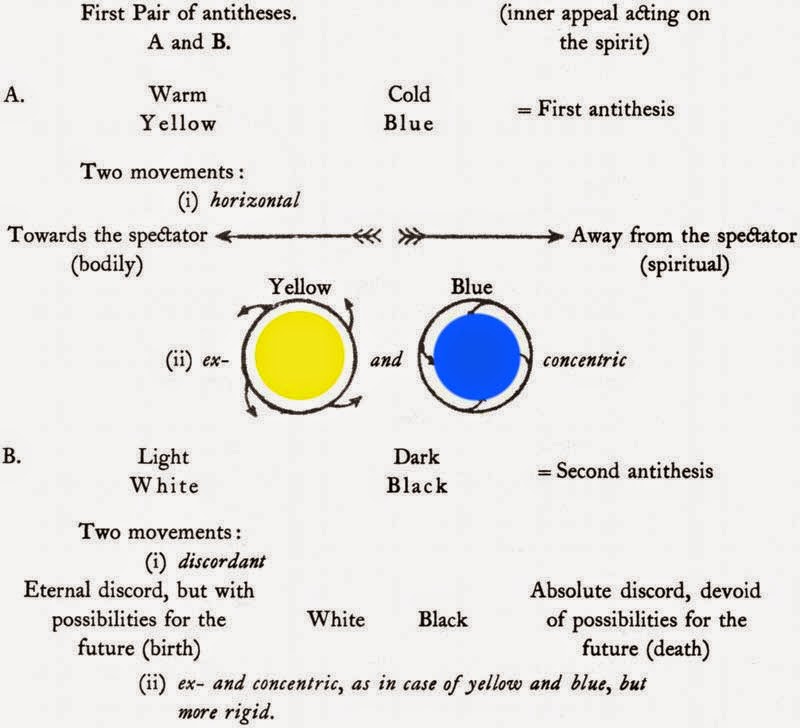
Inner
Outer
Fig 2. P. 38
Spiritual appeal
Yellow
Blue
Green
Activity
A violin
Black and white
Impressionists, who saw no white in nature
Silence
Silence
Gray….being composed of the inactive colors
‘The Letters of Vincent van Gogh’
The powers of red
Different shades
Vermilion is a red
Quenched by blue
The glow of red
The harmony
An admixture of black, quenches the glow
Barely audible
Thunders like a drum
A renewed vigor
Burst forth afresh
Deepened red and a deepened blue
Kandinsky ‘Impression no. 4’, ‘Moscow’ (1911) p.41
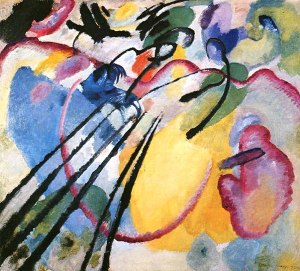
Kandinsky, ‘Improvisation no. 29’. (1912)
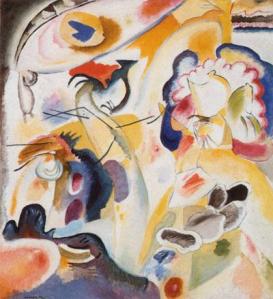
A cello
Fresh beauty
Orange
Violin
Violet
English horn
Wood instruments (e.g. a bassoon)
Complementary colors (see fig. 2)
A serpent biting its own tail
Six colours
Three main antithesis
Emotions
Existence
Expressing/Expression
Among artists one often hears the question ‘How are you?’ answered gloomily by the words, ‘Feeling very violet.’
Art of the future
Richness
Discord
The necessary differences
Superfluous
The spiritual atmosphere
Elements
Purity
Fig III. P.43
Repetition
The musical form
Literary
In isolation
Arrangements
Shades
Experiment and contradiction
Mozart
Balance
Striving, storm and tempest
The composition arising from the harmony is a mingling of colour and form each with its separate existence, but each blended into a common life which is called a picture by the force of the inner need.
Development
Contrast effect
Principles of contrast
Principles of art
Gauguin, ‘Noa, Noa’, where the artist states his disinclination when he first arrived in Tahiti to juxtapose red and blue.
Principles of harmony
Folk pictures
The Virgin in a red gown and a blue cloak
The thinness or thickness of a line
Artistic expansion of space
Concord
Elements in purely artistic composition
Theory
Artistic basis
Leonardo
System of little spoons
Even music has a grammar
The subjection of composition to some geometrical form is no new idea (cf. the art of the Persians)
‘Tendances Nouvelles’, no. 35, Henri Ravel: ‘the laws of harmony are the same for painting and music’.
Beauty of Form and Colour
….old decorative art
Oriental decoration
Swedish
Greek
Allegro, Serioso, etc.
Mere hieroglyphics
Chinese dragons
Design of daisies
A warm red tone
sky, flowers, a garment, a face, a horse, a tree.
A red sky
Sunset
Splendor or menace
The dramatic whole
The dramatic element
A red horse
A fairy story
A meaning
‘closeness of nature’
‘temperament’
‘handling’
‘tonality’
‘perspective’
A ‘literary’ appeal
Cinematographic firm
Dancing
Sexual
Folk-dances
Dancing as religious ceremony
Ballet
The ballet
Isadora Duncan
Nijinsky’s later ballets
‘Le Sacre du Printemps’
‘L’aopres-midi d’un Faune’
‘Jeux’
The Jacques Delcroze system of Eurhythmics
Kandinsky ‘Composition No. 2’ (1910)
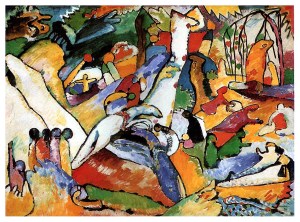
Kandinsky ‘Kleine Freuden’ (1913)
In dancing as in painting
the threshold of the art of the future
The composition for the new theatre will consist of these three elements
(1) Musical movement
(2) Pictorial movement
(3) Physical movement
Scriabin
Schoenberg
Its dangers and possibilities
We may be present at the conception of a new great epoch
Or we may see the opportunity squandered in aimless extravagance.
The ‘emancipation’ of today
Constructive form
Cubism
New art demands a more subtle construction
‘concealed construction’
Henri Rousseau
Heinemann, ‘Goethe’
Wilde, O. ‘De Profundis’
Delacroix, ‘My Diary’
Art and Artists
The work of art is born of the artists in a mysterious and secret way.
From him it gains life and being
A definite purposeful strength
Spiritual life
‘values’, of which the French so constantly speak
Science
Necessary
Scientific precept
The Philistines
A landscape of Caneletto
Famous heads by Denner
The human soul
Spiritual triangle
Activity
Power
Bond between art and the soul
Juggler
King of the castle
Servant
The artist must have something to say, for mastery over form is not his goal but rather the adopting of form to its inner meaning.
A cross to be borne
‘A king’, as Peladan says
Power
Great duties
The inner need
That is beautiful which is produced by the inner need, which springs from the soul.
Maeterlinck : ‘There is nothing on earth so curious for beauty or so absorbent of it, as a soul. For that reason few mortal souls withstand the leadership of a soul which gives to them beauty.’
The oil
Onwards and upwards
Maeterlinck , ‘De la beaute’ interieure’.
Conclusion
(1) Simple composition – the melodic
(2) Complex composition – the symphonic
Geometrical forms
Simple lines
Single line or form
‘fermata’
Cezanne
Hodler
‘rhythmic’
Ravenna mosaic
Augustus John
Rhythm
Unrhythm
Complex rhythmic composition
(1) a direct impression
(2) largely unconscious
(3) a slowly formed inner feeling – a ‘Composition’
Constructive
Impressionists
The age of conscious creation
Great spiritual leaders
Cezanne, ‘Bathing Women’
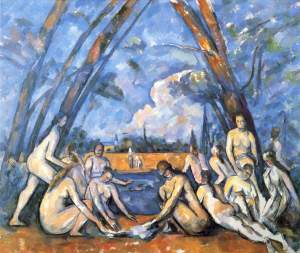
The following books are suggested for additional information on Wassily Kandinsky:
Grohmann, Will. ‘Kandinsky, Life and Works‘ (Harry N. Abrams) 1958
Kandinsky, Wassily, and Marc, Franz, eds. ‘The Blaue Reiter Almanac‘ [English translation] (Viking Press, New York) 1974
Overy, Paul. ‘Kandinsky; The Language of the Eye‘ (Praeger Publishers, New York) 1969
Rebay, Hillisa, ed. ‘In Memory of Wassily Kandinsky [includes 1918 text of Kandinsky’s autobiography ;Text Artista’] (The Soloman R. Guggenheim Foundation, New York) 1945
Whitford, Frank. ‘Kandinsky‘ (Paul Hamlyn, London) 1967
finis.
 tomreading
Leave a comment