An Introduction to Symbolic Logic Suzanne K. Langer
Introduction
The first thing that strikes the student of Symbolic Logic is that it has developed along several apparently unrelated lines
Branches of logic are so many studies in generalization
Progressive systematization and generalization
Discovery of abstract forms
Is a technique as well as a theory, and cannot be learned entirely by contemplation
Boole-Schroeder algebra
Whitehead and Russell
Poincare, Mach, Reichenbach, Carnap, Russell, Whitehead and others.
The principles of logical construction
The difference between fecund and sterile notions
Chapter 1
The Study of Forms
The Importance of Form
Changes
By some process of transformation
Benjamin Franklin – lightning is one form of electricity
‘electricity’
Wide mutability
Two kinds of knowledge
Knowledge of things
Knowledge about them
What Bertrand Russell has called: ‘knowledge by acquaintance’
A most direct and sensuous knowledge
To have knowledge about it we must know more than the direct sensuous quality of ‘this stuff’
A science
Some principle by which different things are related to each other
Logical Form
Philology
Words undergo changes
e.g. ‘pater’ to ‘ pere’, ‘father’ and ‘padre’
In the science or art of musical composition – a rondo form, sonata form, hymn form
Musical form is not material; it is orderliness, but not shape.
‘formality’ in social intercourse, of ‘good form’ in athletics, of ‘formalism’ in literature, music or dancing.
We speak of physical, grammatical, social forms; of psychological types; norms of conduct, of beauty, of intelligence; fashions in clothing, speech, behavior; new designs of automobiles or motor boats; architectural plans, or the plans for a festival; pattern, standard, mode…
‘form’
‘logical form’
Stucture
Structure
Constructed
‘Old Man of the Mountain’ in New Hampshire
Yet resembles a man by its form
Constructs, from its crude structure of strata in a geological fault to the infinitesimal dynamic pattern of protons and electrons in an atom.
A snowflake is a detailed construct
The ordinary musical scale
‘major mode’, ‘do, re, mi, fa, so, la, ti, do.
The form of the scale
‘skippy’
Same substance, differed only in form
He can describe them as two forms of one substance
Logic
Why it sharpens and broadens ones outlook
Form and Contents
Medium wherein form is expressed, its content.
‘Old Man of the Mountain’
A form which is usually expressed in flesh and blood is here articulated in stone; the extraordinary content arouses our wonder and perhaps our superstitious imagination
Same pattern may be cut out of different cloths.
The major scale
Scale
‘ladder’
‘higher’
Analogy is nothing but the recognition of a common form in different things
The Value of Analogy
A house, or a street – plan to show the location
A map
Isographic chart
‘curve’ representing fluctuations in the stock market
…not that of a copy, but of analogy
Graph
The growth, acceleration, climax and decline of an epidemic.
It is only by analogy that one thing can represent another which does not resemble it.
Seven lean cows may mean seven poor years, and seven fat cows, seven years of plenty…
Rosary of beads
Most elaborate structure
Language
‘grammatical structure’
What this structure can represent, is the order and connection of ideas in our minds.
Thinking
Exhibit sequence, arrangement, connection, a definite pattern
Which express completed, organic thoughts, or propositions
Concerted ideas are reflected in the concerted patterns of sound that we utter.
Syntax is simply the logical form of our language
To understand language…
The syntactical construct and the complex of ideas
A representative
‘logical picture’
Bertrand Russell
‘form’
Structure
‘Socrates is mortal’
‘the sun is hot’
The word ‘is’
The form
Socrates – Athenian, he married Xanthippe, drank the hemlock
Diverse forms
‘Socrates drank the hemlock’
‘Coleridge drank opium’
‘Coleridge ate opium’
‘Rorarius drank the hemlock’
It is the business of philosophical logic to extract this knowledge from its concrete integuments, and to render it explicit and pure.
‘logical form’
Sharpen the precision of their understanding, by a systematic study of the principles of structure
Abstraction
The consideration of a form, which several analogous things may have in common, apart from any contents, or ‘concrete integuments’, is called ‘abstraction’
Namely its numerosity – two
In abstracto
The succession
Common form
Number series: first, second, third, etc. …
Algebra
Algebraic technique
Distances
Horse-powers
‘purely verbal’
Ground-plan of a house
The analogy between plan and the prospective edifice
A paper pattern for a dress
Blue chiffon or flowered voile
Compose a tune
It is the form that interests us, not the medium wherein this form is expressed.
Concepts
Scientific concepts
Powerful concepts
Follow the general pattern called ‘oscillation’
‘oscillation’
Skyscrapers, fiddle-strings, and teeth
‘rhythmic motion to and fro’
Grandpa’s palsied hands
Quiver of a tuning fork
They are all derived from some rhythmic motion to and fro.
Such an abstracted form is called a concept
The concept of oscillation
Oscillation, gravitation, radiation etc.
….certain concepts, i.e. that exhibit certain general forms
Interpretation
Interpretation of an abstract form
‘rotation’
Rolling a wheel, the motion of a heavenly body, the spinning of a top, the whirl of a propeller.
Different content for the abstract concept of rotation. In one sense, two exactly similar spinning tops might be taken as two contents of one form
Two instances of one content for the same form
‘concrete’
‘specific’
Some general and important part of reality
Physics
Biology
Interpretation is the reverse of abstraction
Deliberate training
1) by abstraction from instances which nature happens to collect for us (the power to recognize a common form in such a chance collection is scientific genius); 2) by interpretation of empty forms we have quite abstractly constructed
Technical inventions
Theorem
Interpretation
….for the sake of finding physically interpretable forms.
The Field of Logic
‘Orderliness and system’ –
Josiah Royce ‘The Principles of Logic’
Windelband and Ruge’s ‘Encyclopedia of the Philosophical Sciences’, vol. 1, p.81.
Order is order. System is system
General types and characteristic relations
The tracing of such types and relations among abstracted forms, or concepts, is the business of logic.
Logic and Philosophy
What is the use of a science of pure forms?
The branch of logic which we call mathematics
The aim of philosophy is to see all things In the world in proportion to each other, in some order, i.e. to see reality as a system, or at least any part of it as belonging to some system.
In the case of philosophy especially, logic is a well-nigh indispensable tool.
Inconsistencies
Suggests remarkable generalizations
Logic is to the philosopher what the telescope is to the astronomer: an instrument of vision.
Problems of epistemology, metaphysics, even ethics.
An inestimable aid in reasoning
Clear expression is a reflexion of clear concepts; and clear concepts are the goal of logic
Summary
The first step in scientific thinking is the realization that one substance may take many forms
‘structure’
Analogous
The most important analogy is that between thought and language. Language copies the pattern of thought, and thereby is able to represent thought. To understand language requires some apprehension of logical form.
Abstraction
Abstraction is perhaps the most powerful instrument of human understanding
Interpretation
Logic is a tool of philosophical thought as mathematics is a tool of physics.
Questions for review 43
Chapter II
The Essentials of Logical Structure
Relations and Elements
Related
‘Ronald’, ‘Roland’, and ‘Arnold’
Relations of ‘before’ and ‘after’, or ‘right’ and ‘left’
‘Landor’
The importance of relations
The character of coral rock
Lilliputian indi-rock
Their relations to each other
To the right of
Near it
Far from it
Let some monstrous grinding force change their relations
The cohesion
Cohesion itself is not a factor of the rock, but it is a relation among the factors
A young child playing with blocks
Piles one upon another, and a third upon this, and a fourth upon that; by using only the single relation we call ‘upon’
A column
To the right of
One across the two – a sort of ‘lintel’
…and so – proceeds to a wall, a house, a pyramid
Structure
Relations
Many different things may enter into the same relations
Boxes, stones, books or a thousand other things
A column
Concerned only with things ranged above or below each other
‘above’ and ‘below’ are the essential relations which all columnar structures have in common, and by virtue of which they possess a common form.
Suppose, however, a column to be perfectly homogenous, made of a single stone, or tree trunk or cement casting
Parallel rings round the column
The rings divide the column into imaginary parts
Conceptually distinguishable
Possible sections
An upright beam, or an obelisk, or even the air in a chimney or the mercury in a thermometer tube, a column.
Elements of the structure
An element
In a musical scale, the elements are tones; in orthography, letters; in penmanship, they would be height, curvature and slant of lines which compose letters
Abstractable factors
Properties, not portions, of writing
The relative height and width, the spacing, the rounding, etc. of letters
Elements of ‘a handwriting’
…say, a violin
The timbre, clarity, volume and so forth
The various tone-qualities of the violin.
…we must know the relations
‘describe’
Language –picture
To stand for the elements, and also items of language to represent the relations.
There are so many ways of relating elements that relations must have names. In fact, one might say that the conveyance of relationships among elements is the real function of language
Things
‘language’ – grunts and demonstrative gestures would serve almost all purposes of communication
A knowledge about this thing, …and requires a logical picture
Grammatical word-picture
Signs for elements
Signs for their relationship
‘upon’, ‘to the right of’, ‘near’, ‘greater than’, are names for relations
‘loves’, ‘hates’, ‘knows’, ‘writes to’, ‘escapes from’
Relationships into which certain elements may enter with each another.
Terms and Degree
Terms
A relation may be likened to the keystone of an arch, and its terms to the walls, which are combined by the keystone, and at the same time are its sole supports
‘upon’, ‘loves’, ‘gives’, etc. cannot stand alone, but must function in a complex of other words denoting elements
The relation ‘being North of’ requires two terms; we say ‘Montreal (is to the North of) New York’.
‘Cologne is between Paris and Berlin’
‘between’ is a three-termed relation
‘Being North of’ is two-termed
Dyadic
Triadic
Tetradic
This numerosity is called the ‘degree’ of the relation.
Some relations, i.e. ‘among’, have no definite degree, but are merely more than dyadic, so we may call them ‘polyadic’
‘Greatest of’, ‘least of’, and all other relations expressed by superlatives, are polyadic.
…the expression ‘polyadic relation’ for relations whose terms are of indefinite number.
Propositions
The commonest means of expressing a relation among several terms is a proposition.
‘Brutus killed Caesar’, or ‘Abraham was the father of Isaac’, or ‘The winters in Siberia are cold’, each proposition asserts that a certain relation holds among certain terms.
A word-picture or ‘logical-picture’ of a state of affairs (real or imaginary)
‘Caesar and Brutus in the relation of killing’
Any symbolic structure, such as a sentence, expresses a proposition, if some symbol in it is understood to represent a relation, and the whole construct is understood to assert that the elements (denoted by the other symbols) are thus related.
For e.g. in ‘Brutus killed Caesar’, the verb furnishes both the name and the name of the relation, and the assertion that it holds; but in ‘the book upon the table’ the preposition ‘upon’ merely names a relation
We need an auxiliary word e.g. the verb ‘is’
‘The book is upon the table’ is a proposition. The relation is named, and it is said to hold between the elements.
Natural Language and Logical Symbolism
Language is very elusive
…‘Jones killed his wife’, it denotes a term; but if we say: ‘Xanthippe is the wife of Socrates,’ the relation is ‘being the wife of’. In this case, the noun ‘wife’ names the relation, and the verb ‘is’ asserts that it holds between the terms.
…a simplified grammar of logical structure.
In such a symbolism, one character stands for another term, etc., and a symbol of different type entirely represents the relation
A kd B
C wf D
In this symbolism we do not distinguish between verbs, prepositions, adjectives, and nouns which denote relations; for the present, we shall always merely name relations, and take the function of the auxiliary verb for granted.
A bt B, C
Is to be read ‘A is between B and C.’
Now, ordinary speech is rich in meanings, is full of implicit ideas which we grasp, by suggestion, by association, by knowing the import of certain words, word-orders, or inflections.
A few words can convey very much. But this same wealth of significance makes it unfit for logical analysis.
‘Jones killed his wife’
A kd B and B wf A
The easiest thing in the world to miss the logical form completely
But confusion of elements and relations, and the contraction of several propositions into one, are not even the only charges to be brought against natural language as a revealer of logical forms
‘Montreal is North of Albany and New York’
(1) I played bridge with my three cousins
(2) I played chess with my three cousins
‘bridge-playing’ requires four terms, i.e. it is tetradic, whereas chess-playing is dyadic. Linguistic grammar gives no indication whatever of this distinction. But if we operate with symbols the difference of structure becomes immediately apparent
Let A stand for the speaker B, C, D, for the three cousins respectively, ‘br’ for ‘playing bridge’, ‘ch’ for ‘playing chess’
Then the first statement may be expressed:
A br B, C, D
The second , however, means either that the speaker played with each of the three cousins in turn, or that the three banded together as one opponent for a very superior player
A ch B
A ch C
A ch D
For the latter we should write:
A ch (B-C-D)
It is evident that the ‘br’ and ‘ch’ are relations of different degree, so that the two propositions which language seem to differ only by the denotation of one word actually represent situations of different logical structure. In ordinary conversation, though, errors occur through ambiguity….
….then a medium which obscures such essential differences as between dyadic construct and a tetradic one is simply inadequate. We must resort to a symbolism which copies the structure of facts more faithfully.
When a relation-symbol stands in a construct, the number of terms grouped with it reveals the degree of the relation. But when it is not actually used, but merely spoken of, it is sometimes convenient to have some way of denoting its degree. This may be done by adding a numerical subscript; for example ‘kd₂’ means that ‘killing is dyadic, ‘bt₃’, that ‘between is triadic. The upshot of treating the above propositions (1) and (2), symbolically, is that we find we have relations of different degree, namely ‘ch₂’ and ‘br₄’.
‘the morning breaks, and with it breaks my heart,’
Amphibolous
Ambiguity
Amphiboly
‘is’ in half a dozen different senses
(1) the rose is red
(2) Rome is greater than Athens
(3) Barbarossa is Frederick I
(4) Barbarossa is a legendary hero
(5) To sleep is to dream
(6) God is
In each of these sentences we find the verb ‘is’. But each sentence expresses a differently constructed proposition;
In (1) ascribes a property to a term;
In (2) ‘is’ has logically only an auxiliary value of asserting the dyadic relation, ‘greater than’;
In (3) ‘is’ expresses identity;
In (4) it indicates membership in a class (the class of legendary heroes);
In (5) entailment (sleeping entails dreaming);
In (6) existence
So we see that in (1) and (2)
…only to assert the relation
And in the remaining four cases, where ‘is’ does function as the whole logical verb, it expresses a different relation in every case
Our linguistic means of conveying relations are highly ambiguous
‘the King’ in Gilbert and Sullivan’s ‘Gondoliers’

…this John and that John, but two relations named ‘is’ are very likely to meet with such a fate, because relations become explicitly known – become visible, so to speak – only in discourse.
…so the study of relations is necessarily bound up with a study of discourse. But if the latter obscures and disguises relations, as it often does, there is no escape from error, except by adopting another sort of discourse altogether. Such a new medium of expression is the medium of logic.
(3) Barbarossa = Frederick I
(4) Barbarossa ϵ legendary hero
(5) to sleep < to dream
(6) E! God
Only by a refined and ever more precise symbolism can we hope to bring logic out of language.
Some Principles Governing Symbolic Expression
Since the simplest structures – complexes of one relation and its terms – yield propositions, we may regard propositions as our first material for analysis; and the task to which we immediately address ourselves is the adequate expression of the forms which those propositions really have, i.e. the forms involved in their meanings, and not their customary idiomatic renderings.
The interpretation
‘=int’
‘=’ =int – identical with
‘ϵ’ =int – membership of the class
‘<’ =int – entailment
‘E!’ =int – there exists
e.g. of the cousins playing bridge and chess
‘I played chess with my three cousins’ would be:
‘A’ =int ‘the speaker
‘B’, ‘C’, ‘D’ =int ‘cousins’ (respectively)
‘br₄’ =int – ‘bridge playing’
‘ch₂’ =int – ‘chess playing’
(1) A br B, C, D
(2) A ch B
A ch C
A ch D
The symbols adopted are arbitrary
1, 2, 3, 4
Α, β, γ, δ
But certain general principles of symbolization should be borne in mind in the selection of logical characters:
(1) Signs for elements and signs for relations should be different in kind
(2) Signs for relations should not strongly suggest relations which are not meant
(3) Suggestiveness should never be allowed to interfere with logical clarity or elegance
…but to use NY for New York would be confusing, because, if we use Roman capitals for elements, the use of two letters would suggest some combination of two elements.
(4) The assignment of arbitrary meanings to signs with traditionally established uses should be avoided. That is to say, one should not use = to mean chess-playing, or ϵ for ‘to the right of’
A chess-man, unless it were highly conventionalized, would be a poor symbol for ‘ch’ because it would be elaborate.
Further problems of typographical convenience..
The Power of Symbols
An intelligent use of symbolism is of utmost importance in the study of structure; one should try from the beginning to develop definite, consistent, and easy habits of expression.
The power of a happily chosen ideographic language…
Consider what a development resulted in the science of mathematics from the introduction of a symbol for ‘nothing’! it has given us the better part of our arithmetic, columnar addition and subtraction, long division, long – multiplication, and the whole decimal system. A child in grammar school can write, offhand, computations for which a Roman sage would have needed the abacus. This is due simply to our superior symbolism, our nine digits, and 0. The revolutionizing of mathematics by the Arabic number system is the most striking example of the aid which a good medium of expression lends to the mind.
Summary
The structure of a thing is the way it is put together. Anything that has structure, then, must have parts, properties, or aspects which are somehow related to each other. In every structure we may distinguish the relation or relations, and the items which are related.
Elements
The elements which stand in a relation to each other are called the terms of that relation
The number of terms which a relation demands is called the degree of that relation. Two-termed relations are called dyadic, three termed triadic, etc. some relations have a minimum of more than two, but no maximum, number of terms; they are called polyadic.
A symbolic construct, e.g. a combination of words denoting terms and relations, which is understood to assert that the denoted terms stand in the denoted relation, is a proposition.
…therefore logic is necessarily bound up with language
…by (1) using the same word for relations and for elements (2) telescoping several propositions into one, (3) disguising the degree of a relation, and (4) using one word in several senses.
Because of these shortcomings of natural language, logicians adopt the simpler and more consistent medium of ideographic symbols
Since symbols may have meanings arbitrarily assigned, it is necessary to state what each sign equals by interpretation
(1) Radical distinction between term signs and relation signs
(2) Avoidance of false suggestion
(3) precedence of logical exactness over any psychological advantages
(4) avoidance of traditionally pre-empted signs
(5) Due attention to distinctness, compactness, and typographical simplicity
A good symbolism leads not only to a clear understanding of old ideas, but often the discovery of new ones.
Questions for review p.62
Chapter III
The Essentials of Logical Structure (continued)
Context
Newspaper headline: ‘lived together ten years without speaking’
‘these should be rubbed together to a smooth paste’
The range of its possible applications
Make sense
A great vaguely apprehended class of things
We look only for relations which might conceivably hold among these things
A context
In ordinary thinking, the context is indefinite, mutable and tacitly assumed. It grows and shrinks with every turn of the conversation. You hear a bang, and ask: ‘who has just come into the house?’
People, front door
Closing, entering, etc….
wood-box dropping. Making noise.
So the context in everyday conversation is always varying, adjusting itself to the interests of many people and many domains of thought.
Concepts and Conceptions
But in the sciences, which study the interrelations of elements within certain limited, definite realms of reality, or in logic, which deals with any given realm, and studies the possible means of making sense out of its constituents, we cannot do with a vague, indefinite, tacitly accepted context. If we want to build up an elaborate conceptual structure, we must have recognizable concepts, not subjective and incommunicable mental pictures. It does not make any difference what sort of mental picture embodies a concept; all that counts in science is the concept itself.
‘absolute zero’ (the temperature of interstellar space in complete absence of heat)
The properties of ‘absolute zero’
The sensation in the void only represents the concept, which is ‘the first element of the ordered series of all possible temperature ranged in the relation ‘warmer than’
Due to psychological factors, the two people have divergent conceptions of absolute zero, but are operating with the same concept.
‘my concept of honor’
‘conception’ for the mental image or symbol, ‘concept’ for the abstractable, public, essential form …
Formal Context
Conceptions rather than concepts
The loneliness and silence
Are irrelevant
Picturesque personal conception
‘loneliness’, ‘silence’, and length’ are not logically connected with the meaning of; absolute zero’. If we make our formal statement: ‘Absolute zero is the first element in a series of all possible temperatures ranged in the relation ‘warmer than’, the only elements are ‘temperatures’, and the only relation is ‘warmer than’
Psychological
Concept
‘cooler than,’, warmer than’, of like temperature’, are concepts which may be derived by definition from ‘warmer than’
Formal context of the discourse
The formal context of any discourse may be agreed upon and expressed; the psychological context cannot.
Psychological framework
We know that ‘death’ figures in a different context for a kidnapper’s victim who feels a pistol at his back, and for an undertaker whose telephone is ringing, but we cannot exhaustively state such a context and know all ideas that are relevant to it.
(A) The Universe of Discourse
The total collection of all those and only those elements which belong to a formal context is called a Universe of Discourse
‘Everybody knows that another war is coming’, and assume that ‘everybody’ will be properly understood to refer only to adults of normal intelligence and European culture, not to babies in their cribs, idiots, or the inhabitants of remote wildernesses.
The asseverator
Logicians and scientists, however take no pleasure in casuistry
Everybody is born into some social group
The head-hunter of Patagonia
American ambassador to the Court of St. James
All human beings
Elaborate a structure as a natural science has a very great universe, whereas a lesser construct, say the formal set of rules for playing chess, is limited to 64 elements called ‘squares’, and 32 elements called ‘men’.
‘chess-men’
Limited to 32
The universe of discourse must be recognized and expressed
The German Klasse, a class
An italic K
K(A, B, C,D) K=int ‘houses’
Interpretation
(B) Constituent Relations
A formal context involves not only elements, but the relations which connect such elements.
One cannot say that 2 is older than 3, or that one house is wiser than another
Meaningless
We must choose our relations with reference to the sort of elements contained in K
Now, if we let K =int ‘houses’ there are many relations which ‘make sense’ when taken to function among its elements; we may say of two houses, A and B, that A is greater than B, A is as old as B, A is costlier than B, A is to the right of B, and so forth and so on indefinitely.
connects
form a triangle
in the midst of
universe of discourse
if we want to describe the spatial arrangement of four houses, the relation costlier than has obviously no place in the discussion; neither has old as
to choose the simplest concepts, and the smallest number of them, that will serve the purpose of the discourse
all propositions must be made solely out of elements A, B, C, and D and the relation ‘nt’
constituent relation
K(A,B,C,D)nt₂ K =int ‘houses’
nt₂=int ‘to the North of’
Every possible pair of terms from this universe, combined by the relation ‘nt’, yields a proposition; the sixteen propositions which can be made in this wise are called the elementary propositions in the formal context K(A,B,C,D)nt₂
Truth – Values
Every combination of elements in a formal context yields a proposition which is either true or false
The value for an ‘unknown’
Only x|2 or ten sheep left then the value is 20.
‘truth –value’
Eternal or divine or moral qualities of ‘truth’
Merely with the fact that we have here the property of ‘true – or false’
We may say it has the truth-value ‘truth’, and if false, then its truth –value is ‘falsity’
Related Propositions in a Formal Context
Since nt is dyadic, i.e. combines its terms two at a time, there are sixteen possible ways of combining A, B, C and D
Each possible combination by means of ‘nt’ yields a proposition which is either true or false.
None of the houses is to the North of itself
~(A nt A) means ‘A nt fails’, ‘A is not North of A’, or ‘it is false that A nt A.’
So the nature of the constituent relation determines the truth –value of our propositions
Either true or false
Now, let us assume just one such item; namely that ‘A nt B’ is true.
A nt B
and ~(B nt A)
the falsity of the latter follows from the truth of the former, as we recognize from our common sense understanding of ‘nt₂’. We know that this particular relation cannot connect two terms in both possible orders. The truth of one proposition precludes the truth, or implies the falsity, of the other. (Note that to be told ‘A nt B is false’ would not give us any knowledge of ‘B nt A’, since both might be false, though not both can be true.)
A nt B
B nt C
Jointly asserted, assure us of the following facts:
A nt C
~(B nt A)
~(C nt A)
~(C nt B)
So it appears that even in the case of the twelve undetermined propositions, the truth-values that might be assigned to them are not entirely arbitrary and unrestricted. The truth of one proposition precludes that of another, or the joint assertion of two propositions implies a third. The possible truth-values that could be attached to these twelve constructs are relative to one another.
Constituent Relations and Logical Relations
In describing the formal concept for this discourse about houses, the only elements to be used were given as A, B, C, D, and the only relation as ‘nt₂’. In merely formulating all the possible elementary propositions in this context, certainly no other constituents were employed. But as soon as the propositions were formulated, it was apparent that some could not reasonably be asserted at all, and even the others could not all be asserted together indiscriminately. Certain ones were dependent upon certain others, by implication, or even the mere joining-up of two propositions in one assertion, are relations; so there appear to be relations operative in our discourse besides the relation ‘nt’ which is mentioned as a constituent of the formal context.
Such relations, however, hold among propositions of the discourse, not among elements. The relations which hold among elements form elementary propositions, and are constituents of those propositions, and items in the formal context; the relations which hold among propositions are not constituents of elementary propositions, and are therefore not enumerated as materials of the formal context. I shall call the latter kind logical relations, to distinguish them from the constituent relations of the discourse.
The constituent relations vary with the formal context; in every discourse there must be constituent relations, but what are to be arbitrary, within the limits of what makes ‘sense’ in the given universe. Logical relations, too, occur in any discourse of more than one proposition; but are always the same few relations.
‘logical constants’
Professor Sheffer
The principle logical relations are:
(1) conjunction of propositions, or joint assertion
The word ‘and’ or the traditional symbol ‘.’
Thus ‘A is to the North of B, and B is to the North of C’, is expressed symbolically:
(A nt B) . (B nt C)
(2) Disjunction
‘one, or the other, or both’; that is, it means ‘at least one of the two propositions
Either ‘A nt B’ or ‘B nt A’ must be false. They may, in fact, both be false.
The accepted symbol, ‘v’ for ‘either-or’, we may say:
~(A nt B) v ~(B nt A)
(3) Implication
The notion of preclusion, which is the implication by one proposition that another is false.
Then you first express the conjunction, bracket the whole expression, and use it as one proposition:
[(A nt B) . (B nt C)] > (A nt C)
‘neither…nor’ instead of ‘either…or’
But all these relations which may be used in place of ‘.’, ‘v’, and ‘>’ really come to the same thing; they express the same form, the same state of affairs; so we may as well abide by the ones which are in most general use.)
Systems
Two propositions which cannot both be true are said to be inconsistent
(A nt B) . (B nt C) . ~(A nt C)
It is systematic because the propositions are interrelated, linked to each other by logical relations. Such an ordered discourse within a formal context is called a system.
There are innumerable ways of constructing systems
The process of reasoning from one truth-value to another among propositions is known as deduction; for instance, from ‘(A nt B) . (B nt C)’ one may deduce ‘A nt C’ a system wherein this is possible, so that a small number of known propositions determines all the rest, is a deductive system.
Suppose you are told that:
A nt B
B nt C
C nt D
From the first two in conjunction we deduce ‘A nt C’, since
[(A nt B) . (B nt C)] > A nt C
Likewise, [(B nt C)] . (C nt D)] > B nt D
And if we take this last proposition together with the first, we have:
[(A nt B) . (B nt D)] > A nt D
Here are three propositions whose truth is deducible from that of the three given ones. Moreover, each of these true propositions implies that its converse is false:
(A nt B) > ~(B nt A)
(A nt C) > ~(C nt A)
(A nt D) > ~(D nt A)
(B nt C) > ~(C nt B)
(B nt D) > ~(D nt B)
(C nt D) > ~(D nt C)
So, by assuming the truth of just three of the twelve ‘undetermined’ propositions that could be constructed in our context, we have been enabled to deduce all the rest. The three original assumptions were made to establish a deductive system
Logical structure
Suppose , however, that we assume a different formal context, say a collection of five persons, whom I shall denote as S, T, U, V, W. the constituent relation is, ‘likes’. I shall express it by the symbol ‘lk’. We have then,
K(S, T, U, V, W)lk K =int ‘persons’
lk₂=int ‘likes’
Let us assume,
S lk T
T lk U
U lk V
V lk W
(S lk T) . (T lk U) does not tell us whether S lk U is true or false; we cannot even guess whether any one of these persons likes himself or not.
If we want to assign truth-values to all the propositions we must make twenty –five separate assignments such a system I call inductive, in contradistinction from deduction
K(S, T, U, V, W)lk₂ must be completely inductive; this is due to the character of its constituent relation.
Most systems exhibit a mixture of both types…
Mixed
Most scientific systems are of this sort…
The dream of every scientist is to find some formulation of all his facts whereby they may be arranged in a completely deductive system
Elements
Relations
Elementary propositions
Simple constituents; relations among elementary propositions, or logical realties;
Systems
All higher logical structures may be treated as systems or parts of systems.
Summary
Every discourse, no matter how fragmentary or casual, moves In a certain context of inter-related ideas. In ordinary thinking this context is indefinite and shifting
The psychological context
Different conceptions
But if they understand each other at all, then their respective conceptions embody the same concept.
Logic is concerned entirely with concepts, not conceptions. A logical discourse rules out all private and accidental aspects. Its context must be fixed and public. The elements and relations that may enter into its propositions may, therefore, be enumerated in advance. These constitute the formal context of discourse.
The total collection of elements in a formal context is called the universe of discourse.
The relations which obtain among such elements are called constituent relations of the formal context.
The combinations which may be made out of the elements in a formal context by letting a constituent relation combine them according to its degree are the elementary propositions of the discourse.
Every elementary proposition has a truth – value, which is either truth or falsity.
‘value’ here has nothing to do with the quality of being ‘valuable’
The propositions constructible in a formal context may be such that they cannot all be true, or cannot all be false; that is it may be that to fix the truth –values of some of them automatically assigns truth –values to others. The propositions of such a context are interrelated
The relations which hold among elementary propositions are not the constituent relations mentioned in the formal context, but are logical relations.
Conjunction, (.) disjunction (v), and implication (>)
A total set of elementary propositions in a forms context, connected by logical relations and jointly assertable without inconsistency, is a system
A system wherein a small number of propositions, known from outside information to be true, implies the truth or falsity of all other elementary propositions, called a deductive system
A system wherein all truth-values must be separately assigned by pure assumption or outside information is an inductive system.
A system wherein some truth-values may be deduced, but others neither imply anything nor are implied, is a mixed system.
The essentials of structure are: elements, and relations among elements, or constitutional relations; elementary propositions; relations among elementary propositions, or logical relations; and finally, systems, the higher forms of structure, composed of related elementary propositions within a logical context.
Questions for Review 81
Chapter IV
Generalization
Regularities of a System
When each of these is either asserted or denied, the system is completely and explicitly stated
K(A, B, C, D, E, F, G, H, I, J)fm₂
K =int ‘persons’
fm₂ =int ‘fellowman of’
let the following truth-values be assigned to propositions of the system”
A fm B
B fm C thru to
I fm J
Exclusion (no one can be called his own fellowman):
~(A fm A)
~(B fm B)
_______
_______
_______ thru to
~(J fm J)
Implication
(A fm B) > (B fm A)
(B fm C) > (C fm B)
(C fm D) > (D fm C)
_______
_______
(I fm J) > (J fm I)
‘if –then’ i.e. if A is a fellowman of B, and B of C, then A must be a fellowman of C : ‘A fm C’
By the same principle we relate A to D, to E, to F, etc.
A swarming multitude of statements
[(A fm B) . (B fm C)] > (A fm C)
[(A fm C) . (C fm D)] > (A fm D)
_______
_______
[(C fm D) . (D fm E)] > (C fm E)
Each proposition to the right of the implication sign is a newly established elementary construct, and each of course, implies its converse, so we augment the list beginning:
(A fm B) > (B fm A)
etc.
By:
(A fm C) > (C fm A)
_______
_______
(H fm J) > (J fm H)
Altogether, the explicit statement of this system requires 100 assertions
Analogous
Merely started each column
The repetitiousness of the logical relations
…and no matter which three elements we select, if we make two propositions out of them, such that the second term of one is identical with the first term of the second, and relate these two propositions by ‘.’, then this conjunct has the relation ‘>’ to a third proposition combining the first term of the first with the second term of the second. What the assertion in each list have in common, is (1) the number of elementary propositions involved in them, (2) the number of distinct elements involved in these propositions, (3) the location of identical and of distinct elements, (4) the nature and location of logical relations contained in each total assertion.
These regularities stamp all the assertions in any one list with the same logical form, no matter which element, or which two or three elements figure in any such assertion.
Regularities
Variables
A variable symbol
It is called a variable because it can mean all the elements in turn; its meaning may vary from A to J.
To distinguish such symbols from specific names, like A, B, C, etc., use lower case italics for variables
~ (A fm A)
Means: ‘it is false that the element called A has the relation fm to itself’; but
~(a fm a)
Means by turns,
~(A fm A),
~(B fm B)
, etc.
Or
A fm B
A fm C
_______
B fm C
B fm D
_______
The first-mentioned term
The second –mentioned term
If however, two elementary structures are logically related, the whole construct is one assertion; and if a variable is given a meaning in one part of that assertion it must be kept throughout
(a fm b) > (b fm a)
May mean (C fm D) > (D fm C)
Or: (B fm A) > (A fm B)
The fact that a certain (first –mentioned) term has the relation fm to a certain other (second) term, implies that the other term has that relation to the first.
So we may say that a variable may mean any element, but whichever it does mean, it must mean that same one throughout the whole assertion.
It must mean just one and the same thing in all the logically related elementary propositions of one total assertion
This point is very important; once a variable is given a meaning, it keeps it throughout the whole assertion; but it must be remembered that in another assertion it may have another meaning. That is, if in:
a fm a
we let ‘a’ mean ‘J’, so we have the meaning:
J fm J,
And then say:
(a fm b) > (b fm a)
The meaning ‘J’ need not therefore be assigned to ‘a’ in this second assertion; we may give a and b here the meanings of E and F, if we choose, or any other pair of elements. But of course, if our choice falls upon E and F, then a means E and b means F in both the elementary propositions connected by ‘>’
Values
The elements which may be meant by a variable symbol are called its values
The entire class of possible values for a variable, i.e. of individual elements it may signify, is called the range of significance of the variable
Any element whatever may be substituted for a, and the result will be a proposition which is either true or false.
Dyads
Specification
A certain kind of thing as: K =int ‘houses’
Specification
‘a =spC’
Every pronoun is a variable
Antecedents of pronouns
A pronoun must have the same antecedent throughout the entire statement
Any
Interpretation
specification
Propositional Forms
Every proposition in a formal context is either true or false.
A fm b
A construct
Such an expression which has the form of a proposition, but contains at least one variable term, is called a propositional function
Propositional form
Formalization
‘A fm E’ is related to ‘b fm a’ by partial specification
Restricted propositional form
As soon as we replace a single term in a proposition by a variable, we have a propositional form which has as many values as there are values for that variable; and the more elements we formalize, the greater becomes the range of entire propositional form.
The Quantifiers (a) and (Ǝa)
The form
A device to express that a propositional form holds for any value of its variables, i.e. that no matter how the terms are specified, the resultant proposition is true
~(a fm a)
~(a fm a)
Holds for every value of a
The symbol (a) which may read, ‘for any value of a’
(a): ~(a fm a)
Is read: ‘for any a, it is false that ‘a fm a’
Restricted propositional form, i.e. to use one specific term and formalize the other
A fm a
‘For some value of a’, is (Ǝa).
(Ǝa): A fm a
Means ‘For some value or values of a. ‘A fm a’ holds.
Or briefly: ‘For some a, ‘A fm a’
It is a good practical rule, in logic, not to say more than is essential,
‘there is at least one ‘a’, such that…….’
(Ǝa) : A fm a
‘There is at least one a, such that ‘A fm a’
If the propositional form has two variables….
a fm b
(Ǝa, b): a fm b
‘There is at least one a, and at least one b, such that ‘a fm b’
The complex proposition:
(a fm b) > (b fm a)
Holds no matter how we choose a and b. so we may say:
(a,b): (a fm b) > (b fm a)
‘For any a and any b, ‘a fm b’ implies ‘b fm a’
the symbols (a) and (Ǝa) are called the quantifiers of the term ‘a’.
(a) ‘For any a’ – ‘universal’ quantifier
(Ǝa) – ‘particular’ quantifier
We might encounter:
(a) (Ǝa): a lk b
(Ǝa) (b): a lk b
The first says: ‘For any a, there is at least one b such that ‘a lk b’
The second however asserts: ‘There is at least one person, ‘a’, such that for any person ‘b’, ‘a lk b’; that is there is at least one ‘a’ who likes everybody.
Suppose we took the relation fm;
(a) (Ǝa): a fm b
Is true if there is more than one man in the world; but
(Ǝa) (b): a fm b
Cannot be true, because (b) makes b refer to any man whatever, including the first term of the relation, so we would have by implication:
(Ǝa) . a fm a,
Which is false
e.g. if we wished to say: ‘Everybody has some secret which he will not tell to anyone’, the form of the proposition (using ‘à’ for ‘telling’) is:
(a)(Ǝa)(c): ~(a à b,c)
‘For any a, there is at least one b such that, for any c, a does not tell b to c.’
General Propositions
It is either true or false that:
(a): ~(a fm a)
…so we have here not an empty form to be filled in with values, but a proposition about an empty form and its possible values.
Prefix the quantifier (a) to ~(a fm b), we no longer mean just…
It is then, a general term
The expression: ‘(a): ~(a fm b)’ is therefore a general proposition
‘for any a, a is not his own fellowman’ is true, and expresses a general condition
(Ǝa) refers us to some element in that range, but – again – no matter which.
The officious radio promptly reports to the world:
‘(Ǝa): a rb A!’
‘Somebody in the party robbed Smith!’
(Ǝa): a rb A
We must generalize both terms:
(Ǝa, b) : a rb b
‘There are at least two terms, a and b, such that ‘a rb b’ holds.’
Both of these statements are general propositions; but only one is only partly generalized, and the other completely so.
The Economy of General Propositions
The nine specific propositions are all instances of the general fact that (Ǝa, b) : a fm b.
Lists of logical propositions such as:
(A fm B) > (B fm A)
(B fm C) > (C fm B) etc., etc.
Here, clearly, what holds for one pair of terms holds for all:
(a, b) : (a fm b) > (b fm a)
This one general assertion takes the place of nine specific ones. Similarly,
[(A fm B) . (B fm C)] > (A fm C)
Is an instance of the universal proposition:
(a, b, c) : {(a ¹c) . (a fm b) .(b fm c)] > (a fm c)
This saves the whole list of derivations of A fm C, A fm D, A fm E…B fm D…to H fm J. the converse of these derived propositions, by the way, are already provided for by the first logical statement. Finally, the fact that ‘fm’ cannot relate a term to itself my be stated universally:
(a) : (a fm a)
So it may be shown that, whereas a statement of the system in entirely specific terms requires one hundred separate assertions, a general account involves just twelve – nine specific and three general propositions, and that is a considerable saving in paper, ink and human patience!
The Formality of General Propositions
‘a fm b’ is significant with any two elements of K’, but not necessarily true for them.
(a) : ~(a fm a)
(a, b) : (a fm b) > (b fm a)
(a, b, c) : [(a¹ c) . (a fm b) . (b fm c)] > (a fm c)
No; which ones they are makes no difference whatsoever; it is enough to know:
(Ǝa, b) : a fm b
‘There are at least two elements of which it is true that one is the other’s fellowman.’
This is enough to assure us that the relation obtains somewhere in the system.
And we would know it of any system in a formal context where ‘fm’ was significant.
‘a first, a second, a third…..an nth element)
K(a, b, c…)
(a) : (a fm a)
A mathematical elegance
K(a, b, c…)fm₂ K’ =int ‘creatures’
Fm =int ‘fellowman of’
(a) : ~(a fm a)
(a, b) : (a fm b) > (b fm a)
(a, b, c) : [(a ¹c) . (a fm b) . (b fm c)] > (a fm c)
(a) (Ǝb) : a fm b
K’(a, b, c…)fm₂ K’ =int ‘creatures’
Fm =int ‘fellowman of’
1’. (a) : ~(a fm a)
2’. (a, b) : (a fm b) > (b fm a)
3’. (a, b, c) : [(a ¹c) . (a fm b) . (b fm c)] > (a fm c)
4’. (Ǝa) (b) : ~(a fm b)
5’. (Ǝa, b) : a fm b
K’’(a, b, c…)fm₂ K’’ =int “creatures’
Fm =int ‘fellowman of’
1’’. (a) : ~(a fm a)
2’’. (a, b) : (a fm b) > (b fm a)
3’’. (a, b, c) : [(a ¹c) . (a fm b) . (b fm c)] > (a fm c)
4’’. (a, b) : ~(a fm b) {the assertion of 4’’ makes 1’’ unnecessary : for 1’’ is simply a case of 4’’, namely the case where a and b are identical, and is therefore implicit in 4’’.
In the first system, proposition 4 asserts that every creature has a fellowman; every creature in this universe, then, must be human.
In the second, 4’ asserts that there is at least one creature which is not any other’s fellowman; this means either it is not a man, or else no other creature is.
The latter alternative, however, is denied by 5’, which says that there are at least two men.
We learn from 4’’ that no two creatures are fellowmen, i.e. that there cannot be more than one man in K’’.
Similarity
The general nature of fm₂
To this extent a system is always affected by the character of its constituent relations
The other propositions – 4, 4’ and 5’, and 4’’ – describe the nature of the three respective universes.
….only items that may vary, and thus produce different systems.
…much more definite and specialized statements are possible, without any mention of specific elements.
An instance of a certain kind of system
The people inhabiting Paris are another….
The two authors of ‘Principia Mathematica’, though they represent the minimum number of K-elements, are yet another instance
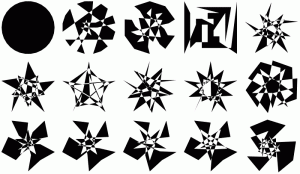
Each group is a very simple specific system, and each one of these systems exemplifies the same form. It is this form which may be expressed in general, without mention of any specific elements.
…an economy, i.e. they serve to say in small compass what could also be said in a great array of specific statements;
….formulating universes of a certain kind
Principles of arrangement
Rather than specific facts
In system (I) we have a formulation of any group whose elements are creatures, in the relation ‘fellowman’, where all the creatures are human; In (II), the arrangement of any group containing at least two men, and at least one non-human creature; in (III), that of any group containing not more than one man (which applies to such as contain no man)
Three kinds of groups
A general account of a system describes its form. Since it is the form, not the specific instance of it, that concerns logicians, we shall henceforth deal entirely with generalized universe of discourse, and therefore with general propositions as ‘descriptions of systems of certain kinds’
All elements from now on will be denoted by lower-case italics, and all elements in propositions hereafter must be quantified.
There are no more ‘variable’, i.e. words (or letters) of unassigned meanings
No more ‘values’ or specific meanings assigned to variables’.
Logic deals only with general terms.
Quantified Terms in Natural Discourse
‘indefinite pronouns’
Something, anything, somebody, anybody, nobody, nothing, none.
A sentence about ‘somebody’ or ‘something’ expresses a general proposition which would be preceded by (Ǝa).
Anything, or anyone is quantified by (a).
‘nothing’ is symbolically rendered by the universal quantifier before a negative proposition, but for a negation with the particular quantifier there is no special word. We use ‘something’ together with ‘not’.
From Aristotle, the four types of proposition:
A: All S is P
E: No S is P
I: Some S is P
O: Some S is not P
Anyone conversant with symbolic logic….
Variable
A(s) : s is P
E(s) : ~(s is P)
I(Ǝs) : s is P
O(Ǝs) : ~(s is P)
Wherever in ordinary language, we meet and ‘indefinite pronoun’, we have a general proposition (unless some personal pronoun without antecedent makes the sentence a propositional form).
By ’~” note that the negation sign never precedes the quantifier).
This will show that although there are many ‘indefinite pronouns’, there are really only two kinds of quantification; all general terms of language may be rendered by the use of (a) and (Ǝa)
So it appears that language, which (as we saw in a previous chapter) often gives complicated relations a false appearance of simplicity, may also sin in the opposite direction, and needlessly complicate structures which, when expressed with greatest rigor and economy, are found to be genuinely simple and clear.
Summary
When a system is completely stated, its propositions may be listed in such a way that each list shows a marked internal regularity.
That is to say, the propositions may be listed so that each list assembles all the propositions of a certain form.
But to denote in turn….
Variable
Range of significance
The value of the variable
Once a certain value is assigned to a variable term
…but the same variable occurring in independent constructs need not have the same value every time.
A proposition is either true or false
But a construct containing a variable whose value is not fixed is neither true nor false.
It is only an empty form of several propositions, and is therefore called a propositional form.
Plus this information
‘true for all values of a’ is (a).
Universal quantifier
i.e. that the relation expressed in the form holds among any terms. Where more than one variable occurs, there must be more than one quantifier.
If only some values of a variable in a form yields true propositions, this fact is expressed by the particular quantifier, (Ǝa). This is read: ‘There is at least one a, such that…’
Great care
Proper order
Differences of order often makes difference of sense.
A completely quantified propositional form is a general proposition
An economical substitute for long lists of specific ones
General propositions may describe the properties of a certain kind of system.
Specific terms
In general
From specific inverses to ‘K(a, b…)’
‘a certain number’
(1) how the relation functions among such terms if it functions at all and
(2) whether it holds for all, or merely some, or no terms of the universe.
Such a generalized discourse conveys a principle of arrangement, and presents a logical pattern of which many different specific systems are instances.
We have discussed two procedures in the use of symbolism, which must not be confused namely with:
(1) interpretation, the assignment of meanings (connotations) to symbols. The opposite of interpretation is abstraction, of which more later
(2) Specification, the assignment of values (specific denotations) to variables. The opposite of specification is generalization.
The so-called ‘indefinite pronouns’
The symbolic expression of general propositions is simpler than their rendering in ordinary speech.
Questions for review p. 110
Chapter V
Classes
Individuals and classes
A specific proposition always concerns a certain subject, which could be pointed out and given a proper name. it is about this or that subject; this boy James, this house called A, that place, that poem. Such a subject, whether it be a person, place, thing, or ‘what-not’ is termed an individual.
‘this’
Completely general propositions, on the other hand, never mention individuals.
The general proposition
‘all men are mortal’ entails ‘Socrates is mortal’ by specification
It ‘applies’ to Socrates
The fable of ‘Reynard the Fox’
‘some animal killed a lamb’
‘your honor, it was not I!’
Membership in a Class
What a general proposition does not mention is a member, or members of a certain class.
‘any man is mortal’ means that any member of a certain class, namely the class of men, is mortal.
Logic does not deal with specific men or animals; it can ‘apply’ to individuals if they are members of a class, but it can actually mention them only as members, not as individuals. We cannot say in logic, ‘Reynard killed a lamb’, meaning by ‘Reynard’ an individual known by personal acquaintance; we can only say,
(Ǝx) : x is named Reynard and x killed a lamb.
But this tells us only that at least one member of a class is named Reynard, and has killed a lamb.
Logic, which deals only with ‘some’ ,or ‘all’ members of a class,
The relation of class-membership, therefore is one of prime importance. For hundreds of years it has been confused with the relation of part to whole, and this circumstance has led to some of the most intricate metaphysical problems known to philosophy
The officious ubiquity of the little word ‘is’
Peano
Recognizing the difference between ‘is’ and ‘is a’, honoured the latter relation with a special symbol, ‘ϵ’, the Greek letter epsilon (from ‘ϵοτί).
By means of a different notation, the relation of class-membership may at last be clearly distinguished from identity, inclusion, entailment, or any number of the other relations named ‘is’, with which it has traditionally been confounded
Thus, to express briefly and concisely that Reynard is a member of the class ‘fox’, we shall write:
Reynard ϵ fox
Which may be read ‘Reynard is a fox’, if we bear in mind that ‘ϵ’ really means ‘is a member of the class’
Likewise we may write:
two ϵ number
A ϵ house
(Ǝa) : a ϵ house
The relation of membership in a class must be distinguished from that of a part to a whole, which it helps to compose.
A class is not a composite whole, as a little reflection will show.
The class of ‘fox’
‘mankind’, which is a class
Concepts and Classes
A class is usually referred to as ‘the class of so-and-so’s’, i.e. the class whose members have a certain character.
A matter of importance to define the concept
Propriety
A ‘class’ may be described, then, as a collection of all those and only those terms to which a certain concept applies.
That a class is the ‘field of applicability of a concept; in traditional logic, this field is called the extension of the concept.
Defining Forms of Classes
What does it mean to say that Socrates is mortal?
‘Socrates must die’
If ‘Plato must die’ is true, Plato is a member of this class
‘Apollo must die’, if it were true, would relegate Apollo too, to the class of mortals.
‘Apollo must die’ is false; therefore Apollo is not mortal
‘x must die’
All their subjects are values for ‘x’
A true value for ‘x’
The range of applicability of the concept
Class-concept
Class in intension
Regard a class as a logical construction; a purely conceptual entity
‘ϵ’ or ‘membership’ is a peculiar and subtle one.
Classes and Sub-Classes
Black sheep
Sub-classes of the original class
A, B, C denote certain classes
Every white sheep is a sheep
(x) : (x ϵ A) > (x ϵ B)
The class A is entirely included in the class B (fig.1) p.118
Let class C (fig. 2), be the class of ‘royal children’ in the old fairy – tale, ‘The White Swans’ (or ‘The Six Swans’)
Every prince is a royal child, a member of C. In other words, (x) : (x ϵ P) > (x ϵ C).
The Notion of a ‘Unit Class’
Suppose there were six princes in the story, and also six princesses
The sub-class princes
The sub-class princesses
Let us call the latter class of C by the general proposition:
(x) : (x ϵ S) > (x ϵ C)
The number of members in the class is immaterial
A class which has only one member is known as a unit class
All its offices devolve upon one
‘at most one’. The first condition is easy to express:
(Ǝx) : x ϵ A
Conjunctive statement
(Ǝx) (y) : (x ϵ A) . [(y ϵ A) > (y = x)]
‘There is at least one x, such that, for any y, x is an A, and if y is an A, then y is identical with x.’
This limits the membership of A to some one element, x.
‘the’ indicates all members of the class are meant.
‘The sons of Charlemagne’
Denotes all three members of that class, and if, unknown to history, there were more than three, the unknown ones are logically included in the denotation
‘The City–States of Greece’
i.e. it means collectively all true values for the form :
x ϵ City–State of Greece
‘The Laws of Thought’

The author of ‘The Laws of Thought’
y wrote ‘The Laws of Thought’
The Notion of a ‘Null Class’
The word ‘the’ means more than ‘all’; it also expresses the fact that there is at least one element in a certain class
‘The wife of King Arthur’
We mean:
(1) that we refer to the whole extension of the concept ‘wife of King Arthur’, and
(2) that at least one element falls under this concept
So ‘the’ really means ‘all, and at least one’
The singular noun ‘wife’ then adds, ‘at most one’
The total combination conveys:
‘there is just one x, such that x is a wife of King Arthur.’
There may be no wife of King Arthur
Then there is simply nothing of that sort
Null class
‘all its members’
‘All wives of King Arthur are named Mary’
‘No wives of King Arthur are named Mary’
‘the’ connotes existence as well as universality. It combines the senses of (x) and (Ǝx) into:
‘all, where there is at least one.’
8 The Notion of a Universe Class
Suppose in a given universe of discourse, we form a class A such that ‘x ϵ A’ holds for all values of x, i.e. such that:
(x) : x ϵ A
System: ‘houses in relation to nt’
Form the class of houses which are not to the north of themselves
(x) : ~(x nt x)
Thus – a ‘universe class’
Any statement about ‘everything’ concerns a universe class
‘Everything is mutable’ asserts that the class of mutable things contains all elements in the universe, i.e. that:
(x) : x may change
Because what is true for nothing is false for anything. Thus ‘Nothing is created from empty space’ means that anything you like is not so created:
(y) : ~(y is created from empty space)
Note that the opposite of this characterization, i.e. the form:
‘x is created from empty space’
Defines a null class. Likewise in the system of houses, where
~(x nt x)
Defines a universe class, the positive form: ‘(x nt x)’ defines a null class.
We do not need a quantifier for ‘no x’, but can get along with ‘ all x’ and the denial of the form that characterizes an empty class
Assertions about a null class are always expressed as denials about a universe class
For instance, if our universe contains ‘creatures’, and we say:
(x) (Ǝy) : x fm y
Then the class of ‘creatures having a fellowman’ is a universe class.
We might very well assume that there is one person who likes everybody (including himself), i.e.
(Ǝa) (b) : a lk b
This is a particular proposition because its first quantifier is particular; but it expresses as universal the condition of ‘being liked by a’ and the class of elements ‘liked by a’ is a universe class.
Identity of Classes
One class is said to include another if every member of the latter is also a member of the former.
‘Royal Children’ includes ‘princes’, because every member of ‘princes’ is a member of ‘Royal Children’
‘Passengers on the first trip of the Mayflower’ (call this class A), and another class, B, ‘Founders of Plymouth’.
Mayflower’s first trip
Inclusion
The two classes are mutually inclusive
They differ in intension, their extensions, however are exactly alike.
The extension of A is the extension of B; so we say, the two class-concepts define the same class
Common membership
The concepts as such offer no clue to each other; their only relatedness lies in the fact that they determine the same class.
The systematization of general propositions is the great contribution of logic to the concrete sciences
Formally ‘A includes B’ means ‘(a) : (a ϵ B) > (a ϵ A)’, and ‘A includes B and B includes A’, i.e.:
(a) : (a ϵ B) > (a ϵ A) . (a ϵ A) > (a ϵ B)
May be expressed by the simple equation
A = B
The Uniqueness of ‘I’ and ‘0’
System : K(a, b, c…)fm
Creatures in the relation of ‘fellowman’
Suppose our universe to be composed of human beings; then:
(a) (Ǝb) : a fm b
Let us call it by a ‘special’ name: ‘the number ‘1’, to connote ‘wholeness’
It includes everyone of the K elements.
Furthermore it is a general proposition of the system that:
(a) : ~(a fm a)
No creature is its own fellowman
Another ‘universe class’ call it ‘1’ also
These two classes, then are identical
All universe classes are identical
‘the’ universe class
Commonly called ‘1’
Form the class of creatures which are fellowmen to themselves (again)
Since there are no such creatures; call it ‘0’ or a null class.
Consider a universe where class of (a) (Ǝb) : a fm b holds, that class must also be null.
All null classes are identical
There is only one class ‘nothing’
If 0 = 0’, then it is , of course, defined by the defining form of 0’ which is:
(b) : ~(a fm b)
The expression reads: ‘a has no fellowman’, but it is defined by the form:
A fm a
The ‘null’ class is the one and only class which may have incompatible properties, and more than that, it is the class which has all incompatible properties, which all absurd combinations of concepts define. It is the class of round squares, secular churches, solid liquids, and fellowmen without fellowmen.
The ‘Null Class’ defined by all forms that have no true values
‘everything’, ‘nothing’, and the committee of one or the modest graduating class are classes
Summary
Specific propositions – deal with individuals. An individual is anything that might be pointed out, indicated by ‘this’, or a given proper name.
General propositions – deal with some or any member of a class, and refer to individuals only indirectly, i.e. applying to them
To say a class A is included in a class B, one may use a general proposition about members of A and B respectively, and say:
(x) : (x ϵ A) > (x ϵ B)
‘the so-and-so’
Two classes, A and B, which have the same membership are mutually inclusive; for in this case:
(x): [(x ϵ A) > (x ϵ B)].[(x ϵ B) > (x ϵ A)]
‘inclusion’
Universe classes
‘everything’
Null classes
‘nothing’
Chapter VI
Principal Relations Among Classes
The Relation of Class-Inclusion
‘inclusion’
‘class-concepts’
The definition ‘A is included in B’ means:
(x): (x ϵ A) > (x ϵ B)
‘class-membership’
Let ‘<’ stand for ‘is included in’ thus:
A < B
Is read: ‘class A is included in class B’ or ‘A is included in B’, and is known to mean:
(x): (x ϵ A) > (x ϵ B)
‘Every member, x, of A is also a member of B.’
A ‘logical relation’ by definition or: ‘≡df’
‘A < B’ ≡def ‘(x): (x ϵ A) > (x ϵ B)’
A concentrated rendering of an old idea…
A mere shorthand
Consequences of the Definition of ‘<’
‘<’ – ‘inclusion’
Every member of a class is a member of that class. The proposition:
A < A
Is perfectly acceptable
(1’ < 1).(1 <1’)
‘all’, ‘some’, or ‘no’ members…
…this gives us five possible types of inclusion:
(1) Mutual inclusion or identity of classes
(2) Complete inclusion of a lesser in a greater class
(3) Partial inclusion of one class in another, or ‘overlapping’ of two classes
(4) Complete inclusion of two or more classes in one greater class, or ‘composition’ of a class out of lesser ones; and
(5) Complete mutual ‘exclusion’ of classes
See fig. types 1 – 3 138
Type 3, is new, and merits special attention.
Partial Inclusion or Conjunction of Classes
Two classes, A and B, neither of which includes the other, may yet have some members in common.
Overlap
(Ǝx): (x ϵ A) . (x ϵ B)
There is at least one individual which is member of A ‘and’ is a member of B
Product of A and B
A x B
X is called conjunction
(A x B < A) . (A x B <B)
A red apple belongs to the class of red things and the class of apples, i.e. the class defined by
(x ϵ red thing) . (x ϵ apple)
A female dog is of the class ‘females x dogs’, it is both a female creature and a dog.
Form the class of ‘English Socialists’
‘English Socialists’ is a sub-class of ‘Englishmen’, and also of ‘Socialists’
It is the product of the two class, ‘Socialists ‘ and ‘Englishmen’
Joint Inclusion or Disjunction of Classes
Two classes may be related to one another by a third class
Either
Belongs to A or belongs to B
The ‘sum’ of A and B or ‘A + B’
(x ϵ A) v (x ϵ B)
The general proposition:
(x): [(x ϵ A) v (x ϵ B)] > (x ϵ A + B)
‘It is true for any individual that if either it is an A, or it is a B, then it is a member of A + B.
6
Sign (+) is known as the sign of disjunction
‘wormy x over-ripe’ < ‘wormy + over-ripe’.
A native citizen of the United States
A + B
House of Commons and the House of Lords
Every member of Parliament is a member ‘either’ of the House of Commons or the House of Lords, and no one belongs to both.
Parliament is the class A + B: Either A, or B or both, in case anything is both.’
There are no individuals who are both Lords and Commons; the class of such persons is zero.
Also there are no carnivorous cows
If A means ‘carnivorous’ and B means: ‘cows’, then A x B = 0
The Principle of Dichotomy: A and –A
Whenever we form a class within any universe of discourse, then every individual in that universe must either belong to the class, or not belong to it.
This is simply the ancient and honourable method of classification introduced by Aristotle the division of a universe, known as a fundamentum divisionis, or not what is A and what is not A.
Suppose we let the universe =int ‘creatures’: the universe class 1, in this universe is the class of ‘all creatures’. Now let A stand for ‘cats’. Then:
(x): (x ϵ A) V ~ (x ϵ A)
‘For every x, either x is an A or x is not an A.
I – A + -A
Every class creates a dichotomy, or ‘division-in-two’; for every class, say N, defined by a form: ‘x ϵ N’, automatically determines a class with the following form,
‘(x ϵ -N)
Complementary classes
Negating the defining form
Now, this may always be done
x ϵ creature
the null class 0 defined by negating any defining form of the class I
the universe class and the null class are each other’s complement.
~(x ϵ creature)
x ϵ cat
x ϵ unfeline
~(x ϵ unfeline)
The Importance of Dichotomy Negation
Two complementary classes not only divide the universe between them, but are mutually exclusive.
No creature can be a cat and not be a cat
A negative statement
(Ǝx): ~(x ϵ A)
Equivalent in meaning to another, which is positive in form:
(Ǝx): (x ϵ -A)
Denial
May be replaced by an assertion
All negative propositions about class membership may be replaced by positive propositions
C < -D
D < -C
One of the weaknesses of diagrammatic expression is that it cannot represent ‘0’.
The Ubiquity of the Null Class
That the null class is included in every class
Cats and not-cats
X ϵ A, x ϵ -A
Defines the null class
So we may say that:
(x): (x ϵ 0) > (x ϵ A) . (x ϵ -A)
0 < A
If our classes A and B are ‘soldiers’ and ‘brave men’ respectively, then there is a Class C, ‘brave soldiers’
C = A x B
-(A x B)
D = A + B
-(A + B)
See diag. pgs. 148, 149 (Venn diagrams)
The shaded portion always represents a single class
Equivalent Expressions
Suppose we turn back to a simple deductive system
K(a, b, …)nt₂
K =int ‘Houses’
Nt =int ‘’to the north of’
Granted propositions
(a) : ( a nt a)
(a, b) : ~[(a nt b) . (b nt a)]
(a, b, c) : [(a nt b) . (b nt c)] > (a nt c)
Now suppose we might single out some element, call it x, and say there is at least one (perhaps more than one) house to the north of x; we have then the general proposition:
(Ǝx)(Ǝy): y nt x
Class-concept:
y nt x
where x is a certain element, is a defining from, and defines a class, call it Aᵪ , of ‘houses North of x’. Consequently,
(y): ‘y nt x’ ≡df ‘y ϵ Aᵪ’
Now suppose there is a term y, i.e. Aᵪ is not 0, and that we take a certain y in Aᵪ: then certainly,
(x): (z nt y) > (x nt x)
‘Any term North of y’ refers to a class of ‘houses North of y’. Let us call this class Bᵧ , therefore
(x): (z nt y) > (z nt x)
May also be written:
(z) : (z ϵ Bᵧ) > (z ϵ Aᵪ)
Any house, z, that is ‘a house North of y’ is also a ‘house North of x’
But the statement:
(z): (z ϵ Bᵧ) > (z ϵ Aᵪ)
Asserts that any member of Bᵧ, is also a member of Aᵪ,; and this is known to be equivalent, by definition, to a yet simpler expression
Bᵧ < Aᵪ
‘the class of houses to the North of y’ is included in the ‘houses to the North of x’
The meaning…is the same in all three of these propositions:
(Ǝx, y)(z): (z nt y) > (z nt x)
(z): (z ϵ Bᵧ) > (z ϵ Aᵪ)
Bᵧ < Aᵪ
‘The power of recognizing equivalent expressions is the test of clear comprehension.’ – SKL
Re-express
More manageable ways
The intelligent use of equivalent form is the touchstone of logical insight.
Summary
There are five types, or degrees of inclusion:
(1) mutual inclusion, or identity; A = B
(2) Complete inclusion of a lesser is a greater class A < B
(3) Partial inclusion of one class in another, or overlapping; the overlapping part, or product of A and B, is called A x B.
(4) Joint inclusion of two classes in a greater class, or composition; the two classes A and B, disjoined to form a greater one, are called the sum of A and B, or A + B.
(5) Complete mutual exclusion of A from B, or A x B = ).
What is in the class and what is not in the class
It’s ‘compliment’
Relations among classes may be expressed either with < or with ϵ
If we know how membership in a certain class is defined, we may further reduce ϵ-propositions in the terms of the definition
This gives us several alternative ways of expressing the same fact
It is very important to cultivate skill in recognizing equivalence in different propositions, because a statement fits into a certain context only if it is formulated in terms of that context, but our information may come to us in a very different form.
Inclusion
Exclusion
Questions for review p. 155
Chapter VII
The Universe of Classes
Relations and Predicates
The system of houses
Based on a general K of individuals (houses) and a dyadic relation
Two elements
A class, such as A
Some fixed element, m, of the relation
The class-concept for the class
A triadic relation such as ‘between’
a and b, or ‘the class of terms not between a and b.
we form such classes as ‘white houses’, ‘two-storied houses’, etc. without reference to any given term
the concept of predicates
two, three, four……n at a time
called ‘degree’
the lowest degree we are acquainted with is 2
a relation, it appears, must be at least dyadic, must affect at least two terms at a time
‘being white’
Such a relation of ‘monadic’ degree is called a predicate.
Let us agree that ‘relation’ is one thing, and ‘predicate’, is another
A monadic relation
They characterize one term at a time
Predicates function instead of monadic relations in a system
Predicates
The only important use of predicates in a logical structure is classification
They generate the simplest type of defining form
The variable
wt n
‘x is white’
Where or main purpose is classification, we are more likely to start with a formal context containing elements and predicates than with a relation-pattern in the strict sense.
The case of the simplest kind of defining form for a class
‘Aristotelian’
Classes as Indispensable Constructs of a System
Since predicates may be treated as ‘monadic relations’…
Suppose we use the familiar universe of houses, but , instead of nt₂, use wt₁
wtx
~(wt x)
Just four possible general propositions
(a): wt a
(a): ~(wt a)
(Ǝa): wt a
(Ǝa): ~(wt a)
For all a predicative proposition can do is to classify an element, and all that its generalization does is to delimit the class
But of course it is possible to have several relations in a system; we might assume a context:
K(a, b, c….) lk₂, br₂, md₃
K =int persons
lk =int ‘likes’
br =int ‘is a brother of’
md =int ‘mediates between’
‘there are just 2’ may be expressed similarly as follows:
(Ǝx, y) (z) : x ¹ y . [(z = x) v (z =y)]
Let us assume two predicates instead of one with our given K; we have say,
K(a, b…) K =int ‘houses’
wt =int ‘is white’
bk =int ‘is of brick’
the elementary propositional forms in such a context are:
wt a
~(wt a)
bk a
~(bk a)
There are eight elementary general propositions:
(a): wt a
(a): ~(wt a)
(a): bk a
(a): ~(bk a)
(Ǝa): wt a
(Ǝa): ~(wt a)
(Ǝa): bk a
(Ǝa): ~(bk a)
A system with two predicates requires compound propositions
We must know whether any of the white houses are also brick, etc. so we have the further possibilities:
(a): (wt a) . (bk a)
(a): (wt a) . ~(bk a)
(a): ~(wt a) . (bk a)
(a): ~(wt a) . ~(bk a)
(Ǝa): (a) wt . (bk a)
(Ǝa): ~(wt a) . (bk a)
(Ǝa): ~(wt a) . ~(bk a)
Any house may be ‘either white or brick’, either white or not brick, etc.
This gives us the third list of eight possible general propositions:
(a) (wt a) v (bk a)
(a): ~(wt a) V (bk a)
______________
______________
(Ǝa): ~(wt a) V ~(bk a)
…to the slip-shod corroboration of common sense…
Suppose we make a choice of consistent general statements in our universe
K(a, b….) wt, bk
Let us assume:
(Ǝa): (wt a).(bk a)
(Ǝa): (wt a). ~(bk a)
(Ǝa): ~(wt a) . (bk a)
(Ǝa): ~(wt a) . (bk a)
These are very powerful propositions. The four of them together determine the truth –value of all other possible propositions…
Classifications
Wt a
~(wt a)
Bk a
~(bk a)
Each of which defines a class
The only connection among elements which can be established by predicative propositions is common membership in a class
From general elementary propositions in logical relations to classes in class-relations. The transition is effected by definition:
(x) : ‘wt x’ =df ‘x ϵ W’
(x) : ‘bk x’ = df ‘x ϵ B’
This changes our ‘assumed’ propositions to :
(Ǝa): (a ϵ W).( a ϵ B)
(Ǝa): (a ϵ W). ~(a ϵ B)
(Ǝa): ~(a ϵ W). (a ϵ B)
(Ǝa): ~(a ϵ W). ~(a ϵ B)
By a further definition, familiar from the previous chapter, namely: ‘~(a ϵ B)’ ≡df ‘ a ϵ -B’, we may simplify the statements to:
(Ǝa): (a ϵ W) . (a ϵ B)
(Ǝa): (a ϵ W) . (a ϵ -B)
(Ǝa): (a ϵ -W) . (a ϵ B)
(Ǝa): (a ϵ -W) . (a ϵ -B)
In terms of classes alone
‘(Ǝa) : (a ϵ W) . (a ϵ B)’ ≡df ‘W x B ¹ 0’
Consequently the four propositions assumed for our system may be written as statements about the specific classes W. ‘white houses’ , and B, ‘brick houses’, as follows:
W x B ¹ 0
W x -B ¹ 0
-W x B ¹ 0
-W x –B ¹ 0
Diagrammatic expression, which is a tremendous aid to logical insight the whole system in a form so simple
Classes as ‘Primitive Concepts’ in a System
The admirable simplicity of statement
Why start with a general universe of houses, of our real concern is the interrelationship of specific classes of houses?
Every system rests upon a certain number of primitive concepts, terms and relations which are not defined, but simply taken for granted; their meaning is given by interpretation only.
‘is included in’
‘cls’ (pt. ‘clss’) is the usual symbol for ‘class’
By interpretation
The radical distinction between K, the universe of discourse, and I, the universe class.
DeMorgan, who originated the term ‘universe of discourse’
John Venn, Symbolic Logic
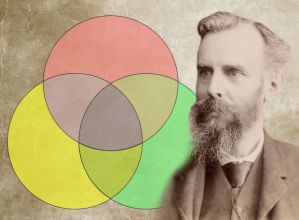
Generalized System of Classes
The partly generalized proposition:
(a): 0 < a
A general assertion about the specific term I:
(a): a < I
Two completely general propositions:
III (Ǝ0)(a) : 0 < a
‘there is at least one class, 0, such that, for any class a, 0 is included in a;,
And IV (ƎI) (a) : a < I
‘there is at least one class, I, such that, for any class a, a is included in I’
Then (a) 0 < a
And (a) a < I
K(a, b….)<
With the general interpretation:
K =int ‘classes of individuals’
< =int ‘is included in’
The constituent relation of a general system of classes
George Boole
A Convenience of Symbolism
Boolean system
(a, b) : a fm b . b fm a
Thus in the proposition:
(a, b, c): a nt b . b nt c .>. a nt c
The dots around the implication sign set apart ‘a nt b. b nt c’
From ‘a nt c’
For instance, to say that if a is North of b or of c, then it is North of d, would read:
(Ǝa, b, c, d): . a nt b .v. a nt c : > a nt d
The entire structure is visually and typographically much simpler than:
(Ǝa, b, c, d){[(a nt b) v(a nt c)] > (a nt d)}
(a, b): ~. a nt b . > . b nt a
(a, b): . ~ : a nt b . > . b nt a
In the latter case, the ‘~’ extends over the whole structure. Making it negative
Practice
Practice
To distinguish –(a + b) from –a + b. but propositions are no longer to be enclosed in parentheses
Should be mastered
Summary
A class may be formed by varying one term of its entire ‘range of applicability’.
Classes are usually defined by predicates
A predicate has exactly the logical properties that would belong to a relation of one term, if there could be such a thing
Predicates have just one important use in logic: they are the simplest means of generating classes
To gain any interest we must have more than one predicate
1) that the class is equal to 1, in which case its compliment is equal to 0, or
2) that the class is not equal to 0, i.e. its compliment is not equal to 1.
But ϵ-propositions about general elements may be turned into <-propositions about specific classes.
So it is perfectly legitimate to start with a K whose primitive elements, by interpretation, shall be classes, and a primitive (instead of defined) relation <.
1) propositions expressing certain ‘granted’ facts, that merely happen to s- and therefore must be inductively known, and
2) propositions stating necessary conditions, that belong to the system simply because its elements are classes and its relation is <.
For the sake of typographical ease and visual clarity, dots are used to replace brackets.
Questions for review p. 180
Chapter VIII
The Deductive System of Classes
The Class-System as a Deductive System
(Ǝa, b): ~ . a x b < 0
(Ǝa, b) . a < b
The number of facts about classes and inclusion that may be asserted merely on the basis of their general nature
So that, if only a small selection of them is explicitly stated, the rest must follow implicitly
Postulates and Theorems
A proposition cannot be deduced from anything but another proposition
They have to be frankly assumed, or postulated
A set of postulates
The classic example of a set of postulates for a system is Euclid’s formulation of geometry
Facts which he calls ‘axioms’
Self-evidence
The fact that a whole is greater than any of its proper parts is considered by Euclid to be self-evident
Consequently ‘known by intuition’
But self-evidence of any proposition turns out, on closer scrutiny, to be a very questionable affair.
A little girl would find it self-evident that 365 – 1 = 364; whereas Humpty Dumpty preferred to see it done on paper.
The history of science is full of examples, for instance, that people at the antipodes would be suspended from the earth head down and would fall into space, was undoubtedly self-evident to an age that had not learned to associate ‘falling’ with motion toward a greater body’; and our own children still find the inverted position of China axiomatic. Also it seems self-evident to every right-minded child that he cannot subtract 13 from 10; yet he will presently learn that this proposition is false.
Euclid himself does not draw the distinction between axioms and postulates very sharply
For our part, we know how deceptive intuition may be
All our ‘granted’ propositions are to be regarded as postulates, with no claim to psychological necessity
All we ask of a postulate is
1) that it shall belong to the system i.e. be expressible entirely in the language of the system
2) that it shall imply further propositions of the system
3) that it shall not contradict any other accepted postulates, or any other accepted postulate, or any proposition implied by such another postulate; and
4) that it shall not itself be implied by other accepted postulates, jointly or singly taken.
Coherence
The second is contributiveness
Premises for deduction
The third requirement is the most important; that is ‘consistency’
Inconsistency is a fatal condition
Where this fault is tolerated there is simply no logic at all
The fourth criterion is termed independence
Might be proved by a theorem
What a theorem is needs a little elucidation; any proposition, that is implied by another proposition or conjunction of propositions ‘granted’ or previously proved within the system is a theorem
We may prove something to be necessarily not so
But contradictory theorems can never follow from consistent postulates
A postulate must contain something that cannot be proved in the system
A theorem, on the other hand, must contain nothing that cannot be proved
Contain no assumption not made in the postulates
Truth and Validity
‘Brutus killed Caesar’ > ‘Caesar is dead’
‘Cassius killed Caesar’ > ‘Caesar is dead’
The fact that ‘Cassius killed Caesar’ is false does not alter the implication
For the truth of postulates there is no logical guarantee
A conceivable state; no formal distinction between factual and fictional premises
None whatever. Logic does not go beyond for any original fact.
All it guarantees is that, if the premise be granted….then the system follows thus and so. This is not a factual certainty, or truth; it is logical certainty, or validity.
For in logic we require only that our assertions shall be valid, not that they convey truths about the world.
For instance, the two propositions:
Napoleon discovered America
Napoleon died before A.D.
Jointly imply America was discovered before A.D. 1500 …is perfectly valid
On the other hand, suppose I had postulated:
Columbus discovered America
Columbus died after 1490
And concluded: therefore – America was discovered after 1490
Logical argument would not be sound.
Conclusion: False or invalid
But the truth of premises cannot be established by logic; whereas validity is its whole concern.
Postulates for the System of Classes K(a b…) <₂
A dyadic relation as follows:
K(a,b,c….)<₂ K =int ‘classes of individuals’
< =int ‘is included in’
Postulates:
1) (a) . a < a
‘Every element is included in itself’
2) (a, b, c): a < b. b < c . > . a < c
‘if any element is included in another and that other in a third, then the first is included in the third.’
3) (Ǝ1) (a) . a < 1
‘there is at least one element 1, such that, any element, a, is included in 1.’
(Ǝ0) (a) . a < 1
‘there is at least one element 0, such that, whatever element we call a, 0 is included in it.’ (0 is an ‘empty class’, zero.)
(a) (Ǝ-a)(b, c): . b < a . b < -a . > . b < 0: a < c . –a < c .> . 1 < c
‘for any a, there is at least one –a and such that any b which is included in 0, and any c which includes both a and –a also includes 1’. (This means that a and –a have no common part, and between them constitute the universe-class: -a is, then, the compliment of a).
(a, b) (ƎPᵃᵇ): . P < a . P < b : (c) : c < a . c < b . > c < P
‘For any a and any b, there is at least one element P (the subscript indicates that P has reference to the given a and b), such that P is included both in a and b (i.e. ‘any c included in a and in b, must be included in P’. The element P, therefore, is the greatest common part of a and b
(a, b)(Ǝsᵃᵇ): . a < s . b < s : (c): a < c . b < c . b < c . > . s < c
‘For any a and b there is at least one element s such that a and b are both included in s, an any element c which includes both a and b also includes s’. The element s for the given a and b is, then, the smallest element which includes them both.
(a, b, c): . c < a . c < b . > . c < 0: > . a < -b.
‘For any a, b, c, is c’s being included both in a and b implies that c is zero (i.e., if a and b can have no element in common but zero), then a is included in not-b’.
To these postulates may be added, for convenience, three important definitions:
(i) (a, b) : a = b . ≡df . a < b . b < a
‘a = b’ shall mean the same thing as ‘ a and b are mutually inclusive’
(ii) (a, b): a x b ≡df. Pᵃᵇ postulate 6
‘a x b’ shall represent the element P defined for a and b in postulate 6.
(iii) (a, b): a + b . ≡df. sᵃᵇ postulate 7
‘a + b’ shall represent the element s defined for a and b in postulate 7.
A systematic codification
Noted in chpt. VI
Assuming a relation
Every class includes itself; every class includes sub-classes of its sub-classes; every class is included in the universe class, and includes the empty class.
Every class has a compliment; the class and its compliment are mutually exclusive, and exhaust the universe class between them. Any two classes have a sum and a product (If they are mutually exclusive, the product is zero (0)).
With these notions and these fundamental facts we can construct the whole system of classes by a process of logical deduction.
Relations and Operations
System of classes
Simple deductive systems
Postulates which describe ways of finding further elements
Operation
Thus, if we introduce a general proposition with the quantifiers: (a) (Ǝ –a), ‘for every a there is at least one –a, such that…’
We might perfectly well say:
And hereafter operate with a and x as complimentary terms
A symbol of operation on those given terms
‘the class of what is both a and b and also c,’
(a): a + -a = 1
a x -a = 0
(a, b): (a x b) + b = b
(a,b,c): (a + b) x c = (a x c) + (b + c)
(a, b): -a + -b = -(a x b)
Ad infinitum
….only more and more elaborate expressions for the same classes. For example:
(a, b): (a x b) + (a x –b) = a
A complex (and sometimes very important) description of the class a.
Defined notions – equations and sums instead of the original constituent relation (i.e. <) in practice, equations are much easier to handle than inclusion…
Operations as ‘Primitive Notions’
An operation is a relation to a given term, or to a given terms, whereby further term is defined, such a relation is, of course, more difficult to grasp than (say) ‘<’, ‘fm’ or ‘bt’. But the psychological difficulty in imaging it has nothing whatever to do with its status in logic.
Logically simple, though it may be psychologically complex…
.,..so that we may write:
K(a, b…) + , x, =₂
K(a, b…) (+ =)₃, (x =)₃
Or, as is commonly done, regard = as understood, and write merely: K(a, b…) +, x
Binary operations : + , and x
Triadic: a relationship among three terms, a, b, and s
Or – a, b, and p
Postulates for the System K(a,b…) +, x, =
Constituted operations
We now start from the following assumptions:
K(a, b…) +, x, =
K =int ‘classes’
+ =int ‘class-disjunction’
X =int ‘class-conjunction’
= =int ‘is identical with’
Postulates:
“for any two terms, a and b, there is a third term, c, which is the sum a + b’.
product of a x b’ (note that c has different meanings in these two propositions. In either case, ‘there is a third term’, but the two cases have no relation to each other).
‘there is at least one element 0 such that, for any a, a + 0 is the same as a’.
‘there is one element 0 such that, for any a, a x 1 (i.e. the common part of a and 1, is the same as a).
‘for any a and b, a + b is the same as b + a.
‘for any a and b, a x b is the same as b x a
‘for any a, b, and c, the sum of a with the product of b and c is the same as the product of the sums (a + b) and (a + c)’.
‘for any a, b, and c, the product of a with the sum of b and c is the same as the sum of the two products a x b and a x c’.
These two propositions are much easier to grasp symbolically than verbally; we have come to the point where symbols are easier to manipulate than words. 199 *
‘for every a there is at least one element –a such that the sum of a and –a is the universe class, and their product is the null class’.
We add one more assumption:
‘there are at least two elements which are not identical’.
Laws of their manipulation
The system of classes thus lends itself to computation, i.e. to the finding of new terms from old ones and the exact calculation of their relations to 1, the whole, and 0, the limit.
The Calculus of Classes
Such a class, having definite rules of computation whereby its elements may be uniquely defined, i.e. known to exist and unambiguously described, is a calculus, in the most general sense of that word.
‘the’ calculus
The infinitesimal calculus of mathematics, invented by Leibniz and Newton
A calculus is, in fact, any system wherein we may calculate
The famous ‘hedonistic calculus’ of Bentham
The relative magnitudes of pleasures could be exactly calculated.
The ‘Calculus of Classes’
Summary
Describe classes and describe
Deductive
Postulates
In Euclid’s geometry
Self-evident
‘axioms
(1) coherence
(2) contributiveness
(3) consistency
(4) independence
Not really interested in the truth
But in the validity
If premises are true then the conclusion is true
K(a, b…)<₂ is a deductive system, we may state its arbitrary ‘original’ propositions as a set of postulates
‘operation’
Negation
Class-disjunction
Class-conjunction
=
The ‘calculus of classes’
It is the simplest mathematical system of any importance
Questions for review pg. 204
Chapter IX
The Algebra of Logic
The Meaning of ‘Algebra’ and its Relevance to the Class-Calculus
If we assumed a Universe of Discourse whose elements were certain specific classes, A, B, C, etc. including a universe class I, a null class 0, and for each given class a negative – -A, -B, -C, etc. – and a product, we should have a perfectly good calculus, the operations and relations of which were expressed as facts about specific elements.
The number system
Is a calculus
Algebraic expression. A symbolic language for the generalized expression of operations on a set of elements is an algebra. The form:
a + b = c
Becomes a general rule of arithmetic as soon as its elements are properly quantified:
(a, b)(Ǝc) . a + b = c
(a, b)(Ǝc) . a x b = c
(a, b)(Ǝc) . a – b = c
(a, b)(Ǝc) . a ¸ b = c
The algebra of numbers
Any numbers
Some numbers
1) 1(one) being ‘the element whereby any number, a, may be multiplied without being altered’, and
2) 0 (zero) ‘the element which may be added to any a without altering that a’.
‘(a, b): (a + b) x (a + b) = (a x a) = (2 x a x b) + (b x b)’
But the generalized class-calculus is none the less an algebra, howbeit not a numerical algebra; it is known as the Algebra of Logic, and sometimes Boolean algebra.
Its laws
‘primitive propositions’
Further Discussion and Postulates
The ten postulates for K(a, b…) +, x, =
K(a, b…) +, x, = K =int ‘classes of individuals’
+ =int ‘class-disjunction’
X =int ‘class – conjunction’
= =int ‘is identical with’
(a, b)(Ǝc) . a + b = c
(a, b)(Ǝc) . a x b = c
(Ǝ0)(a) . a + 0 = a
(Ǝ1)(a) . a x 1 = a
(a, b) . a + b = b + a
(a, b) . a x b = b x a
(a, b, c) . a + (b x c) = (a + b) x (a +c)
(a, b, c) . a x (b + c) = (a x b) + (a x b)
(a)(Ǝ-a): a + -a = 1 . a x –a = 0
(Ǝa, b) . a ¹ b)
Altogether we have here ten postulates, or primitive propositions, unproved and unchallengeable assumptions about the system.
The different kinds of postulates are distinguished by the type and order of their quantifiers
e.g. (a) (Ǝb)
Universal – any
A particular quantifier (Ǝa)(b)
‘there is at least one such and –such’ or ‘there are at least two such and such’
The postulates grant the existence of certain elements, rules for deriving new elements, and rules for manipulating whatever elements there are.
operators, like + and x
or the defined operation ‘not’
Principles of Proof: Substitution, Application, and Inference
Canons of logical procedure
Principle of substitution
Identical or equivalent may be substituted
Principle of application
If: (a, b) . a + b = b + a
And if we know there is a certain x and there is a certain y, then it is true of this x and this y that :
‘x + y = y + x’
Principle of inference
Implication
Thus if we know that (Ǝa, b) . a = -b
And also that (a, b): a = -b. > . b = -a, then we may assert b = -a henceforth as an independent proposition, not merely as a part of ‘(a, b): a = -b . > b = -a.’
This is the process of passing from premises to their conclusion, which may be called ‘deductive reasoning’
These general rules of argument
In the form of deduced propositions or theorems
Elementary Theorems
Logical ‘ideals’
What the mathematicians call ‘elegance’, plan and symmetry in exposition
The rules of manipulation
The commutative law: this law grants one the right to commute the elements in a sum (or product) to write:
a + b or b + a, as b x a or a x b
The distributive law:
One for an element added to a product, the other for an element multiplied with a sum. IVa states that an element a which is added to a product, (b x c), may be ‘distributed’ rather in the way a cold may be distributed, by one sufferer, to a whole roomful of people, each person receiving the whole cold in all its glory. IVb asserts this law for the multiplication of an element with a sum; each member of the sum may be separately multiplied by that element so that it is ‘distributed’ over the members of the sum without being itself split up. Thus a(b+c) may be written (a x b) + (a x c).
The form
Most of our proofs, however, involve the element 1 and 0.
Theorem Ia
The element 0 in IIa is unique
Stated in words, not symbols
Huntington
Verbally
Proof:
Assume an element 0₂ having the properties of 0, so that we have 0₁ and 0₂.
Then (a) . a + 0₂ = a
By the principle of application, what is true of a is true of 0₁,
So 0₁ + 0₂ = 0₁
Likewise, what holds for a in IIa holds for 0₂, so
0₂ + 0₁ = 0₂
But, 0₂ + 0₁ = 0₁ + 0₂ by IIIa
But, 0₂ + 0₁ = 0₂ and 0₁ + 0₂ = 0₁
So, by the principle of substitution, 0₂ may be written for 0₂ + 0₁ and 0₁ for 0₁ + 0₂ and we have:
0₂ = 0₁
Any element, therefore, which has the property ascribed to 0 in IIa is identical with 0; which is to say 0 is unique.
Theorem 1b
The element 1 in IIb is unique.
The proof of this theorem is exactly analogous to that of Theorem Ia, applying IIb in place of IIa and IIIb in place of IIIa.
The uniqueness of 0 and 1 being thus guaranteed, we are able to demonstrate another important equation, a characteristic of the system known as the ‘Law of Tautology’:
Theorem 2b.
(a) . a x a = a
Proof: a = a x 1 by IIb
1 = a + -a by V
Hence a = a x (a + -a)
a x (a + -a) = (a x a) + (a x –a) = (a x a) + 0 = a x a
Or: a = a x a Q.E.D.
Theorem 2a.
(a) . a + a = a
The proof of this theorem is analogous to that of 2b, and may easily be carried out, using IIa in place of IIb and IVa in place of IVb.
These propositions are called ‘tautologies’ because they show that it makes no difference how many times a term is mentioned in a sum or a product; a product is not changed by being multiplied by something that is already a factor of it, nor a sum by having one of its summands added to it any number of times. Naturally, the common part of a and a is the whole of a and nothing more; the class of dogs is simply the class of dogs; and what is either a or is a must likewise be just exactly the class a; what is either a cat or a cat is a cat. The tautology is obvious.
It is owing to these two propositions that the algebra of logic has no exponents and no coefficients. If a x a = a, we need not bother about an a², since a²= a; if a + a = a, we can never arrive at 2a; hence the peculiar simplicity of class-calculus.
Theorem 3a.
(a). a + 1 = 1
Proof: a + 1 = (a + 1 x 1)
By IIa, since (a + 1) is a simple term, and may take the place of a in the formula
(a + 1) x 1 = 1 x (a + 1) IIIa
1 = a + -a
Hence 1 x (a + 1) = (a + -a) x (a +1) substitution
(a + -a) x (a + 1) = a + (-a x 1)
By IVa. (the second form in the equation here stands first)
Hence 1 x (a + 1) = a + (-a x 1)
Substituting back, 1 for (a + -a)
But 1 x ( + 1) = a + 1 IIb
And -a x 1 = -a IIb
Hence a + 1 = a + -a Substitution
Or a + 1 = 1
Q.E.D.
Theorem 3b.
(a) . a x 0 = 0
The proof is analogous to that of 3a, using IIa instead of IIb, IIIa, instead of IIIb, IVb instead of IVa.
The rules of logic merely permit some moves and forbid others, but never dictate a line of argument.
To understand logic is a science, resting purely on reason; but to use logic, to select postulates or demonstrate theorems, is an art, and requires imagination.
The next proposition is again a ‘law’ of the system, applying to all its elements.
Theorem 4b.
(a, b) . a x (a + b) = a
Proof: a x (a + b) = (a + 0) x (a + b) IIa
(a + 0) x (a + b) = a + (0 x b) IVa
= a + (b + 0) IIIb
= a IIa
Q.E.D.
Theorem 4a
(a, b) . a + (a x b) = a
The so-called ‘laws of absorption’
i.e. the class of people who are either soldiers or German soldiers is the class of soldiers.
Theorem 5a.
(a, b) . (a + b) x (a + -b) = a
Proof: (a + b) x (a + -b) = a + (b x –b) Iva
a + (b x –b) = a + 0 = a V, IIa
Theorem 5b
(a,b) . (x b) + (ax-b) = a
The proof is similar to 5a, using IVb for IVa
‘the law of expansion’
Thus, a – [(a x b) = (x –b)] + [(a x c) + (a x –c)] + [(a x d) + (a x –d)….since each bracketed expression equals a, and the total, a + a + a + ….by the law of tautology, is also identical wth a.
The value of this formula is that it allows us to use a single term as a sum of products or a product of sums, in making calculations. A term may be ‘expanded’ until it matches some other expression with which it is to be compared in manipulation, so that we can often produce a convenient symmetry of forms, which allows all sorts of mathematical tricks and transformations.
At this point, the operation ‘negation’ requires some further elucidation.
Universe class
i.e. that there is just one compliment for a….
Theorem 6 proves this point.
Theorem 6.
(a, b, c): a = -c . b = -c . > . a = b
Proof: a = a x 1 IIb
= a x (c + b) V
= (a x c) + (a x b) IVb
= (c x a) + (b x a) IIIb
= (0 + (b X a) V
= (c x b) + (b x a) V
= (b x c) + (b x a) IIIb
= b x (c + a) IVb
= b x 1 V
= b IIb
Q.E.D.
This proves that for every a, -a is uniquely determined by the operation – on a. Every term has just one compliment. From this it is easy to prove:
Theorem 7
(a, b): b = -a . > . a = -b
Proof b = -a . > . a + b = 1 . a x b = 0 V
Then b + a = 1 . b x a = 0 IIIa,b commutative law
Therefore a fulfils the condition for –b, and by theorem 6 this makes it identical with –b
Hence a = -b
This is known as the ‘law of contraposition’, from which it follows, as a corollary, the ‘law of double negation’
Theorem 8
(a) . a = -(-a)
The proof is obvious; a term and its complement are each other’s complements. i.e. every element is the complement of its complement.
One further pair of theorems may here be deduced, before we discuss the ‘law of duality’
The theorems in question assert the ‘laws of association’
Theorem 11a
(a, b, c) . ( a + b) + c = a + (b + c)
Theorem 11b
(a, b, c) . (a x b) x c = a x (b x c)
That is to say if:
a + (b + c) = (a + b) + c
And a x (b x c) = (a x b) x c
The parentheses lose their significance
a + b + c and a x b x c
Only where we wish to treat part of such an expression as a single term we employ parentheses to set it off.
a x b is often written simply as ab:
(a x b) + (-a x b) + c + (a x d)
By simply omitting parentheses would be confusing
But : ab + -ab + c + ad is unmistakable
The Duality of + and x
If products are ‘associative’, so are sums, if sums are ‘commutative’, so are products, etc.
Theorem 10a
-(a + b) = -a x b
The theorem asserts that –a x –b is –(a + b). i.e. Is the complement of a + b; if we can show that (a + b) + -a-b = 1 and (a + b) x –a-b = 0, then the theorem is proved.
-a + (a + b) = 1
And – a x ab = 0
Call this Lemma 1.
Proof:
-a + (a + b) = 1 x [-a + (a + b)] IIa
1 = -a + a V
Hence: 1 X [-a + (a +b)] = (-a + a) x [-a + (a + b)]
= -a + [a x {a + b)] IVa
But: a x (a + b) = a 4b
Then: -a + [a x ((a + b)] = -a + a
= 1 V
Similarly, -a x ab may be shown to equal 0, the proof need not be explicitly rehearsed here, but may be designated by Lemma 2.
Now we can prove
Lemma 3. (a + b) + -a –b = 1
Proof: (a + b) + -a –b = [(a + b) + -a]
[(a + b) + -b] IVa
But (a + b) + -a = -a + (a + b) IIIa
And -a + (a + b) = 1 lemma 1
(a + b) + -b = -b + (b + a) = 1 III and lemma 1
Then (a + b) + -a-b = 1 x 1 = 1 2a
Finally we have:
Lemma 4. (a + b) x –a-b = 0
Proof: (a + b) x –aa = -a-b x ( + b) IIIb
-a-b x (a + b) = (-a-b)a + (-a-b)b IVb
= a(-a-b) + b(-a-b) IIIb
a x (-a-b) = 0 lemma 2
b x (-a-b) = 0 lemma 2
0 + 0 = 0 2a
Since (a + b) + -a-b =1
And (a + b) x –a-b = 0
-a-b =-(a +b) Q.E.D.
The rather elaborate proof of theorem 10a is given because of the great importance of the proposition in question. Analogously, we might demonstrate
Theorem 10b:
(a, b) . –(a x b) = -a + -b
But that is left to the brave and ambitious reader
Every sum may be turned into a product and vice versa
The ‘law of duality’
The theorem’s dealing with operation follow two by two, like Noah’s animals
Why then assume both sums and products as ‘primitive notions’ sums are just another way of writing products.
If we assume as ‘primitive’ the meaning of x, and admit
(a, b) (Ǝc) . a x b = c
Then we may regard a + b as merely another way of saying –(-a-b); everything that is true of a +b is true of –(-a-b), and vice versa. So if we take x and – as ‘primitive’ + may be defined as follows:
(a, b): a + b . ≡df . –(-a-b)
….but must wait upon the introduction of the ‘defined notion +’
Professor Lewis, ‘A Survey of Symbolic Logic’
We may define ‘logical disjunction’ as a ‘primitive’ notion, and, with the help of the postulated (i.e. described, not defined)
operation -, define the notion of ‘logical conjunction’, thus’
(a, b): a x b . ≡df. –(-a + -b)
The whole algebra may be determined by a handful of ‘primitive propositions’ in terms of ‘+’ alone; the definition of ‘a x b’ figures in such a system as a mere convenience, since it could always be replaced by –(-a + -)…
Imagine the ‘distributive law’ in terms of ‘x’ alone:
(a, b, c) . a x –(-b x –c) – -[-(a x b) x –(a x c)]
Clumsy
Professor Huntington
Inclusion, symbolized by < , and determined thus:
(a,b): a < b .≡df. a + b = b
‘a is included in b’ is always to mean the same thing as : ‘the sum of a and b is b itself’.
We might as well have defined < through an equation containing a product:
(a, b) : a < b . ≡df. ab = a
‘ a is included in b’, is always to mean the same thing as: ‘the product of a and b is a itself.’
Logical equivalence is equal to mutual implication
And so on theorems 12 – 21 pgs. 226 – 231
Many of these theorems are so simple that their proof is almost a matter of stating definitions. But they have a significance, none the less, for the general understanding of Boolean Algebra, …
Comparison with Postulates for K(a,b…)<₂
It is possible to make more than one selection among all the propositions of Boolean algebra, such that the chosen set of propositions shall imply all the rest.
Two different descriptions of one and the same thing.
Fundamental traits of Boolean Algebra
The existence of a complement for every term
The existence of a sum for any two terms
The existence of a product for any two terms
These are the ‘operational assumptions of the algebra’
The existence of a universe class
The existence of a null class
The existence of more than one term (not essential, but usually assumed).
The laws of tautology:
A + a = a a x a = a
The laws of commutation:
A + b = b + a a x b = b x a
The laws of association:
(a + b) + c = a + (b + c) (a x b) x c = a x (b x c)
The laws of distribution:
a + (b x c) = (a + b) x (a + c)
a x (b + c) = (a x b) + (a x c)
(note that the first of these differs from ordinary algebra, whereas the second does not).
The laws of absorption:
a + ab = a a x (a + b) = a
These are the laws of ‘combination’
The laws of the universe class
a x 1 = a a + 1 = 1
The laws of the null class:
a + 0 = a a x 0 = 0
These are the laws of the unique elements.
The laws of complementation:
a + -a = 1 a x –a = 0
The law of contraposition:
A = -b . > . b = -a
The law of double-negation:
a = -(-a)
The laws of expansion:
Ab = a – b = a
(a + b) x (a + -b) = a
The laws of duality:
-(a + b) = -a x –a
-(a x b) = -a + -b
These are the laws of negation
This algebra – extremely simple
Technicalities
Exhibition of relatedness
Character as structure
It tells us nothing whatever about classes except their ‘formal relations’ to each other
All the algebra describes is, what sort of relations hold among classes.
Summary
Therefore the calculus of classes, which is given, through general (quantified) propositions, is a genuine algebra.
1) substitution
2) application
3) inference
Transformed
The duality of + and x is a peculiarity of Boolean Algebra
The so-called law of duality
(a, b) . –(a + b) = -a-b
(a, b) . –(ab) = -a + -b
For if –(a +b) = -a-b, then a + b = -(-a-b)
Consequently, a + b and –(-a-b) mean the same thing
The ‘laws’ of Boolean algebra
What is a postulate and what is a theorem is always a relative matter
Fits the formal conditions
Questions for review p. 238
Chapter X
Abstraction and Interpretation
Different Degrees of Formalization
Logic – so this book announces in its very beginning – is the study of forms; and forms are derived from common experience, reality, life, whatever we choose to call it, by abstraction
Formalized elements of variable meaning
General terms
From specific elements to quantified variables, or general terms
We can no longer speak of specific things, but only of any or some things of a certain kind.
‘a certain house’ is not an abstraction. It is just as concrete as Mt. Vernon, Sunnyside, or The Elms….
(a) . ~(a nt a)
(a, b): a nt b.>.~(b nt a)
(a, b, c): a nt b .
a nt c
suppose, however, we omit the interpretation of K. what becomes of (say) the statement:
~ (a nt a)?
Certainly it may read:’ For any element north of any sort, it is always false that this element is to the north of itself;
(a) and (Ǝa) may be read ‘anything’ or ‘something’
The quantified formula with an interpreted relation (or predicate, or operation) is a proposition.
The ‘realm of significance’
Obviously ‘Nothing is to the North of itself’ applies only to physical things on earth’s surface; we cannot even ask, except in very modern poetry, whether 3 is to the North of wisdom, or perfection is to North of purple, or whether science is to the North of itself. Such terms do not belong to the universe of discourse’ which is understood’ in the use of the relation ‘nt’, i.e. to the greatest possible universe for this relation.
By formalizing (i.e. leaving uninterested) K, we obtain general statements about unspecified concrete things.
i.e. relation # (higher in pitch)
K(a, b,….)#₂
# =int ‘higher in pitch’
(a) . ~(a # a)
(a, b): a # b.>. ~(b # a)
(a, b, c): a # b . b # c.>. a # c
These three propositions look astoundingly like the three of our previous system:
(a) . ~(a nt a)
(a, b): a nt b . > . ~(b nt a)
(a, b, c): a nt b . b nt a . > . a nt c
Suppose now, a new notation is adopted, and write the following three expressions:
(a) . ~(a R a)
(a, b): a R b . > . ~(b R a)
(a, b, c): a R b . b R c . > . a R c
The symbol R (for relation) may be taken to mean either nt or #.
If R, in the above expression be interpreted as ‘older than’, ‘ancestor of’, or ‘under’, exactly the same constructs will hold that hold for ‘nt’ or for ‘#’.
To make the entire context ambiguous
These prescribed forms however, automatically set limits to the variety of relations which R may mean. For instance, R could not mean ‘next to’, because (a, b): a R b. >.~(b R a) would then be false, and (a, b, c): a R b . b R c . > . a R c would hold only if a = c, or if a, b and c always formed a triangle. ‘next to’ is not the type of relation that universally fits the given arrangement of elements; ‘before’, ‘greater than’, and many other common relations are of the required type, and all such relations are the values for the variable R.
But suppose that, instead of giving R some arbitrary meaning, we may say simply that there are certain relations – or, according to the best logical usage, there is at least one relation, R – having the postulated properties. This turns our propositional forms into one completely generalized proposition about the relation R:
(ƎR): : (a). ~(a R a): . (b, c) : b R c . > . ~ (c R b) : . (d, e, f): d R e . e R f .> . d R f
‘there is at least one R, such that for any term a, a R a is false; and for any two terms, b and c, b R c implies that c R b is false; and for any three terms, d, e, f if d R e and e R f, the d R f is true.’
The nature of a, b : these are given merely as ‘elements’, not things of any specified sort, physical, mental, sensory, conceptual, or what-not.
Abstract
By formalizing the constituent relations (or predicates, or operations), we obtain abstract propositions. And abstract statement is a completely generalized propositional form.
So, when we generalize the constituent relation(s) as well as the elements of any system, we properly abstract the form the content, and this is the essential business of logic.
Properties of Relations
….there is at least one relation R, having certain properties…
The most fundamental characteristic of a relation is its ‘degree’. This is the property of always forming dyads, triads, tetrads, etc….
Reflexive
Irreflexive – i.e. brother of’, higher in pitch’, north of’ , are all irreflexive since:
(a) . ~(a br a)
(a) . ~(a # a)
(a) . ~(a nt a)
Non-reflexive: i.e. , ‘likes’, ‘hurts’, ‘defends’, etc. for we may have either:
(Ǝa) . a likes a
Or: (Ǝa) . ~(a likes a)
A non-reflexive relation allows of the case a R a but does not require it.
Symmetry – Rb always implies b R a
i.e. ‘married to’, ‘resembles’, ‘parallel with’
asymmetrical – a R b precludes b R a
i.e. ‘greater than’, ‘descendent of’, and the familiar ‘#’ and nt of previous sections. For it is true that:
(a,b) . a nt b . > . ~(b nt a)
And (a,b) . a # b . > . ~(b # a)
Non-symmetrical = a relation which may, but need not combine two terms in both orders, i.e. – ‘likes’, ‘fears’, ‘implies’
Finally ( somewhat complicated )
Transitivity: transitivity is the property of being transferable from one pair of terms to another; a transitive relation is one which, if it holds between two terms a and b, and between b and a third term c, holds also between a and c. symbolically, it fulfils the condition:
(a, b, c): a R b . b R c . > . a R c:
All Chinamen are men
All men are mortals
All Chinamen are mortals
Intransitive – i.e. ‘son of’ is intransitive for:
‘if a is the son of b and b is the son of c, a cannot be the son of c.
Where the relation of a to c is possible but not implied, R is non-transitive.
The ‘named’ characteristics are by no means the only ones which a relation may possess.
Postulates as Formal Definitions of Relations
A formal definition of R
A formula for systems of a certain sort.
K(a,b……R₂
(a, b) . ~ (a R a)
(a, b, c) : a R b . b R c . > . a R c
The third namely:
(a, b) > a R b . > . ~(b R a)
theorem proved as follows:
Assume (Ǝa, B) . A R b . b R a
Then a R b . b R a . > . a R a 2
But ~(a R a) 1
~(a R a) . > . ~(a R b . b R a)
Therefore, a R b .> . ~(b R a) Q.E.D.
A third postulate is to be added, however:
(a, b): a ¹ b . > . a R b v b R a
Connected
Irreflexiveness, transitivity, connexity, and (by implication) asymmetry
Serial relations
Spatial elements
Magnitudes
Any system ordered by a serial relation, that is, any interpretation of the abstract system K R above, is a series.
Series
There are kinds of series – finite and infinite
A series with a beginning and no end (e.g. ‘future time’)
Or an end with no beginning (e.g. ‘the past’)
All these different types of series are determined by special postulates, such as:
(Ǝa)(b): ~(a R b). > . a = b
Every series requires a serial relation, and this requirement is fulfilled by any R that is irreflexive, transitive, and connected.
The import of this whole discussion is, that a whole system may be taken as an abstract form.
Every relation allows us to abstract its pure form, i.e. to write R instead of nt, or ‘is the nearest male relative of ‘ or ‘is equidistant from’, or what-not.
What has been said of relations holds equally, of course, for operations, since the latter are really abbreviated expressions for such relations as define a new element from old. Operations are modes of combination.
A ‘formalized’ operation, written ‘op’
Thus instead of (a, b) . a + b = b + a
We might have the completely general un-interpreted proposition:
(Ǝop)(a,b): a op b = b op a
Suppose we adopt the notations ⨁ and ⨂ to represent these two generalized operations
The Boole-Schroeder Algebra of Classes
‘abstract Boolean algebra; it is the latter that is expressed in our new symbolism, by the following abstract propositions:
K(a, b)…..) ⨁, ⨂, =
(a, b)(Ǝc) . a ⨁ b = c
(a, b)(Ǝc) . a ⨂ b = c
(Ǝ0)(a) . a ⨁ 0 = a
(Ǝ1)(a) . a ⨂ 1 = a
(a, b) . a ⨁ b = b ⨁ a
(a, b) . a ⨂ b = b ⨂ a
(a, b, c) . a ⨁+ (b ⨂ c) = ( a ⨁ b) ⨂ (a ⨁ c)
(a, b, c) . a ⨂ (b + c) = (a ⨂x b) ⨁ (a ⨂ c)
(a)(Ǝ-a): a ⨁ -a = 1 . a ⨂ –a = 0
(Ǝa, b) . a ¹ b
The system K, ⨁ , ⨂, = is Boolean algebra in abstracto, the formula of which the class-calculus is an interpretation.
Other Interpretations of the Boolean Formula
We might regard the elements of the algebra as areas in a plane space.
The ten propositions of the algebra now take the following meaning: (see pg. 256 – 258)
…spatial inclusion
Or ‘lying within’
‘Euler’s circles’
‘visible’, conceivable’, or as the Germans aptly express it, the more ‘anschaulich’
The physical symbol exemplifies the same logical form that is exemplified by its object.
Analogy
‘nowhere’
Chapman and Henle, ‘Fundamentals of Logic‘, 1933
We are faced with the astonishing fact that the mathematics of pie-cutting is a Boolean algebra.
The Two-Valued Algebra
….only two possible values. Note that ‘value’ here refers to terms in the system, which may be substituted for a, by the principle of application; not to possible interpretations of a…
Interpretational values
The two-valued algebra
‘the principle of all or none, or ‘the law of the excluded middle’, which students of Aristotelian logic have met among the famous ‘laws of thought’
Quantified elements stand for ‘anything’ and ‘something’
The greatest generalization of the system K R
types
Thus a relation which is irreflexive, connected, and transitive is said to be serial
Series
Such a pattern may be very complicated
VII (a) : a = 1 . V . a = 0
A two-valued algebra
It has a most important possible content, namely the laws of deductive reasoning, the structure of logic itself; to this end it is worth considering in detail.
Questions for review p. 265
Chapter XI
The Calculus of Proposition
Properties of Logical Relations and Operations
But always among propositions; that is to say, the terms of these relations are propositions, and consequently any proposition to which these relations and their terms give rise, are propositions about propositions
Consider, for instance, how the relation of implication functions
> Q and Q .> . R, then P. > . R
So the ‘and’ between two propositions, which combines them into one compound proposition, P . Q, is a logical operation
Commutative
Associative
Propositional Interpretation of Boolean Algebra
⨂ =int ‘logical conjunction’
⨁ =int ‘logical disjunction’
As it would be to say:
⨂ =int ‘class-conjunction’
⨁ =int ‘class-disjunction’
The elements of K must be propositions, if ⨂ and ⨁ become logical operations
With the following postulates:
(p, q)(Ǝr) . p v q = r
(p, q)(Ǝr) . p . q = r
(Ǝ0)(p) . p v 0 = p
(Ǝ1)(p) . p . 1 = p
(p, q) . p v q = q v p
(p, q) . p . q = q . p
Iva (p, q, r) . p v (q . r) = (p v q) . (p v r)
(p, q, r) . p . (q v r) = (p . q) v (p . r)
(p)(Ǝ-p): . p v –p = 1 : p . –p = 0
(Ǝp . q) . p ¹ q
(p) . p = 1 . v . p = 0
A two-valued system
Let 1 =int ‘truth’, and 0 =int ‘falsity’, so that ‘p = 1’ is to be read ‘p is true’ and ‘p = 0’, ‘p is false’.
Then the seventh postulate becomes, ‘for any proposition p either p is true, or p is false.
But how about the other postulates wherein 1 and 0 figure?
(Ǝ0)(p) . p v 0 = p
Here the 0 means ‘some proposition which is false’ (i.e. known to equal 0), for example: ‘England is larger than Asia. ‘the other element p, is ‘any proposition’, true of false. Suppose it true; then p = 1. Let it be: ‘the ocean is salty.’ p v 0, then, becomes: ‘Either the ocean is salty, or England is larger than Asia’; one or the other is to be taken as a fact. And since the ocean really is salty, ‘p v 0’ is true, that is, p v 0 = 1. But p = 1; therefore p v 0 = p.
And this holds for any disjunction of two propositions.
IIb, (Ǝ)1(p).p.1=p, is analogous. A logical conjunction is a joint assertion of two propositions.
In toto
~p v q . = . 1
‘either not –p or q is true.’
See pg. 273
The Propositional Calculus as an Algebra of Truth-Values
q . ~p.~q, etc., are just so many different names for 1 and 0.
Frege
Now, if p means, ‘Russia is big’, and q means ‘Mark Twain wrote ‘Tom Sawyer’, then p = 1 and q = 1. But it certainly sounds strange to say that ‘p = q’…..these two propositions seem as different as can be; the only point in which they agree is their truth –value.
In the propositional calculus, all true propositions are equal, and all false propositions are equal.
…it is a calculus of truth-values and their relations, a system of truths and falsehoods.
Only propositions can be true or false.
For instance, each of the two elements has a negative; the disjunct of the two negatives is 1 and their conjunct is 0; or,
(p)(Ǝ~p): p v ~p = 1 . p ~p = 0
also 0 v 1 = 1, 1 v 1 = 1; 0 . 0 = 0 . 1 . 0 = 0;
or (p) . p v 1 = 1
(p): p . 0 = 0
(p,q) may be read either; ‘for any two propositions, p and q,’ or: ‘for any truth-value p, and any same or other truth value q’.
The application
A criterion of proper reasoning
The Notion of ‘Material Implication’
The implication relation:
(p,q): p > q . =df. ~p v q = 1
‘for any p and q, ‘p implies q’ means either not –p or q’ is true’; i.e. ‘’p implies q’ means either p is false or q is true’.
We have no idea
Startle and estrange one
Two famous, or perhaps infamous, propositions, known as ‘paradoxes’ of symbolic logic:
(p,q): p . > . q > p
‘ a true proposition is implied by any proposition’
(p, q) : ~p . > . p > q
‘a false proposition implies any proposition.’
Material implication
The important proposition for inference is:
(p, q): p . p > q . > . q
‘if p is true, and p materially implies q, then q is true.’
And this is the sense of ‘real’ implication.
The ‘Reflexiveness’ of a Propositional Calculus
For reasoning is nothing else than the employment of logical relations and operations to determine the truth-value of new propositions from old established ones.
The laws of logic must be taken for granted before any calculus can be used
A calculus of logical relations serves only to ‘exhibit’, but not to sanction, the formal properties of logical relations. As Professor Sheffer has put it, ‘Since we are assuming the validity of logic, our aim should be, not to validate logic, but only to make explicit, at least in part, that which we have assumed to be valid.
P and q in the system, but is itself an element of the system.
Boolean algebra
Is in its full glory
The algebra of truths and falsehoods is like Cronos devouring his offspring. Everything we can say about truths and falsehoods is itself a truth or falsehood, to be used in producing new true or false propositions of the algebra.
The Significance of a Propositional Calculus
Systematically
‘Nelson was an admiral’
Its center is the problem of expressing ‘logical relations’ in general
The masterpiece of symbolic logic, the ‘Principia Mathematica’ of Alfred North Whitehead and Bertrand Russell
The ante rooms of logistic, mathematical philosophy, and science.
Summary
The seventh postulates, (p): p = 1 . V . p = 0, now reads: ‘any proposition is either true or false’
P > q. =df. ~p v q = 1.
The ‘propositional’ calculus is a calculus of truth values
A true proposition is implied by any proposition, and a false proposition implies any proposition
The concept symbolized by > is, then, somewhat broader than, the ordinary notion, though p > q always holds when p ‘really’ or ‘intentionally’ implies q.
Bertrand Russell has given the algebraic concept the name of ‘material implication’
‘Principia Mathematica’, which is the starting point of the greatest logical work that has yet been done, a foundation of mathematics and science.
Questions for review p. 285
Chapter XII
The Assumptions of Principia Mathematica
Limitations and Defects of the ‘propositional’ Algebra
A type of logical theory
‘logistic’
A powerful logic
Its peculiar Boolean form
Namely the logical form of their respective inter-relations
The only way to pass from class-concepts to truth-value concepts is by a change of interpretations for the whole calculus.
Russell and Whitehead, ‘Principia Mathematica’
Their system is essentially a Boolean algebra
Changes
A careful progressive critique of the ineptitudes and fallacies of the two-valued propositional calculus.
(p) . p = (p = 1)
P = 1
P = 1 . > . ~(~p = 1)
(p) . p = (p = 1)
A breakdown
No telling what is an element and what is an elementary
Proposition.
If: (p) . p = (p = 1), then of course (~p =1) = ~p; so we may write instead of p = 1 . > .~ (~p =1),
P > . ~~p
As this is the same thing as p = 1 . > . ~(~p =1) and > is by (< =int >), p = 1 . > . ~(~p = 1) must be regarded as an elementary proposition of the system.
There is no end to increasing complication of forms that are all identical with p, and with 1….
A tremendous redundancy of forms and endless number of ‘names’ for the element 1 and the element 0…
The denial of a condition
It becomes impossible to distinguish from what we are talking about.
Such a confusion is not logically tenable.
There must simply be two classes of logical relationships – those which function as constituents and those which are functions as logical mortar for the system.
Professor Lewis: ‘The framework of logical relations in terms of which theorems are stated must be distinguished from the content of the system, even when that content is logic.”
Lewis, ‘Survey of Symbolic Logic’
An element can never be identified with a proposition involving the same element
….can we say ‘p = 1’ means ‘p is the truth’?
To correct this serious weakness, Whitehead and Russell abandon the special form known as ‘Boolean algebra’
Adopt a set of basic assumptions suited primarily to the treatment of propositions and their relations.
Selecting a different set of ‘primitive ‘ statements
Most of their postulates correspond to ‘theorems’ of Boolean algebra
Assertion and Negation
The notion of assertion
The concept of assertion is furnished twice, once by the interpretation of p, and once by the explicit symbolic statement, p = 1. The meaning of ‘= 1’ is already contained in p. hence the redundancy of expressions in the propositional calculus.
…..called the negation of p. there is no other negation-sign than the logical one of denial.
Let us call p ‘four-leaved clovers bring luck.’ What I assert is, ‘some people believe p.’ when p is used in another proposition, it is not asserted or denied, it is merely talked about.
p > q
the main verb
it is the implication between two parentheses that is asserted.
├ called the ‘assertion’ sign
Wherever this sign appears, the whole expression which follows it is an asserted proposition. The separate parts of the expression are not asserted.
Thus if:
├ . p
Then p is asserted; but in
├ : p > q . > . ~q > ~p
P is not asserted; the sign refers to the expression governed by the two dots, for the two dots follow the sign.
Assert the negative
├ . ~p
The assertion sign is the strongest symbol of the system
The sign ├ means ‘= 1’
Chart p. 295
The Calculus of Elementary Propositions
Whitehead and Russell have given the following meaning to ‘elementary proposition’: an elementary proposition is one which takes only individuals (things, persons, etc.) for its terms.’
It may be composed of further propositions, but it is not about propositions.
‘Smith took Jones hat and wore it’
‘Smith took Jones’s or Evans’s hat’
To a proposition, namely what Jones believes
‘Principia Mathematica’
Elementary proposition, assertion, negation, and one binary operation, disjunction. These may be enumerated symbolically:
K(p, q, r…) ├ , ~, v
Furthermore, there is one important definition:
P > q =df. ‘~p v q
The sign > is read ‘implies’; and the very first postulate is an informal one, for it involves the notion of truth
There follow five formal principles:
1.2. ├ : p v p . > . p
‘Either p is true, or p is true’ implies ‘p is true’, is asserted.’
1.3. ├ : q , > , p v q
‘q is true’ implies ‘either p or q is true,’ is asserted.’
1.4. ├ : p v q . > . q v p
‘Either p or q is true’ implies either q or p is true, is asserted.’
1.5. ├ : pv (q v r) . > . q v (p v r)
‘Either p is true, or q or r is true’ implies ‘either q is true, or p or r is true,’ is asserted
1.6. ├ : . q > r , > : p v q . > . p v r
‘q implies r’ implies ‘p or q implies p or r,’ is asserted
In every case, a whole proposition is ‘asserted’
Whenever first clause is true the other is asserted
No postulate asserts that its first proposition is true
Informally:
7. if p is an elementary proposition, ~p is an elementary proposition
7.1. if p and q are elementary propositions, p v q is an elementary proposition.
Turn them back into Boolean: pg.298-300
Law of tautology
The commutative law
Associative law
Principle of summation
If we compare the postulates of ‘Principia Mathematica‘ with the Boolean postulates
The universality of p. ~p, q etc. may be taken for granted. We always mean ‘any p’, ‘any p and q’, any p, q, and r.
4. The Most Important Theorems Involving v, ~, and >
How the old laws of Boolean algebra…
Hundreds of theorems ‘Principia Mathematica‘ proceed to deduce
Selected
Verbal translations of the symbolism may now be omitted, except where it emphasizes the import and systematic necessity of the proposition.
02. ├ : p . > . q > p
This expresses a peculiarity of material implication, that a true proposition is implied by any proposition. Note that p means ‘p is true’. If p is true, then, whatever q is, if q is true, p is true; or if p is true, then q is false or p is true, holds.
3. ├ : p . > . q v p
├ : p . > . ~q v p
~q v p . =df. q > p
├ : p . > . q > p
03. ├ : p > ~q . > .q > ~p
├ : ~p v ~q . > . ~q v ~p
15. ├ : ~p > q . > . ~q > p
16. ├ : p > q . > . ~q > ~p
17. ├ : p ~q > ~p . > . p > q
The principle of transposition
They are thus analogous to the algebraical rule that the two sides of an equation may be interchanged by changing the signs.
04. ├ : . p . > . q > r : > : q . > . p > r
├ : ~p v (~q v r) . > . ~q v(~p v r)
In terms of >,
├ : p > (q > r) . > . q > (p > r)
Punctuating with dots:
├ : . p . > . q > r : > : q . > . p > r
Q.E.D.
The commutative principle…it states that , if r follows from q provided p is true, r follows from p provided q is true.
05. ├ : . q > r . > : p > q . > . p > r
06. ├ : p > q . > : q > r . > . p > r
~p/p
‘the principle of the syllogism’
‘the logic of the syllogism’
‘every proposition implies itself’
08 ├ : . p > p
21 ├ : ~p . > . p > q
The Definitions of Conjunction and Some Important Theorems
…consequently we may define conjunction in terms of disjunction and negation, as follows:
p . q =df ~(~p v ~q) quoted verbatim from Russell and Whitehead:
2. ├ : . p . > : q . > . p . q
‘i.e. ‘p implies that q implies p . q,’ i.e. if each of two propositions is true, so is their logical product,
26. ├ : p . q . > . p
27. ├ : p . q . > . q
i.e. if the logical product of two propositions is true, then each of the two propositions severally is true.
3. ├ : . p . q . > . r : > : p . > . q > r
i.e. if p and q jointly imply r, then p implies that q implies r. this principle (following Peano) will be called ‘exportation’, because q is ‘exported’ from the hypothesis…
31. ├ : . p . > . > r : > : p . q . > r
This is the correlative of the above, and will be called (following Peano) ‘importation’
35. ├ : p . p > q . > . q
i.e. ‘if p is true, and q follows from it, then q is true.’ This will be called the ‘principle of assertion’….it differs from 1.1. by the fact that it does not apply only when p is really true, but requires merely the hypothesis that p is true.
43. ├ : . p > q . p > r . > : p . > . q . r
‘i.e. if a proposition implies each of the two propositions then it implies their logical product. This is called the principle of composition’…
45. ├ : . p > q . > : p . r . > q . r
i.e. both sides of an implication may be multiplied by a common factor. This is called by Peano the ‘principle of the factor’…
47. ├ : . p > r . q > s . > : p . q > . r . s
‘i.e. if p implies r and q implies s, then p and q jointly imply r and s jointly. The law of contradiction,
├ . ~p(p . ~p),
Is proved in this number (3.24); but in spite of its fame we have found few occasions for its use.’
The Definition of Equivalence and Some Important Theorems
Boolean – equations
So far in P.M. – implications
But now – ‘two propositions are equivalent if and only if each implies the other. Just as in the algebra, we have
(a,b) . a = b . =df :a > b . b > a
So we have in the present calculus, the definition of = :
01. p = q: =df: p > q . q > p
Wherever we can assert a mutual implication between two propositions, we may assert their equivalence. Either may then be substituted for the other.
This system(i.e. commutivity, absorption, exportation, importation,etc.) as equivalences, instead of mere implications
‘the principal propositions of this number are the following:
1. ├ : p > q . = . ~q > ~p
11. ├ : p = q . = . ~p = ~q
‘these are both forms of the ‘principle of transportation’
13. ├ . p = ~(~p)
‘this is the principle of double negation, i.e. a proposition is equivalent to the falsehood of its negation.
2. ├ . p = p
21. ├ : p = q . = . q = p
22. ├ : p = q . q = r . > . p = r
‘these propositions assert that equivalence is reflexive, symmetrical, and transitive.
24. ├ : p . = . p . p
25. ├ : p . = . p v p
i.e.’ p is equivalent to ‘p and p’ and to p or p’ which are two forms of the law of tautology, and are the source of the principal differences between the algebra of symbolic logic and ordinary algebra.
3. ├ : p . q . = . q . p
This is the commutative law for the product of propositions.
31. ├ : p v q . = . q v p
‘this is the commutative law for the sum of propositions. The associative laws for multiplication and addition of propositions, namely:
32 ├ : (p . q) . r . = . p . (q . r)
33. ├ : (p v q) v r . = . p v (q v r)
‘the distributive laws in the two forms
4. ├ : . p . q v r . – : p . q . v .p . r
41. ├ : . p . v . q . r : = . p v q . p v r
‘the second of these forms has no analogue in ordinary algebra;
71. ├ : . p > q . = : p . = . p . q
‘i.e. p implies q when, and only when, p is equivalent to p . q. this proposition is used constantly: it enables us to replace any implication by an equivalence.
73. ├ : . q . > : p . = . p . q
‘i.e. a true factor may be dropped from or asses to a proposition without altering the truth-value of the proposition.’
‘Principia Mathematica‘
Step by step
Superior power
Makes it applicable to really important fields of thought, will appear in the next chapter.
Summary
Every proposition of the algebra becomes itself a term of the algebra.
One whose elements are individuals
‘anything implied by a true proposition is true’
All the formal postulates concern ‘operational rules’ for v and the defined >, so they are all universal.
Questions for review p. 310
Chapter XIII
Logistics
The Purpose of Logistics
The field of thought to which we now want to apply symbolic logic is none less than mathematics. Through the ages this science has been recognized as the apotheosis of reason. It is the most developed and elaborate system of knowledge, and in the course of its wonderful evolution it has left all concrete material, all physical facts behind, and grown to be a system of purely formal relations among mere logical properties of things – among their shapes, magnitudes, positions, velocities, etc. All these properties might be exemplified by a thousand different things, and are therefore abstractable; it makes no difference whether (say) a certain magnitude is represented by one instance, or by the whole class of its possible instances. Mathematics treats of it only in abstracto.
The science of number
Leibniz
Greek geometry
Descartes and Spinoza
More geometric
Euclid
The art of counting
All irrational, imaginary, or transfinite numbers, had to be regarded as ‘fictions’
The science of formal relations
Boole
deMorgan
Pierce
‘logistic’
A correct logic
Whitehead and Russell
Roughly outlined
The Primitive Ideas of Mathematics
‘lowest terms’
Basic concepts which Peano considers the essential material of mathematics
Peano
Number, successor and zero
Bertrand Russell, ‘Introduction to Mathematical Philosophy‘
The five primitive propositions which Peano assumes are
(1) 0 is a number
(2) The successor of any number is a umber
(3) No two numbers have the same successor
(4) 0 is not the successor of any number
(5) any property which belongs to 0, and also to the successor of any number which has the property, belongs to every number.
The last of these is the principle of mathematical induction
An endless series of continually new numbers
As analysis of the concept ‘number’
Frege and Peano: they came to the conclusion that numbers are classes.
Each set, or collection, is a class and the numerosity of these classes is all they have in common. Their numerosity is 3.
One-to-one correlation
Are similar
Suppose now we take a class A, which has a member a, i.e. which is not empty; we may say then:
(ƎA)(Ǝa) . a ϵ A
Let us assume. Furthermore that
(x): x ϵ A . > . x = a
A, then is a unit class
‘sm’ for similar
A sm A
As the defining form of the class whose members are classes similar to A. this form defines a class of classes, namely the class of all unit classes; and this defining form is the concept ‘1’.
The number 1 is the class of all classes similar to any unit class
Peano: number is a class.
Approximate way how it is possible to regard numbers as classes, and the class of numbers as a class of classes.
Boolean algebra
It can deal with classes only at the expense of propositions
Functions
Consider that p is a proposition about something
This dependent part of the proposition is said to be a function of the subject, which means that its value (in this case truth-value) depends on the subject. The subject is called the argument to the function. The term ‘function’ is borrowed from mathematics. In a mathematical expression such as x + 12, the value of the sum depends upon the meaning of x, and the sum is therefore called a function of x.
A good deal of confusion
Several meanings of ‘function’. For this reason, Langer has somewhat altered its terminology and used ‘function’ to mean only ‘function to an argument’
Call the propositional form ɸx a function, namely a propositional function, with argument ɸx.
In expressing a propositional from, it is customary to write the function first, then the argument; so we write:
ɸx
For a function ɸ with argument x. if ɸ means ‘is big’ ɸx means ‘x is big’
Since p means any proposition, i.e. any ɸ about any x, then what is true about p is true about any ɸx, and what is true about p an q is true for any ɸx and ψy.
Elementary propositional forms, which must hold true wherever any elementary propositions hold true; so we may say
├: ɸx v ɸx . > ɸx
├: ψy . > . ɸx v ψy
├: ɸx v ψy > . ψy v ɸx
And so forth; wherever p, q, r etc. occur we may substitute ɸx, ψy, χz, etc.
ɸx denotes a proposition as a structure
‘Christmas is in Winter’
ɸx > ψx
and in the other:
ɸx > ψy
In place of merely two distinct elementary propositions, p and q, we have three possible cases of two distinct elementary propositions, p and q:
ɸx and ψx
ɸx and ɸy
ɸx and ψy
So p > q may mean ɸx > ψx, ɸx > ɸy, or ɸx > ψy.
Assumptions for a Calculus of General Propositions
The notion of ‘any argument’ is here avowed as a new primitive idea.
A general proposition , namely that p, alias ɸx, is true for any value of its argument x; in our familiar notation,
(x) . ɸx
~[(x) . ɸx): =df. (Ǝx). ~ɸx
‘it is false that ɸx is true for every x’, is equivalent by definition to: ‘For some x, ɸx is false’.
Then
(Ǝx) . ɸx means ~ [(x) . ~ɸx
That is , for some x, ɸx is true’, means ‘ it is false that for every x, ɸx is false. So the form of a simple elementary proposition ɸx (called a ‘matrix’ in P.M.) together with the new notation (x), the defined notation (Ǝx), and the primitive concept ~, gives rise to all four types of general proposition:
(x) . ɸx
(Ǝx). ɸx
(x) . ~ɸx
(Ǝx) . ~ ɸx
Thus:
And so forth, where (x) . ɸx or (Ǝx) . ɸx stands in place of p, and (y) . ψy or (Ǝy) . ψy in place of q, in the formula: p . > . p v q.
Consequently it is possible to construct formulae containing both elementary prpositions and general propositions, e.g.:
‘everything has the property ɸ, or p is true’ is equivalent to ‘p is true, or everything has the property of ɸ’.the disjunction (x) . ɸx . v . p might mean for instance, ‘All dinosaurs are dead, or I am much mistaken.’
The most important use of the calculus of general propositions is, that by means of it certain functions themselves may be related to other functions; that is, it allows us to relate not only two propositions to each other, but to convey the fact that one of two functions entails the other, or is compatible with or equivalent to, the other.
Related propositions having the same argument
Whenever one universal proposition implies another universal proposition, as:
(x) . ɸx . > . (y) . ψy
Where we have:
(x): ɸx . > . ψx
‘ɸx implies ψx. For every value of x; so we may say:
…an implication between two propositions with the same argument, for any value of the argument.
‘for any x, ɸx implies ψx’; e.g. ‘for any x, ‘x is a man’ implies ‘ x is mortal’. This is called a formal implication. Wherever it occurs, the first-mentioned function entails the other, as ‘being a man’ entails ‘being mortal’
If the implication between ɸx and ψx is mutual, i.e. if we have:
Then:
Just as in the calculus of elementary propositions:
Then ɸx and ψx are said to be ‘formally equivalent’ i.e. that ɸ = ψ,
For instance,
ɸ ‘to be mortal’ is the same function as ‘to be destined to die’… one may always be substituted for the other, with any argument.
Formal implication
Formal equivalence
*10 of P.M.
Relations of entailment and equality among functions
The Definition of ‘Class’ and ‘Membership’
Number of argument indicated, not given:
ɸ ( ) . > .ψ ( ).
Might be imagined to contain more than one letter
Instead, write a letter for the argument, then indicate it is ‘eclipsed’ or ‘suppressed’ by placing a ‘circumflex over it:
ɸẑ . > . ψẑ
this may be read, ‘the function ɸ always entails ψ’
they represent empty placed for arguments.
Pure concepts, e.g. ‘dying’, ‘being mortal’; or in logical jargon, they are taken in ‘intension’
Every concept has an ‘intension, or ‘meaning’, and an extension, or ‘range of arguments with which it holds’.
A function ɸẑ taken in extension is written:
ɸẑ(ɸz)
The capped, unnamed values with which ɸz is a true proposition.’
Now, it has been shown that a formal equivalence, such as:
(x): ɸx . ≡ ψx
Means that ɸẑ = ψz; taken in extension,
That is, ‘if ɸx is equivalent to ψx for every value of x, then the class defined by ɸẑ is identical with that defined by ψẑ’
If, by way of abbreviating our symbolism, we let A = ẑ(ɸz). B = ẑ(ψz) and C = ẑ(χz), it may be shown that
Members as well as classes can be named in this system.
We can express the fact that an element is a member of a class, by defining membership, ϵ, as follows:
‘x is a member of the class ẑ (ɸz)’ means by definition ‘ɸx is true.’
This relation, ϵ, is extremely important when we want to construct classes whose members are classes
Purely logical constructions
The Definition of ‘Relations’
The Calculus of Relations is, simply and frankly, too difficult to figure in an introductory book,
A certain internal order, i.e. classes whose members are all those entities which have certain relations to other entities
A certain ordering relation
Defining function
Pairs of individuals
The class of married couples may be signified by :
(ẍẑ (ɸx, z)
We may have:
> ψx, y
Just as well as (x) . ɸx > ψx
Let us call ɸẍ, ẑ, R, and ψẍ, ẑ, S
Then:
Let R mean ‘being the successor of’ and S, mean ‘greater by 1 than.’:
The calculus of relations is required for all such important subjects as the study of progressions, co-ordinates, and types of order generally.
(1) that a function of two or more arguments defines a relation
(2) that the class of dyads, or triads, or tetrads, etc., defined by such a function is the relation in extension
The Structure of Principia Mathematica
Facts about propositions
Ingenious manipulation and definition
A systematic augmentation of the system until we have:
K(p, q, r…), K’(ɸ, ψ, χ….x, y, z), ├,v , ~, (x)
Follows Boolean laws
Great system
Relations among relations
On this logical foundation, Whitehead and Russell rear the whole edifice of mathematics, from Cardinal Arithmetic to the several types of Geometry. The more difficult logical problems, notably the ‘theory of logical types’
The great classic of logistic, “The Principia Mathematica”
Large oaks from little acorns grow.
Science of logic that derives, by rigorous proofs, all the facts of mathematics from the forms of propositions
The Value of Logic for Science and Philosophy
It is a striking fact that the logical propositions enunciated by Leibniz, who believed his mind to be a small mirror of the Divine Mind, are perfectly acceptable to Bertrand Russell, who regards his mind (and Leibniz’s) as a transient occurrence of ‘mnemic causations’, and the Divine Mind as a subject for poetry.
The advance of logic has had a great deal to do with the growth of science, and has shifted many a philosophical point of view
Reformations
Gravitation
The new concepts of unconscious mind and psychological symbolism
Interesting exploits of constructive thought
It is no exaggeration, …, the claim that every philosopher should not only be acquainted with logic, but intimately conversant with it; for the study of logic develops the art of seeing structures almost to the point of habit, and reduces to a minimum the danger of getting lost amid abstract ideas.
General logic is to philosophy what mathematics is to science, the realm of its possibilities, and the measure of its reason.
Summary
Fertility of concepts and potency of primitive propositions as well.
Peano
A ‘number’ is defined as a class of classes having a certain membership.’ The number 0 is the class of all empty classes; 1, the class of all classes with only identical members.
The Boolean formulation of logic is not powerful enough to support mathematics
Function and argument.
The notion of ‘any individual’, i.e. the quantifier (x), is taken as primitive; (Ǝx) is defined by means of (x) and ~, thus:
It holds for any case where the argument is the same in both propositions; that is,
The implied propositional express, respectively, a formal implication and a formal equivalence. The purpose of the calculus of general propositions is to express as many formal equivalences as possible.
Establish relations between the functions involved. Thus,
(x): ɸ . > . ψx
Means that ɸẑ entails ψẑ, and (x): ɸx . ≡ . ψx means that the functions are identical (interchangeable).
A member of a class which is the extension of a function, ɸẑ, is an individual, x, such that ɸx is true. Symbolically,
X ϵ ẑ (ɸz) . ≡df . ɸx
With these concepts, the primitive ideas of Peano’s arithmetic can be defined.
Kind of relation
Relations among relations
A relation appears as the class of dyads, or triads, …m-ads, for which the function holds. Its formal definition (using R to mean ‘relation’) is:
Rẍẑ . ≡ ẍẑ(ɸx, z)
Principia Mathematica
‘theory of logical types’
For philosophy, logic is indispensable, because analysis of concepts is practically our only check on philosophical errors. Also it offers a great deal of direst philosophical material, although the science of logic, itself is independent of metaphysical views or psychological origins.
Questions for review p. 338
Appendix A
Thousands of men
Millions of headaches
Symbolic Logic proves them all equivalent to just three forms of a much greater system:
(1) a –b = 0 . b –c = 0 . > . a –c = 0
(2) b –c = 0 . ab ¹ 0 . > . ac ¹ 0
(3) a ¹ 0 . a –b = 0 . b –c = 0 . > . ac ¹ 0
For a true Aristotelian, this exhausts the abstract systems of logic.
Later generations of scholars
The hypothetical and the disjunctive
Port Royal Logic
Appendix B
Proofs of Theorems IIa and IIb
Appendix C
The construction and use of Truth Tables
Suggestions for further reading p.356
Index
A catalogue of selected Dover Books
Dover books on Western Philosophy
finis
 tomreading
Leave a comment