Introduction
By Sibyl Moholy –Nagy
‘For the artist communication with nature remains the most essential condition. The artist is human; himself nature; part of nature within natural space.’
This statement, written in 1923 by Paul Klee, was the Leitmotif of a creative life that derived almost equal inspiration from painting and from music. Man painted and danced long before he learned to write and construct. The senses of form and tone are his primordial heritage. Paul Klee fused both of these creative impulses into a new entity. His forms are derived from nature, inspired by observation of shape and cyclic change but their appearance only matters in so far as it symbolizes an inner actuality that receives meaning from its relationship to the cosmos. There is a common agreement among men on the place and function of external features: eye, leg, roof, sail, star. In Paul Klee’s pictures they are use as beacons, pointing away from the surface into a spiritual reality. Just as a magician performs the miraculous with objects of utter familiarity, such as cards, handkerchiefs, coins, rabbits, so Paul Klee uses the familiar object in unfamiliar relationships to materialize the unknown.
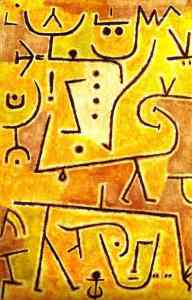
The Symbolic Expressionists and the Cubists during the first decade of the Twentieth century had already questioned the validity of Academic Naturalism. Their painting had looked below the surface with the analytical eye of psychology and x-ray. But the multi-layered figures of Kirchner and Kokoschka or the simultaneous views of Braque and Picasso, were analytical – statements, resting statically on the canvas. Klee’s figures and forms are not only transparent, as if seen through a fluoroscope; they exist in a magnetic field of cross-currents: lines, forms, splotches, arrows, color waves. As if it were a symphonic composition, the main motif moves from variation to variation in its relationship to other objects on the canvas. A bird in THE TWITTERING MACHINE, for instance, is different from all other birds through its relationship to transmission belt, crank shaft, and musical notations, floating in the air. Without contradicting himself, Klee could confess to ‘communication with nature’ as the essence of his work, but he could say also that ‘all true creation is a thing born out of nothing.’ The seeming contrast is resolved through his unfailing originality ‘born out of nothing’ which is the spiritual cause. The optical effect is a pictorial composition that uses the identifiable natural shape as mediary. In THE ROOM AND ITS INHABITANTS from1921, floor boards, window frame and door, are unrecognizable, together with the faces of woman and child. But they are mere points of reference in a world of lines, arrows, reflections, fade-outs that reveal intuitively the mysterious man-shelter relationship that has determined the course of civilization.
If ever an artist understood the visual aspirations of his epoch it was Paul Klee; and the civilized world came to recognize his contemporaneousnous even before his death in 1940. Exhibitions and publications have constantly increased in number; and it might be assumed that together with Cezanne and Picasso, he will be the most reproduced and annotated painter of this century. But it is known to few that Paul Klee was more than a painter. His ‘communication with nature’ produced much more than the transfiguration of the perceived form. It produced a philosophy that rested on empathy with the created world, accepting everything that is with equal love and humility. As a very young man he had spoken of his art as ‘andacht zum kleinen’ (devotion to small things). In the Microcosm of his own visual world he worshipped the Macrocosm of the universe. This was his revolution. Academic art had been based since the Renaissance on the Aristotelian principle of deduction, meaning that all representation was deduced from the broad general principles of general beauty and conventional color canons. Paul Klee replaced deduction by induction. Through observation of the smallest manifestation of form and interrelationship, he could conclude about the magnitude of natural order. Energy and substance, that which moves and that which is moved, were of equal importance as symbols in the universal scheme. And with the instinct of the true lover he had to comprehend what he loved. The phenomenon perceived and analyzed, was investigated until its significance was beyond doubt. It is in Paul Klee that science and art fuse. Exactitude wined by intuition was the goal he held out for his students.
Paul Klee the painter could not help becoming a teacher in the original meaning of the term. The word ‘to teach’ derives from the Gothic ‘taiku-sign’ (our word token). It is the mission of the teacher to observe what goes unnoticed by the multitude. He is an interpreter of signs. When Walter Gropius developed the curriculum of his German Bauhaus, he gave back to the word teacher its basic significance. Kandinsky, Klee, Feininger, Moholy-Nagy, Schlemmer, Albers, who taught there, were interpreters of the visual as tokens of a fundamental optical and structural order that had been obscured by centuries of literary allegorism. In this community of guides Paul Klee chose for himself the task of pointing out new ways of studying the signs of nature. ‘By contemplating the optical-physical appearance, the ego arrives at intuitive conclusions about the inner substance.’ The art student was to be more than a refined camera, trained to record the surface of the object. He must realize that he is ‘child of this earth; yet also child of the Universe; issue of a star among stars.’
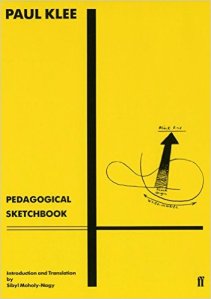
A mind so in flux, so sensitive to intuitive insights, could never write an academic textbook. All he could retain on paper were indications, hints, allusions, like the delicate color dots and line plays on his pictures. The PEDAGOGICAL SKETCHBOOK is the abstract of Paul Klee’s inductive vision. In it the natural object is not merely rendered two-dimensionally, it becomes ‘raumlich’, related to physical and intellectual space concepts, through four main approaches that form the four divisions of the Sketchbook.
Proportionate Line and Structure
Dimension and Balance
Gravitational Curve
Kinetic and Chromatic Energy
The first part of the Sketchbook (sections 1.1-1.13) introduces the transformation of static dot into linear dynamics. The line, being successive dot progression, walks, circumscribes, creates passive-blank and active-filled planes. Line rhythm is measured like a musical score or an arithmetical problem. Gradually, line emerges as the measure of all structural proportion, from Euclid’s Golden Section (1.7) to the energetic power lines of ligaments and tendons, of water currents and plant fibers. Each of the four divisions of the Sketchbook has one key-sentence, strewn almost casually – without the pompousness of a theorem – among specific observations. This one sentence in each chapter points to the path from the particular to the universal. The first part on ‘Proportionate Line and Structure’ is condensed into one laconic statement: purely repetitive and therefore structural’ (1.6), explaining in five words the nature of vertical structure as the repetitive accumulation of like units.
The second part of the Sketchbook (II. 14-II.25) deals with ‘Dimension and Balance’. Here the object, rendered by line, is related to the subject power of the human eye. Man uses his ability to move freely in space to create for himself optical adventures. What are railroad ties? Functional cross-beams, occurring at regular intervals. Yes, but they are also sub-divisions of infinite space, capable of bisecting the third dimension at a hundred different angles (II.I5). Man, precariously balanced on two legs, uses optical illusion as a safety device. Horizon as concrete fact, and horizon as an imaginary safety belt that has to be believed in, are exemplified in the graceful example of the tightrope walker and his bamboo pole (II.21). The purely material balance of light and dark, weightless and heavy colors (II.24). The key word to this section reads: ‘non-symmetrical balance’ (II.23). It asserts the ‘the bilateral conformity of two parts’ which is the old definition of symmetry, has been superseded by ‘the equalization of unequal but equivalent parts.’ Dimension is in itself nothing but an arbitrary expansion of form into height, width, depth and time. It is the balancing and proportioning power of eye and brain that regulate this expansion of the object toward equilibrium and harmony.
The third aspect of the study of nature in the Sketchbook (III. 26- III.32) deals with the tension existing between man’s ability to project himself and the object into space, and the limitations imposed upon this urge by the gravitational pull. The linear extension of the first section of the book, and the balance of dimensional form in the second section, is here followed up with the projection of motion above and below the horizon of the human eye. The plump line (III.26) is man’s umbilical cord to the center of the earth. It symbolizes the tragic termination of his direction toward rest. The falling stone, the ascending flier, the shooting star on the firmament (III.30-32) are natural dynamics whose course is decided by the gravitational curve. ‘But’, Klee concludes, ‘there are regions with different laws and new symbols, signifying freer movement and more dynamical position.’ With this mere hint (IIII.26) at the existence of purely spiritual dynamism, that supersedes the phenomenal world and its earthbound fate. Klee defines his Naturalism as a symbolism of great depth. The core of this third section, which is a transition from observation to intuition, is defined in the axiom that is perhaps Klee’s deepest wisdom.
TO STAND DESPITE ALL POSSIBILITIES TO FALL!
The concluding chapter (IIII. 33-43) allows the student a glimpse at the forces that create optical sensation, forces that are either kinetic-mobile, or chromatic-caloric. Plato spoke of EIDOS as the inner essence of an object as distinguished from the apparent outer form-giving cause that manifests an idea in a material configuration. True to his inductive creed, Paul Klee demonstrates inner essence and form-giving cause on the most insignificant objects, the spinning-top, for instance (IIII.33) that defies gravity by the centrifugal energy of its gyrations, or the feathered arrow (IIII.37) whose path is hampered by gravitational friction. “To be impelled toward motion, and not to be the motor!’ Thought and intention that send the arrow on its way are identified with the supra-mechanical force of the Eidos. With the ease of the perfect dancer who has sublimated his intense effort into seeming play. Paul Klee presents his naturalism through an interchange of natural phenomenon and pure idea. The proportionate relationship of point and rudder to shaft in the actual arrow (IIII.38) is calculating the orbit of the symbolic arrow, overcoming the friction of human fear by aiming ‘a bit farther than customary – farther than possible!’ the final decision rests with man’s willingness to produce energy. ‘The stronger the pull of the drop rudder, the steeper the fall’.
Energy, the Sketchbook concludes, is without termination only in the chromatic and thermo-dynamic field. Motion that may be called infinite in the sense of unending self-transformation, exists only in the activation of color, moving between the fervid contrasts of utter black and utter white (IIII.40) with the thermo-dynamic implications of intense heat and extreme cold. The last six diagrams complete the cycle that had started on page one when the dot was stirred from its static existence into line progression. On its way through the Sketchbook it has been transformed by the counter forces of earth and world, of mechanical law and imaginative vision, and it has found equilibrium in a centrality that no longer points away but rests within a unified diversity (IIII. 43). The sum total is what Paul Klee calls “Resonanzverhaltnis”, meaning a reverberation of the finite in the infinite, of outer perception and inner vista. The experience of this dual reality of the SEEN and the FELT essence of nature, impels the student toward
‘A free creation of abstracted forms which supersede didactic principles with a new naturalness, the naturalness of the work. He produces or participates in the production of works which are indications of the work of God.’
PAUL KLEE
INITIAL PLAN FOR A SECTION OF THE THEORETICAL INSTRUCTION AT THE GERMAN BAUHAUS
I.1
An active line on a walk, moving freely, without goal. A walk for a walk’s sake. The mobility agent is a point, shifting its position forward.
Fig.1
The same line, accompanied by complementary forms (figs. 2 and 3):
I.1
The same line, circumscribing itself (fig. 4)
Two secondary lines, moving around an imaginary main line (fig. 5)
I.23
- An active line, limited in its movement by fixed points (fig. 6)
- A medial line which is both point progression and planar effect (fig. 7)
I.4
- Passive lines which are the result of an activation of planes (line progression) (fig 8)
Passive angular lines and passive circular lines become active as planar constituents.
I.5
- Summary (figs. 9-12)
FIRST CASE
Active lines, passive planes, linear energy (cause), linear impact (effect), secondary planar effect.
SECOND CASE
Fig. 10 – medial lines; linear energy (cause), planar impact (effect)
Fig 11
Active planes, passive lines; planar energy (cause), planar impact plus secondary linear effect.
I.5
THREE CONJUGATIONS
Fig 12
Semantic explanation of the terms active, medial, and passive:
Active: I fell (the man fells a tree with his ax).
Medial: I fall (the tree falls under the ax stroke of the man).
Passive: I am being felled (the tree lies felled).
I.6
- Structure
(Divisional Articulation)
Fig.13. the most primitive structural rhythm based on a repetition of the same unit from left to right, or top to bottom.
Fig. 14: very primitive structural rhythm in double motion top to bottom and left to right.
Fig. 15. This rhythm is more complex. Its theme is one plus two (1 + 2).
If 1 + 2 +1 +2 are replaced by (1 + 2) + (1 + 2) it equals 3 + 3 + 3 + 3 which amounts to another repetition of the basic theme.
I.6
QUANTITATIVE STRUCTURE, moving to two dimensions.
(The Chessboard) fig. 16
Horizontal and vertical sums (fig 16)
11 + 10 + 11 + 10 + 11 + 10 = (11 + 10) + (11 + 10) + (11 + 10) = 21 + 21 + 21 = 1 + 1 + 1.
Fig. 17: if one considers section 17a as a unit with 6 values, one arrives at the following numerical presentation of fig. 17:
Purely repetitive and therefore structural.
I.6
Fig. 18:
Fig. 19. Linear variation
Since these figure arrangements rest on the principle of repetition, any number of parts can be added or taken away without changing their rhythmic character.
Therefore the structural character is divisional.
I.7
- Individual Articulation
In contrast to structural units, individual (or abstract) numerical divisions cannot be reduced to I, but must stop at proportions
Such as 2 : 3 : 5
Or 7 : 11 : 13 : 17
Or a : b = b: (a + b) (Golden Section)
I.8
- Material Structure
In nature.
Fig. 21
Structural concept in nature
The grouping of the smallest recognizable entities in matter:
Bone matter is cellular or tubular.
Ligament structure is a sinuous-fibrous web.
Tendons are continuous with the connective tissue of the muscle, strengthened by cross grain.
I.9
- The natural organism of movement as kinetic will and kinetic execution (supra-material).
- Bones are coordinated to form the skeleton.
Even at rest they depend on mutual support.
This is furnished by the ligaments.
Theirs is a secondary function; one could speak of a hierarchy of function.
The next step in motoric organization lead from bone to muscle.
The tendon is the mediary between these two.
Fig. 22
I.10
10.
- and what is the relationship of muscle to bone?
Through its ability to contract or shorten itself, the muscle brings two bones into a new angular relationship.
If one considers further the realm of kinetic organisms, one comprehends in the relationship of bone to muscle the mediary function of the tendon.
The position of two bones toward each other must change if the muscle so decides.
Muscle function supersedes bone function; in relationship to muscle function, the bone function is passive.
Bones give support to the total organism; also when in motion.
Muscles have a higher function because they act beside each other.
One bends, the other stretches.
One bone alone achieves nothing.
I.11
11.
C.
The independence of the muscle function is, of course, relative. It applies not only in relationship to bone function. Actually the muscle is not independent but obeys orders, issued from the brain. It does not want to act; or, at best, it wants to obey. The transmission of a brain order can be compared to a telegram, with nerves acting as wires.
On order to visualize the relative interrelationship of serving and commanding, or of structural to individual function, fig. 24 presents a diagram comparable to nesting toy boxes.
Fig. 24.
I.12
- Exercises
(Based on Trichotomy):
First organ active (brain).
Second organ medial (muscle).
Third organ passive (bones).
- Waterwheel and Hammer (fig. 25)
I.12
- b) The Watermill (fig 26):
- Two Energies: a) gravity, b) the obstructing mountain (active)
- Diagonal force to energies 1a and 1b: The Waterfall (medial).
III. The turning wheel (passive).
I.12
- c) The plant (fig.27)
- d) Not illustrated) Propagation:
- Male organs (antlers), active
- Pollen-carrying insects, medial
III. Female organs (fruit) passive
- e) Circulatory System (fig. 28)
- The heart pumps (active)
III. The blood is moved (passive).
- The lungs receive blood and participate in sending it on transformed (medial)
- The heart pumps
III. The blood again is moved and returns to the heart, its point of departure.
I.13
- Productive Receptive
The work grows ‘stone upon stone’ (additive) or the block is hewn ‘chip from chip’ (subtractive). Both processes, building and reducing, are time-bound. Already at the very beginning of the productive act, shortly after the initial motion to create, occurs the first counter motion, the initial movement of receptivity. This means: the creator controls whether what he has produced so far is good.
The work as human action (genesis) is productive as well as receptive. It is continuity.
Productively it is limited by the manual limitations of the creator (who has only two hands).
Receptively it is limited by the limitations of the perceiving eye. The limitations of the eye is the inability to see even a small surface equally sharp at all points. The eye must ‘graze’ over the surface, grasping sharply portion after portion, to convey them to the brain which collects and stores the impressions.
The eye travels along the paths cut out for it in the work.
II.
Dimensions
14.
- Dimensions: left (right)
- Dimension: top (bottom)
- Dimension: front (back)
Fig. 39
- 15
- Two dimensional:
- a) Two parallel lines seen frontally by the eye
- b) Railroad tracks, seen frontally.
- c) Two parallel lines, seen from a deflected angle of vision
- d) Railroad tracks, seen sideways, with ties serving as measure of the perspective progression from rear to front (fig. 32):
Fig. 32
- e) Figure 32 seen frontally (fig.33)
- 16.17.
- Operation in three dimensions (fig. 34)17. Verticality
Fig. 35. Railroad ties, seen frontally. A distant and a close tie are subdivided equally.
Fig. 36. The perspective progression visualized through lines running parallel to the tracks. Emphasis on the frontal plump line (perpendicular to the ties).
II.24
- Diagrammatic presentation to fig. 23.
Fig. 50a: Overloaded through the heavy dark, the axis AB has dropped from a to A, and has risen from b to B. its original horizontal position was ab. Both axes, ab and AB, have the point C has a common pivot. As the result of a turn around this point, left-dark is now lower than right-light. To restore balance, black is added to the right –light.
Or: I am stumbling toward left and reach out forward right to prevent a fall.
Fig 5b. The upper portion of my body is too heavy. The vertical axis shifts toward left and I would fall if correction would not take place in time by broadening the base through a step outward of my left leg.
Fig 50a
Fig 50 b.
II.25
- Building a Tower
Fig. 51: Stone I rests on the foundation stone. This upsets the balance toward left. To equalize, and causing a new disturbance, stone II is added to the right. Following this pattern, stone III pulls toward left, stone IV equalizes and pulls toward right, etc., until finally the keystone establishes a definite equilibrium.
Fig 52. P1, P2, P3, etc. are the pivot points of the toppling stones. Connected with each other by a line, they form a zig-zag pattern that circumscribes the vertical axis.
Fig. 52
III.26
- Earth, Water and Air
Symbols of the static area are plummet (position) and balance. The plummet aims at the earth center where all materially-bound existence is anchored.
But there are regions with different laws and new symbols, signifying freer movement and dynamic position.
Water and atmosphere are transitional regions.
Fig. 53
III. 27., 28. 29.
27 Air
Fig 54. A bullet, fired at a steep angle, rises with diminishing energy into the air, it turns, and falls to earth with accelerated energy. (Loose continuity).
Fig. 55 a climber of stairs, ascending with increasing energy from step to step. (Rigid continuity)
- Water
Fig 56.
The leg strokes of a swimmer – rhythm in loose continuity.
III. 30., 31. 32.
- Earth (mountain) and Air combined.
A stone falls increasing the acceleration, it bounces down a steep hill.
Continuity partly loose, partly rigid)
- Air
A balloon rises from a warm into a cool air stratum, then into somewhat warmer and finally into a very warm region.
(Loose continuity)
- Cosmic and atmospheric combined.
Fig. 59.
A meteor moves along an orbit. Attracted by the earth, it is deflected from its course and traverses the earth earth’s atmosphere, as shooting star, it barely escapes the peril o be tied forever to the earth, and moves on into the stratosphere, gradually cooling off and extinguishing. (Loose continuity.)
IIII.33.
Symbols of form in motion.
- The spinning top.
A scale deprived of its material support, and reduced to one point of contact, will topple and fall, even if its weight has been carefully distributed (fig. 60).
Horizontal gyration will save this toy from falling.
This is the principle of the spinning top. (Fig 61)
A double top will even dance on a taut string without falling (fig. 62).
IIII. 34
- The pendulum
The plumb fig 63.
Is transformed into a pendulum by swinging it back and forth. fig. 63a
Motion and counter motion of the pendulum result in equilibration of movement (fig 64)
Or, motion path of the pendulum with static fixation point (fig 65).
IIII. 35. 36.
- The Circle
The latter form (fig 65) can be expanded through increased motion at the fixed guidance point of the pendulum. The observable significance of such a form continuity, originating at the guidance point, is transposed into larger mobile forms. The purest mobile form, the cosmic one, however, is only created through the liquidation of gravity (through elimination of material ties).
This moment (fig 66) is imagined as occurring while the pendulum is in full swing. It will circumscribe a circle which is the purest of mobile forms.
The necessity for a back and forth motion of the pendulum from a fixed point has been eliminated. The newly created form (fig 66a) remains the same whether the motion starts from left toward right, or from right toward left.
- The Spiral.
Changing length of the radius, combined with peripheral motion, transforms the circle into the spiral. Lengthening of the radius creates a vibrant spiral. Shortening of the radius narrows the curve more and more, till the lovely spectacle dies suddenly in the static center. Motion here is no longer finite; and the question of direction determines either a gradual liberation from the center through freer and freer motions, or an increasing dependence on an eventually destructive center. This is the question n of life and death; and the decision rests with the small arrow. (Fig 67)
IIII. 37. 38.
- The Arrow
The father of the arrow is the thought: how do I expand my reach? Over this river? This lake? That mountain?
The contrast between man’s ideological capacity to move at random through material and metaphysical spaces and his physical limitations, is the origin of all human tragedy.it its contrast between power and prostration that implies the duality of human existence. Half-winged half –imprisoned, this is man! Thought is the mediary between earth and world. The broader magnitude of his reach, the more painful man’s tragic limitation. To be impelled toward motion and not to be the motor! Action bears this out.
Now does the arrow overcome the hindering friction? Never quite to get where motion is interminate.
Revelation: that nothing that has a start can have infinity. Consolation: a bit farther than customary! – Than possible?
Be winged arrows, aiming at fulfillment and goal, even though you will tire without having reached this mark. An actual arrow consists of shaft point feathering (rudder). The symbolic arrow is direction with point and feathering combined as point-rudder. Equal length of the point-rudder and equal degrees of the point –rudder from the shaft, result in straight flight (fig.71): (a=b; a=b).
IIII. 38
- (The Arrow)
Uneven lengths and uneven angle degrees of the point-rudder result in a deviating course (fig 72).
Ascending course. Ab
The stronger the pull of the ascension rudder, the higher the rise;
The stronger the pull of the drop rudder, the steeper the descent.
Fig 75
IIII. 39
39
Fig.74 In the world of physical reality every ascent must be followed by a descent at the moment at which the gravitational pull of the earth overcomes the ascending energy of the rudder. The physical curve thus ends as a perpendicular line (theoretically in the center of the earth).
In contrast to fig 74 a cosmic curve frees itself more and more from the earth in infinite motion, to fulfill itself freely in a circle or at least an ellipse.
IIII. 40
- Formation of the Black Arrow (fig 76)
This arrow forms when a given, or adequate, or actual white receives intensified energies from additive, acting, or futural black. Why not the other way around? Answer: the stress lies on rare specialty as against broad generality. The latter affects us as competently static and customary; the first one as unusual, activating. And the arrow always flies in the direction of action.
In a well arranged equilibrium of both characteristics, the direction of movement manifests itself so forcefully that the ambiguous symbol (the arrow) may be eliminated.
The given white, much too much seen and tiresome white, is noticed by the eye with little sensation, but the contrasting peculiarity of sudden action (black) sharpens the vividness of vision toward the climax or the termination of this action.
This extraordinary increase in energy (in a productive sense) or of energy food (in a receptive sense) is decisive for the direction of movement.
IIII.40.
The black arrow (diagram of formation).
The red arrow
The hot arrow
Caloric arrow form heat to combustion
Extinguishing a blaze.
The green-red arrow
Chromatic
Fig.78
The red –green arrow
Chromatic
Fig 79
IIII.41.42
- Table of chromatic incandescence (mainly blue-orange)
Fig 80
Table of incandescence (mainly orange-blue).
Fig. 81
- The organization of movement
The preceding diagrams (figs 76-81) are suggestions for the rendering of mobile factors in composition. The composition itself: kinetic coordination is an intricate task and demands a concept of advanced maturity. As norm for such a composition we may postulate a harmonization of elements toward an independent, clam-dynamic, and dynamic-calm entity. This composition can only be complete if movement is met by counter0-movemet or if a solution of kinetic infinity has been found. (to the first case see fig 82), also fig 65)
Fig. 82
IIII. 43.
- The infinite movement, chromatic.
Passing on to infinite movement where actual direction of movement becomes irrelevant, I first eliminate the arrow. Through this act heating and cooling off, for instance, become one. Pathos (or tragedy) turns into ethos which encompasses energy and counter energy within itself.
Fig. 83
At first, movement and counter movement; so à or ß so. In this way a center is prepared – the central grey (fig 83).
The pure the presentation of the grey, the narrower its reach, theoretically confined to a mere point.
Left of the grey point, green is in the ascendency; right, close to the grey point, already red. Consequently one could be tempted to arrive at the following diagram (fig. 85).
IIII.43.
It is, however, not logical to bring the steps green-red and violet-yellow in contrast to blue-orange (fig. 85). Therefore a diagonal presentation of the main scale is indicated (fig 86).
We have arrived at the spectral color circle where all the arrows are superfluous. Because the question is no longer: ‘to move there’ but to be ‘everywhere’ and consequently also
There!’
A concluding note
The beacon, guiding Klee through his adventures in seeing, is the line in action. The dot, extended into a graphic curve, cannot come to rest on the last page of the Sketchbook. It urges on to further explorations, both in space and spirit. For the teacher who wants to respond to this incentive, a complete program is indicated in the four subdivisions:
I:
Line as point progression
Line as planar definition
Line as mathematical proportion
Line as coordinator for the path of motion
II.
Line as optical guide
Line as optical reason
Line as psychological balance
III.
Line as energy projection
IIII:
Line as symbol of centrifugal and centripetal movement
Line as symbol of ill and infinity
Line as symbol of color mutations and kinetic harmony
There are endless phenomena all around us on which to aim Klee’s ideas like a searchlight. The ‘line on a walk’ can produce new rhythmic curves. Any surface offers itself for definition through line connected points. Klee’s examples of coordinated linear motion: bones and muscle, blood stream, waterfall, can be supplemented by the vertical extension of bird flight, the horizontal motion of the tides, the circular rhythm of tree rings. The optical perceptions and illusions of each student form the framework of his security. But has he observed their patter as they relate him to the experiences of physical height, spatial distance, forward motion, light and ark contrasts? What does he actually see and what are the optical facts? And there is the intimate and instinctual identification of object and meaning which Klee defines through the two arrows, the spinning top, and the shooting star. Many other examples can widen the theme: Lightning for instance, as scientific and as emotional experience, or the path of an eclipse, the swing on its rope hooks – free and confined at the same time, the forward dash of sail and prow. These are mere hints, pointing toward a use of Klee’s book that will in the words of Novalis:

‘….give sense to the vulgar,
Give mysteriousness to the common,
Give dignity of the unknown to the obvious,
And a trace of infinity to the temporal.’
S.M-N.
 tomreading
Leave a comment